Stock Analysis · Medline Inc (MDLN)
Overview
Medline Inc operates in medical supplies and healthcare distribution. The company sells a very broad range of products used every day across hospitals, surgery centers, nursing facilities, physician offices, and home care settings. Its role is not limited to manufacturing selected items under its own brands; it also acts as a large-scale distributor, helping healthcare providers source gloves, gowns, drapes, wound care products, diagnostics, surgical products, and many other consumables that are essential to patient care.
For a long-term reader, the key point is that Medline is tied to the ongoing need for healthcare delivery rather than to one blockbuster product. That generally makes revenue less dependent on a single patent cycle or one device platform. The business model is built on volume, logistics, private-label manufacturing, and customer relationships with healthcare systems.
Public reporting indicates that Medline’s revenue base is primarily recurring and spread across a wide catalog rather than concentrated in one narrow niche. Precise current segment percentages are not clearly disclosed in the material available here, so a strict ranked split by revenue line cannot be stated with confidence. Broadly, the business appears to be organized around these main revenue drivers:
- Medical-surgical supplies and distribution — the largest contributor, including everyday consumables used across care settings.
- Private-label and proprietary products — products sold under Medline-controlled brands, typically supporting better margins than pure third-party distribution.
- Specialty clinical categories — including areas such as wound care, surgical solutions, diagnostics, incontinence, and other higher-value clinical supplies.
- Service and supply-chain support — procurement support, inventory management, and related logistics embedded into customer relationships.
Financially, the business has expanded meaningfully over the last several years. Revenue rose from about $21.4 billion in 2022 to about $28.4 billion in 2025, while gross profit also moved up strongly. A notable improvement is that net income recovered from a slight loss in 2022 to more than $1 billion in both 2024 and 2025. The main caution in that progression is that operating expenses rose sharply in 2025, which deserves attention when assessing whether margin gains can keep scaling.
The operating picture shows a company that has been getting larger and more profitable at the gross profit level, while interest costs and overhead remain important swing factors for final earnings.
Key Figures
| Metric | Value | Sector ⓘ |
|---|---|---|
| Date | Nov 09, 2026 | |
| Context | ||
| Sector | Healthcare | |
| Industry | Medical Instruments & Supplies | |
| Market Cap ⓘ | $52.17B | |
| Beta ⓘ | N/A | |
Value (Cheapness) | ||
| P/E Ratio ⓘ | 90.09 | 25.93 |
| P/B Ratio ⓘ | 12.38 | 3.08 |
| FCF Yield ⓘ | 4.55% | 3.00% |
| Dividend Yield ⓘ | N/A | 1.57% |
| EBIT / EV ⓘ | 3.50% | 0.64% |
| PEG ⓘ | N/A | |
Growth (Business expansion) | ||
| Revenue Growth ⓘ | 10.40% | 7.10% |
| RPS Growth (5Y CAGR) ⓘ | 8.72% | 8.49% |
| EPS Growth (5Y CAGR) ⓘ | N/A | -12.89% |
| BVPS Growth (5Y CAGR) ⓘ | -64.63% | 3.72% |
| Margin Growth (5Y Trend) ⓘ | 0.10% | -0.66% |
| FCF Growth (5Y CAGR) ⓘ | N/A | 1.18% |
| DPS Growth (5Y CAGR) ⓘ | N/A | 6.69% |
Quality (Business durability) | ||
| ROIC (Latest) ⓘ | 4.94% | 5.20% |
| ROA (Latest) ⓘ | 1.43% | 2.86% |
| ROIC (5Y Median) ⓘ | N/A | 4.53% |
| ROA (5Y Median) ⓘ | N/A | 1.82% |
| Net Debt / EBIT (Latest) ⓘ | 6.68 | 1.33 |
| Net Debt / EBIT (5Y Median) ⓘ | 8.51 | 1.84 |
| Net Debt / EBITDA (Latest) ⓘ | 4.00 | 0.89 |
| Net Debt / Assets ⓘ | 25.53% | 5.23% |
| EBITDA / Interest ⓘ | 3.86 | 9.66 |
| Operating Margin (Latest) ⓘ | 5.01% | 9.20% |
| Operating Margin (5Y Median) ⓘ | 5.72% | 7.24% |
| Debt to Equity (Latest) ⓘ | 106.60% | 26.44% |
| Profit Margin (Latest) ⓘ | 1.85% | 3.28% |
| Free Cash Flow (Latest) ⓘ | $2.38B | |
Momentum (Price trend) | ||
| 3Y Return ⓘ | -3.32% | +51.84% |
| 12M Return (excl. last month) ⓘ | N/A | +12.70% |
| 6M Return ⓘ | -5.30% | +14.28% |
| Price vs. 200-Day MA ⓘ | +0.40% | +9.12% |
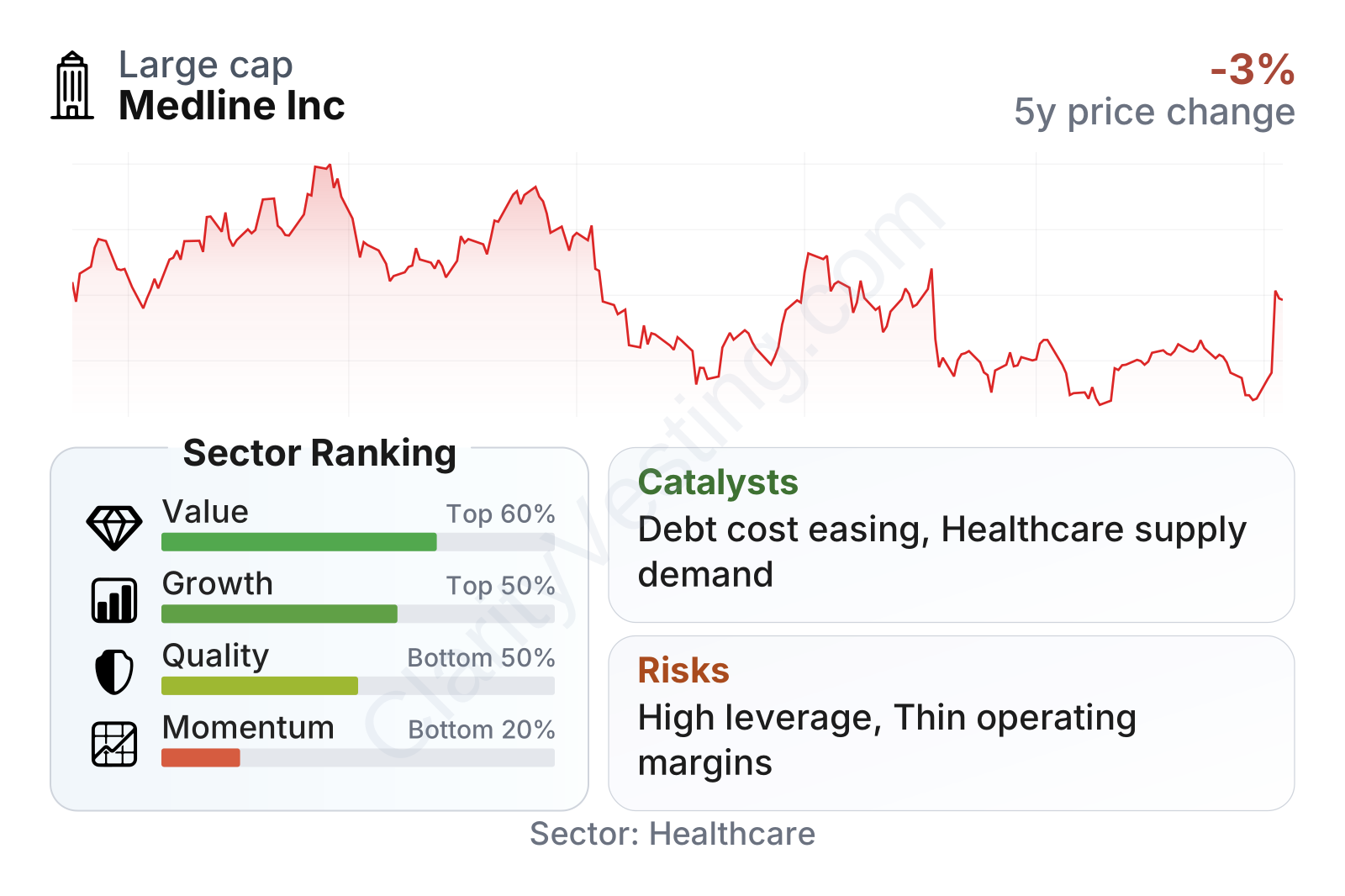
Medline stands out as a large healthcare company with above-sector revenue growth and solid free cash flow generation, but the profile is mixed. Growth metrics are around the middle to upper part of the sector, while quality measures sit below average because leverage is high and returns on assets are relatively modest. The stock’s recent market performance has also been weak compared with the broader healthcare group, suggesting that the market is waiting for clearer evidence that earnings quality and balance-sheet progress will keep improving.
The share price trend over recent quarters has been negative, with a noticeable decline from late 2025 into 2026. That weakness contrasts with the company’s still-growing revenue base, which means valuation depends heavily on whether margins, debt reduction, and execution continue to move in the right direction.
Growth
Medline operates in a healthcare supply market that benefits from durable structural demand. Aging populations, rising procedure volumes, expanding outpatient care, and the ongoing need for infection prevention and routine medical consumables all support long-term sector growth. This is not the fastest-growing part of healthcare, but it is one of the steadier ones because providers must keep buying supplies regardless of the economic cycle.
The company’s strategy makes practical sense for future expansion. A broad catalog, deep distribution capabilities, and close integration with provider purchasing processes can create sticky customer relationships. In this type of market, scale matters: large customers often prefer suppliers that can deliver thousands of items consistently, manage inventory, and support standardized procurement. That can help Medline win share even if end-market growth itself is moderate.
Recent operating trends also point to real progress. Revenue growth of about 10% year over year is ahead of the sector median, and the multi-year revenue-per-share growth rate is slightly above the industry midpoint. Gross profit has expanded faster than revenue over the past few years, which suggests a more favorable mix, pricing support, or better operating discipline in sourcing and distribution.
One important catalyst is the reduction in interest expense from the elevated levels seen earlier in the period. Lower financing pressure can give the company more room for earnings growth if operating performance remains stable. Another is the company’s ability to convert business scale into cash: free cash flow is substantial in absolute terms, giving Medline flexibility to manage debt, invest in operations, and support strategic initiatives.
A further opportunity comes from the increasing complexity of healthcare procurement. Hospitals and care systems continue to value reliability, supply continuity, and integrated vendor relationships after several years in which supply-chain resilience became a major operational issue. That backdrop can favor established, scaled operators such as Medline.
Risks
This article is for informational purposes only and does not constitute financial advice. Some content is AI-generated. See Disclaimer