Stock Analysis · MedinCell S.A (MDCLF)
Overview
MedinCell S.A. is a French biotechnology company focused on long-acting injectable medicines. Its core technology platform is designed to release a drug slowly over days, weeks, or months after a subcutaneous injection. In simple terms, the company works on turning existing or known medicines into treatments that do not need to be taken as often, which can improve adherence and make chronic care easier for patients and providers.
The business model is still centered more on partnerships, milestone payments, and licensing economics than on a broad base of recurring product sales. MedinCell’s most visible commercial asset is its long-acting risperidone product developed with Teva, marketed in the United States as UZEDY for schizophrenia. That product gives MedinCell a clearer route toward royalty-type income than many early-stage biotech peers, but the company remains in a transition period where reported revenue can move sharply depending on milestones and accounting timing.
Based on recent annual disclosures, revenue appears to come mainly from the following sources:
- Collaboration and licensing revenue: approximately the large majority of total revenue in recent years, including development funding, milestones, and license-related recognition from partners such as Teva and other programs.
- Royalties and commercial-linked revenue: still a smaller share than collaboration revenue, but increasingly important as partnered products move into the market, especially UZEDY.
- Other revenue: limited or immaterial compared with the two categories above.
The financial profile is typical of a biotech platform company: high research spending, uneven yearly revenue, and losses that can persist until several partnered products become commercially meaningful. What matters most for long-term analysis is whether MedinCell can convert its technology into multiple approved products rather than relying on a single launch.
The business has shown a step-up in revenue versus the earlier period, but expenses have also remained heavy. Research and development is still the main cash-consuming item, which is normal for a company trying to build a product pipeline. The more mixed signal is that operating losses widened again in the latest fiscal year as overhead and financing costs increased alongside commercialization and pipeline efforts.
Key Figures
| Metric | Value | Sector ⓘ |
|---|---|---|
| Date | Oct 17, 2026 | |
| Context | ||
| Sector | Healthcare | |
| Industry | Biotechnology | |
| Market Cap ⓘ | $1.24B | |
| Beta ⓘ | 0.92 | |
Value (Cheapness) | ||
| P/E Ratio ⓘ | N/A | 24.79 |
| P/B Ratio ⓘ | 402.98 | 3.08 |
| FCF Yield ⓘ | -0.67% | 3.15% |
| Dividend Yield ⓘ | N/A | 1.94% |
| EBIT / EV ⓘ | N/A | 0.57% |
| PEG ⓘ | N/A | |
Growth (Business expansion) | ||
| Revenue Growth ⓘ | -44.60% | 7.45% |
| RPS Growth (5Y CAGR) ⓘ | 42.39% | 8.61% |
| EPS Growth (5Y CAGR) ⓘ | -14.13% | -17.81% |
| BVPS Growth (5Y CAGR) ⓘ | N/A | 3.72% |
| Margin Growth (5Y Trend) ⓘ | N/A | -0.62% |
| FCF Growth (5Y CAGR) ⓘ | N/A | 1.04% |
| DPS Growth (5Y CAGR) ⓘ | N/A | 6.77% |
Quality (Business durability) | ||
| ROIC (Latest) ⓘ | -95.48% | 3.24% |
| ROA (Latest) ⓘ | -59.72% | 3.01% |
| ROIC (5Y Median) ⓘ | -43.79% | 4.60% |
| ROA (5Y Median) ⓘ | -45.98% | 1.89% |
| Net Debt / EBIT (Latest) ⓘ | N/A | 1.34 |
| Net Debt / EBIT (5Y Median) ⓘ | N/A | 1.84 |
| Net Debt / EBITDA (Latest) ⓘ | N/A | 1.00 |
| Net Debt / Assets ⓘ | -4.98% | 5.45% |
| EBITDA / Interest ⓘ | N/A | 9.64 |
| Operating Margin (Latest) ⓘ | -81.31% | 9.27% |
| Operating Margin (5Y Median) ⓘ | -221.98% | 7.38% |
| Debt to Equity (Latest) ⓘ | 1873.73% | 28.58% |
| Profit Margin (Latest) ⓘ | -128.88% | 3.59% |
| Free Cash Flow (Latest) ⓘ | -$8.29M | |
Momentum (Price trend) | ||
| 3Y Return ⓘ | +392.98% | +42.80% |
| 12M Return (excl. last month) ⓘ | +392.98% | +18.50% |
| 6M Return ⓘ | 0.00% | +7.57% |
| Price vs. 200-Day MA ⓘ | +7.27% | +5.12% |
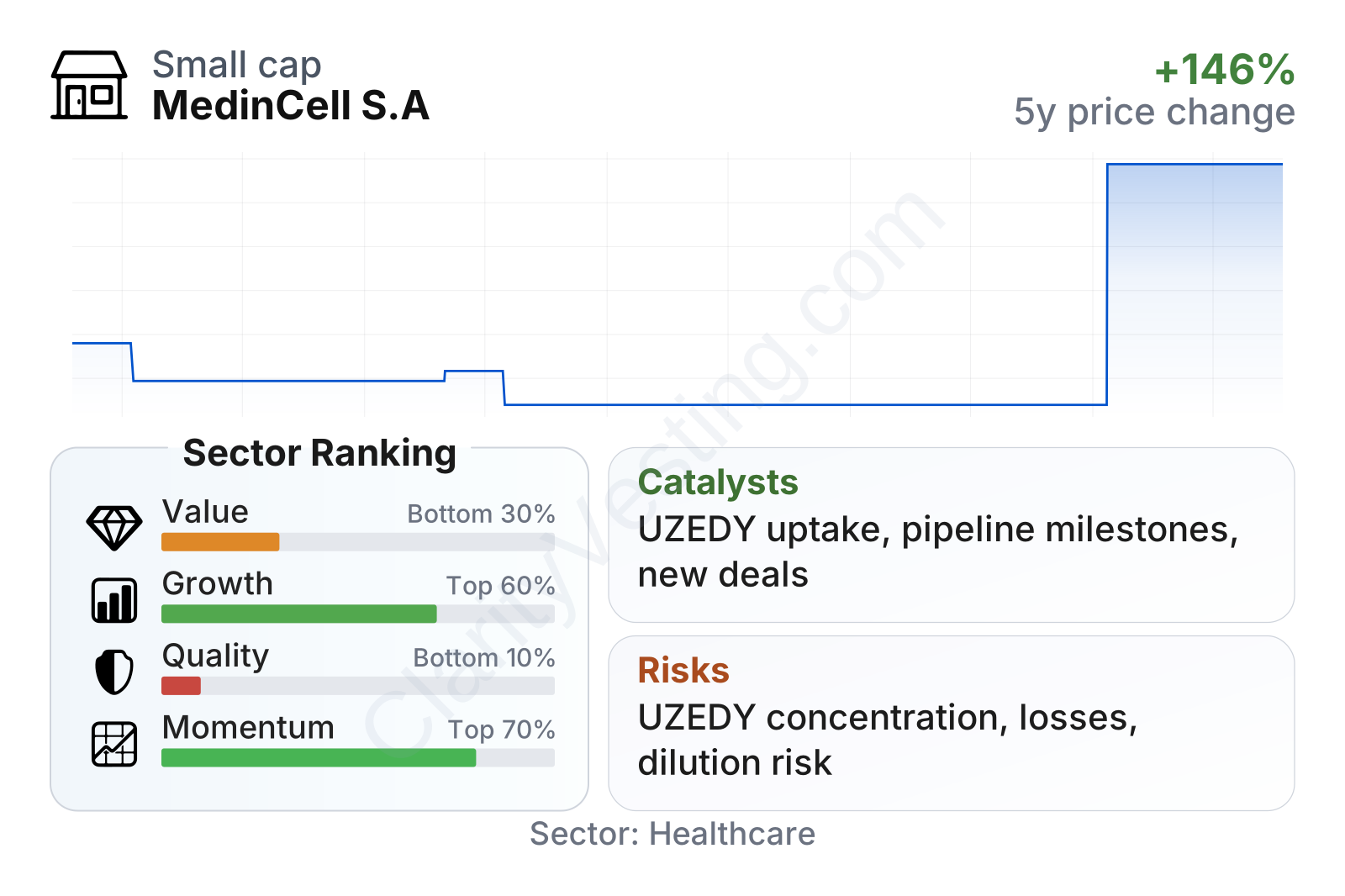
MedinCell sits in a difficult middle ground financially. Growth over five years looks strong on a per-share revenue basis, but the latest year was much weaker, with revenue down roughly 45% year over year. Profitability and capital efficiency remain far below healthcare sector norms, with deeply negative margins and returns on capital. On the other hand, market momentum has been unusually strong over the last three years, reflecting a major re-rating by the market, likely tied to progress around commercialization and pipeline validation.
The balance sheet has some unusual features. Net debt relative to assets is slightly negative, which suggests cash is still meaningful, but debt-to-equity appears extremely high because equity remains thin after years of losses. That makes the headline leverage ratio look alarming even though the more practical question is whether current cash and partnership inflows can fund development without major dilution or refinancing pressure.
Growth
MedinCell operates in a part of healthcare with solid long-term demand drivers. Long-acting injectables are attractive in areas such as psychiatry, pain, and other chronic conditions because they can improve treatment adherence, reduce relapses, and simplify dosing. That makes the sector structurally interesting even if individual company results can be volatile.
The company’s strategy also makes sense on paper. Rather than discovering entirely new molecules from scratch, MedinCell focuses on reformulating medicines into long-acting versions using its delivery platform. This can lower some scientific risk compared with novel-drug discovery, while still creating differentiated products that may be valuable to large pharmaceutical partners. The Teva relationship is especially important because it gives MedinCell commercial exposure through a much larger organization with established sales and regulatory capabilities.
A major catalyst is the continued rollout of UZEDY in the United States. If prescription uptake, payer coverage, and physician adoption continue to improve, MedinCell’s royalty stream could become more visible and less dependent on one-time accounting items. Beyond that, the pipeline offers additional optionality: if more programs reach late-stage development, the platform could gain broader validation and attract additional deals.
Recent company communications have also highlighted progress in expanding partnered and proprietary programs, including assets in areas where longer dosing intervals could be commercially meaningful. For a company of this size, even one extra approval, a new licensing agreement, or stronger-than-expected uptake from the lead commercial product could have an outsized effect on revenue expectations.
Risks
This article is for informational purposes only and does not constitute financial advice. Some content is AI-generated. See Disclaimer


