Stock Analysis · MEDIQON Group AG (MDCKF)
Overview
MEDIQON Group AG is a healthcare software company focused on tools that help hospitals and medical practices manage billing, coding, compliance, and administrative workflows. In simple terms, it operates in the digital infrastructure behind healthcare reimbursement: making sure medical services are documented correctly, billed accurately, and processed efficiently. That places the company at the intersection of healthcare and enterprise software, a niche that can benefit from both rising healthcare complexity and the long-term shift toward digital administration.
The company’s revenue base appears to come mainly from software and related healthcare administration services. Public information available for the U.S. over-the-counter listing is limited compared with large U.S. issuers, so a precise segment split is not reliably disclosed in the materials commonly accessible to retail readers. Based on the company’s business description, the main sources of revenue are likely organized as follows:
- Healthcare software solutions — recurring or project-based revenue from applications used for coding, billing, workflow management, and practice or hospital administration.
- Implementation and support services — setup, customization, maintenance, training, and customer support linked to software deployments.
- Other digital healthcare services — adjacent service lines tied to reimbursement optimization, compliance support, or outsourced administrative functions.
The overall financial picture shows a business that has scaled up rapidly in recent years. Revenue expanded from roughly $29 million in 2021 to about $181 million in 2025, which is a major increase in a short period. The trade-off is that costs rose even faster, and losses widened instead of narrowing. Gross profit has also increased strongly, which suggests the core offering is commercially gaining traction, but the company has not yet translated that growth into durable profitability.
The revenue path is clearly upward, and gross profit has grown with it, but operating expenses and interest costs have also climbed materially. That pattern points to a company still in expansion mode, with scale improving the top line faster than the bottom line.
Key Figures
| Metric | Value | Sector ⓘ |
|---|---|---|
| Date | Nov 21, 2026 | |
| Context | ||
| Sector | Technology | |
| Industry | Software - Application | |
| Market Cap ⓘ | $1.16B | |
| Beta ⓘ | 0.27 | |
Value (Cheapness) | ||
| P/E Ratio ⓘ | N/A | 26.18 |
| FCF Yield ⓘ | N/A | 3.74% |
| Dividend Yield ⓘ | N/A | 1.32% |
| EBIT / EV ⓘ | -0.15% | 3.92% |
| PEG ⓘ | N/A | |
Growth (Business expansion) | ||
| Revenue Growth ⓘ | 48.10% | 17.95% |
| RPS Growth (5Y CAGR) ⓘ | 31.10% | 8.44% |
| EPS Growth (5Y CAGR) ⓘ | N/A | -6.06% |
| Margin Growth (5Y Trend) ⓘ | N/A | 0.56% |
| FCF Growth (5Y CAGR) ⓘ | 90.51% | 9.84% |
| DPS Growth (5Y CAGR) ⓘ | 152.95% | 7.96% |
Quality (Business durability) | ||
| ROIC (Latest) ⓘ | N/A | 10.05% |
| ROIC (5Y Median) ⓘ | -1.76% | 8.19% |
| Net Debt / EBIT (Latest) ⓘ | N/A | 0.61 |
| Net Debt / EBIT (5Y Median) ⓘ | N/A | 0.48 |
| Net Debt / EBITDA (Latest) ⓘ | N/A | 0.33 |
| Net Debt / Assets ⓘ | 24.53% | 4.20% |
| EBITDA / Interest ⓘ | N/A | 13.53 |
| Operating Margin (Latest) ⓘ | N/A | 10.59% |
| Operating Margin (5Y Median) ⓘ | -5.57% | 8.53% |
| Debt to Equity (Latest) ⓘ | N/A | 34.34% |
| Profit Margin (Latest) ⓘ | -16.15% | 7.54% |
| Free Cash Flow (Latest) ⓘ | N/A | |
Momentum (Price trend) | ||
| 3Y Return ⓘ | +675.11% | +26.20% |
| 12M Return (excl. last month) ⓘ | +13.05% | +11.65% |
| 6M Return ⓘ | +25.00% | -4.21% |
| Price vs. 200-Day MA ⓘ | +8.74% | -4.34% |
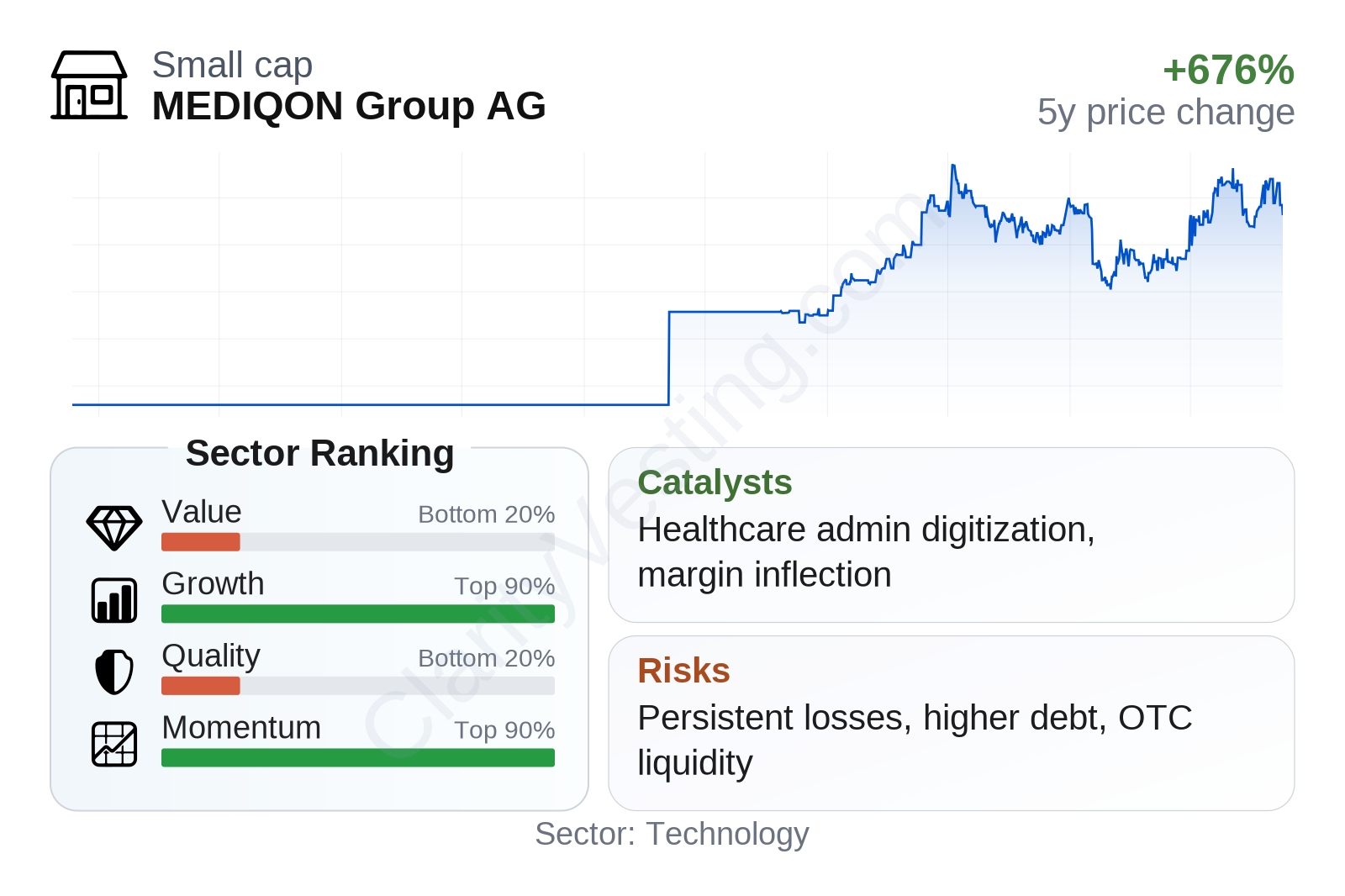
MEDIQON is currently a mid-sized company by market value, but its financial profile is unusual compared with most software peers. Growth metrics are strong: annual revenue growth is far above the sector median, five-year revenue-per-share growth is also well ahead of typical software companies, and free cash flow growth over several years has been very strong as well. On that front, the company stands out positively.
At the same time, quality and valuation metrics are much weaker. Profitability remains below sector norms, margins are negative, and leverage looks heavier than what is common in software. Net debt as a share of assets is meaningfully above the sector median, while return on invested capital has been negative over a five-year view. In other words, MEDIQON looks like a company the market is valuing primarily on expansion potential rather than on current earnings strength.
The stock chart also reflects that tension. The share price was largely flat for an extended period, then repriced sharply higher from mid-2024 onward. Even after some volatility in 2026, the three-year share performance remains far stronger than the broader software group. That indicates a major change in market expectations, not a slow and steady rerating.
Growth
MEDIQON operates in a part of the market with favorable long-term drivers. Healthcare systems continue to face rising administrative complexity, stricter reimbursement rules, labor shortages, and growing pressure to digitize back-office processes. Software that reduces billing errors, improves coding accuracy, and saves staff time fits directly into those needs. This is not a fashionable consumer-tech niche; it is a practical business area supported by regulation, cost pressure, and the need for operational efficiency.
The company’s recent growth numbers suggest that its strategy is connecting with demand. Revenue growth of about 81% year over year is far above the software sector median, and the five-year revenue-per-share growth rate above 30% is also strong. Those are not small improvements. They imply either a significantly enlarged customer base, meaningful expansion through acquisitions, or both. The rise in gross profit over time supports the idea that the company is building a larger economic footprint rather than just passing through low-margin sales.
A further growth catalyst is the basic nature of healthcare administration software itself. Once embedded in billing and compliance workflows, these tools can become hard to replace because hospitals and medical practices are cautious about disrupting mission-critical reimbursement systems. That can create sticky customer relationships if the software performs reliably and integrates well with existing processes.
The strongest visible catalyst, however, is execution toward profitability. The company does not need to prove that it can grow revenue; recent history already shows that. The more important next step is showing that scale can produce healthier operating margins and lower loss intensity. If that transition becomes visible, it would likely matter more than another year of pure top-line expansion.
Risks
This article is for informational purposes only and does not constitute financial advice. Some content is AI-generated. See Disclaimer