Stock Analysis · Metcash Limited (MCSHF)
Overview
Metcash Limited is an Australian wholesale distribution company focused on everyday consumer goods and hardware. Rather than operating as a classic global consumer brand owner, it mainly acts as a supply chain and distribution partner for independently owned retailers. Its network helps supermarkets, liquor stores, convenience outlets, and hardware businesses source products, manage logistics, and compete with larger chains.
The group is organized around three main business pillars:
- Food – the largest segment, supplying independent supermarkets, convenience stores, and related food-service customers. This includes grocery, fresh, frozen, chilled, and tobacco distribution, as well as support services for retail banners such as IGA and Foodland.
- Hardware – supplying trade, DIY, and building-related customers through businesses including Independent Hardware Group and Total Tools. This segment gives Metcash exposure to renovation, repair, and building activity rather than only grocery spending.
- Liquor – supplying independent bottle shops and hotel customers through wholesale liquor operations and retail support banners.
Based on the latest annual mix reported by the company, revenue is still dominated by food distribution, with hardware as the second-largest contributor and liquor third. Approximate revenue shares are:
- Food: about 65% to 70%
- Hardware: about 20% to 25%
- Liquor: about 10% to 15%
This mix matters for long-term analysis. Food distribution usually offers steadier demand because consumers keep buying staples even in weaker economies, while hardware and liquor can add growth opportunities but also more cyclicality. Over the past several years, the business has expanded revenue and operating profit overall, but margins have remained thin, which is typical for large-scale distribution.
The financial flow also shows the basic nature of the company: very high revenue, high product costs, and relatively modest profit margins. Revenue has climbed from roughly A$15.2 billion in fiscal 2022 to about A$17.3 billion in fiscal 2026, while operating income has gradually improved into the mid-A$400 million range. That points to a business with scale and resilience, but not one with large pricing power.
Key Figures
| Metric | Value | Sector ⓘ |
|---|---|---|
| Date | Oct 17, 2026 | |
| Context | ||
| Sector | Consumer Defensive | |
| Industry | Food Distribution | |
| Market Cap ⓘ | $1.97B | |
| Beta ⓘ | 0.41 | |
Value (Cheapness) | ||
| P/E Ratio ⓘ | 10.53 | 17.88 |
| P/B Ratio ⓘ | 1.17 | 1.29 |
| FCF Yield ⓘ | 39.25% | 12.39% |
| Dividend Yield ⓘ | 10.06% | 2.85% |
| EBIT / EV ⓘ | N/A | 6.43% |
| PEG ⓘ | N/A | |
Growth (Business expansion) | ||
| Revenue Growth ⓘ | 0.30% | 4.10% |
| RPS Growth (5Y CAGR) ⓘ | 0.49% | 6.18% |
| EPS Growth (5Y CAGR) ⓘ | N/A | -13.59% |
| BVPS Growth (5Y CAGR) ⓘ | 8.69% | 3.20% |
| Margin Growth (5Y Trend) ⓘ | 0.22% | -0.15% |
| FCF Growth (5Y CAGR) ⓘ | N/A | 4.10% |
| DPS Growth (5Y CAGR) ⓘ | -4.40% | 6.79% |
Quality (Business durability) | ||
| ROIC (Latest) ⓘ | N/A | 12.34% |
| ROA (Latest) ⓘ | 8.04% | 6.30% |
| ROIC (5Y Median) ⓘ | 17.68% | 10.49% |
| ROA (5Y Median) ⓘ | 4.60% | 5.44% |
| Net Debt / EBIT (Latest) ⓘ | 1.90 | 1.96 |
| Net Debt / EBIT (5Y Median) ⓘ | 3.43 | 2.35 |
| Net Debt / EBITDA (Latest) ⓘ | 1.25 | 1.38 |
| Net Debt / Assets ⓘ | 26.21% | 21.51% |
| EBITDA / Interest ⓘ | 6.56 | 9.46 |
| Operating Margin (Latest) ⓘ | 2.78% | 8.87% |
| Operating Margin (5Y Median) ⓘ | 2.66% | 9.53% |
| Debt to Equity (Latest) ⓘ | 111.37% | 72.35% |
| Profit Margin (Latest) ⓘ | 1.61% | 5.40% |
| Free Cash Flow (Latest) ⓘ | $772.74M | |
Momentum (Price trend) | ||
| 3Y Return ⓘ | +0.25% | +20.92% |
| 12M Return (excl. last month) ⓘ | -21.83% | +2.13% |
| 6M Return ⓘ | -19.17% | +1.26% |
| Price vs. 200-Day MA ⓘ | +15.38% | +1.39% |
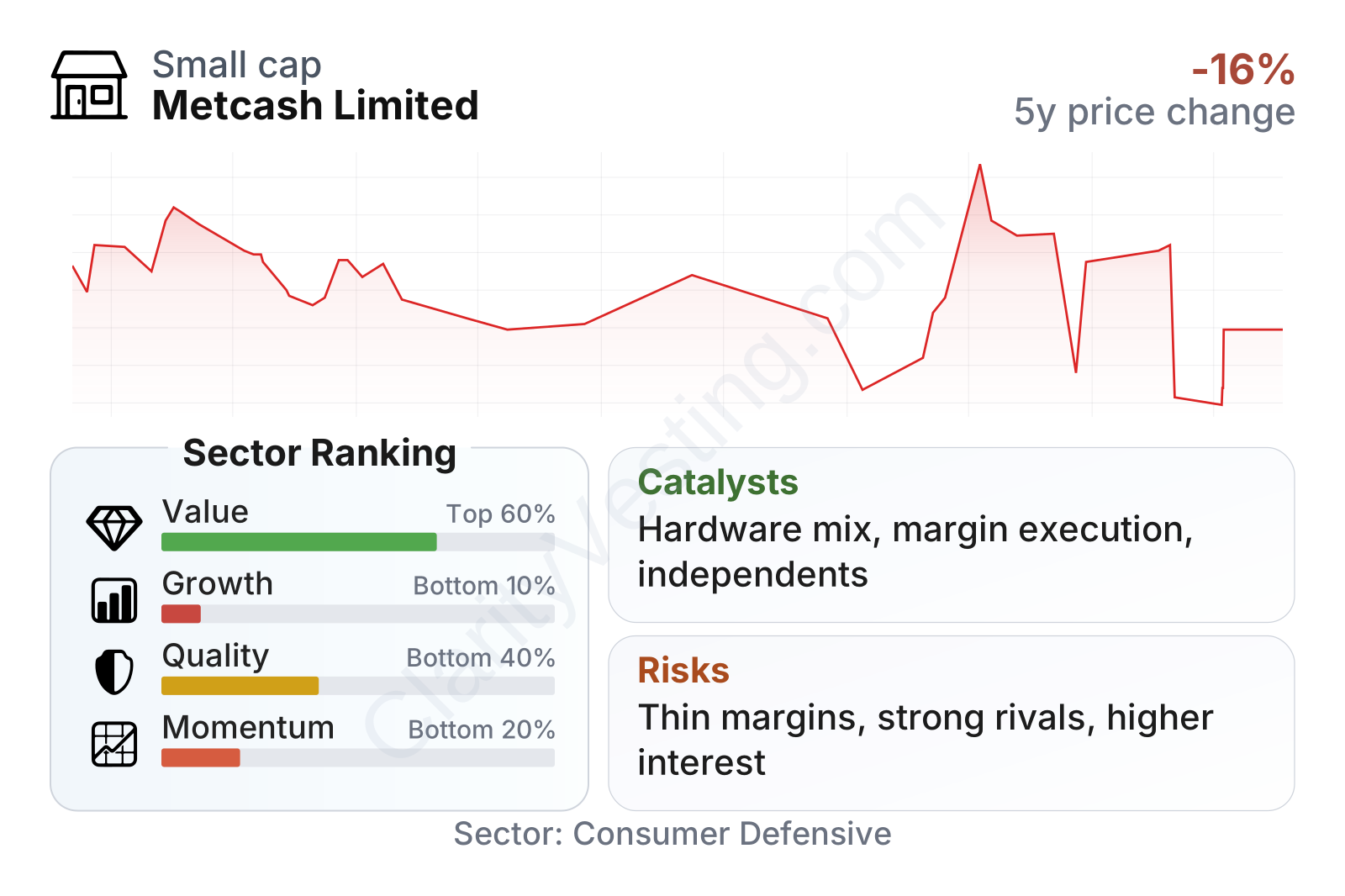
Metcash sits in the mid-cap range and its share price volatility has been relatively low, with a beta well below 1. On valuation and cash generation, the picture is more favorable than on growth. The company screens better than much of its sector on earnings multiple, price-to-book, free cash flow yield, and trailing dividend yield. By contrast, its growth profile ranks near the bottom of the sector, reflecting very slow recent sales expansion and limited dividend growth over five years.
Business quality is mixed. Return on assets is solid, and long-term return on invested capital has been respectable, but operating and net profit margins are clearly below the broader consumer defensive median. Leverage is manageable rather than alarming, with net debt to EBITDA close to sector norms, but debt-to-equity is elevated and interest coverage is weaker than many peers. Price performance has also lagged over the last year and over three years, even though the stock has recently traded above its long-term average trend line.
Growth
Metcash operates in sectors that are partly defensive and partly cyclical. Food wholesaling is tied to recurring household demand, which gives the company a steady base. That is attractive from a durability standpoint, but it also means growth tends to be modest because grocery distribution is mature and intensely competitive. Hardware adds a different angle: it gives exposure to renovation, repair, trade activity, and independent hardware retailing. Liquor adds another recurring-consumption category. Together, this portfolio is more diversified than a pure grocery wholesaler.
The company’s strategy is logical for long-term expansion because it is built around scale, logistics, and support for independent retailers that need purchasing power and supply chain reach. In Australia, many independents rely on strong wholesale partners to remain relevant against large integrated chains. That creates a structural role for Metcash, especially in regional areas and community-based retail formats.
One of the clearest growth catalysts has been the shift toward hardware as a larger part of the group. That broadens earnings sources beyond supermarket distribution and reduces dependence on any one category. Another important catalyst is operational execution: if the company can keep improving gross margins, distribution efficiency, and mix, even low sales growth can still support earnings and cash flow. Recent financial progression suggests that this is where much of the company’s progress has come from.
There is also a strategic opportunity in consolidation among independents. The more fragmented the customer base, the more valuable a national distribution platform can become. Metcash’s established retailer relationships, store support services, and banner network may help it capture this advantage over time. The key point is that future upside is more likely to come from better execution, category mix, and network strength than from rapid underlying market growth.
Risks
This article is for informational purposes only and does not constitute financial advice. Some content is AI-generated. See Disclaimer


