Stock Analysis · MicroPort Scientific Corporation (MCRPF)
Overview
MicroPort Scientific Corporation is a China-based medical device company that develops, manufactures, and sells products used in cardiovascular treatment, orthopedics, cardiac rhythm management, electrophysiology, neurovascular intervention, surgical robotics, and other hospital procedures. In simple terms, it supplies doctors and hospitals with implants, consumables, and equipment for some of the most complex areas of care.
The business is diversified across several device categories, which matters because no single product line fully defines the company. Based on the latest annual reporting and company disclosures, revenue is mainly generated from the following activities:
- Cardiovascular intervention devices: approximately 40% to 45% of revenue. This usually includes coronary stents, balloons, catheters, and related products used to open blocked blood vessels.
- Orthopedic devices: approximately 20% to 25%. This segment includes joint replacement and trauma-related implants.
- Cardiac rhythm management and electrophysiology: approximately 15% to 20%. These activities include pacemakers, defibrillators, ablation systems, and mapping tools used to manage heart rhythm disorders.
- Neurovascular and peripheral vascular products: approximately 10% to 15%. These devices are used in stroke-related procedures and other minimally invasive vascular treatments.
- Surgical robotics and other emerging businesses: generally a small single-digit share today, but strategically important because they represent newer growth platforms.
Geographically, the company still depends heavily on China, but it also has an international footprint through subsidiaries, overseas commercialization, and product approvals in other markets. That combination gives it exposure to the large domestic Chinese device market while still leaving room for expansion abroad.
One notable operating trend is that revenue has risen from roughly $780 million in 2021 to around $1.0 billion in 2025, while operating expenses have been reduced substantially from earlier peak levels. Research and development spending remains meaningful, but the company has also been cutting selling and administrative costs, which helped narrow losses and move net income back into positive territory in 2025. That shift suggests a business transitioning from heavy expansion spending toward stricter financial discipline.
Key Figures
| Metric | Value | Sector ⓘ |
|---|---|---|
| Date | Oct 24, 2026 | |
| Context | ||
| Sector | Healthcare | |
| Industry | Medical Devices | |
| Market Cap ⓘ | $3.00B | |
| Beta ⓘ | 0.32 | |
Value (Cheapness) | ||
| P/E Ratio ⓘ | N/A | 25.42 |
| P/B Ratio ⓘ | 2.38 | 3.08 |
| FCF Yield ⓘ | -8.74% | 3.12% |
| Dividend Yield ⓘ | N/A | 1.85% |
| EBIT / EV ⓘ | -5.64% | 0.56% |
| PEG ⓘ | 4.95 | |
Growth (Business expansion) | ||
| Revenue Growth ⓘ | 18.10% | 7.50% |
| RPS Growth (5Y CAGR) ⓘ | 4.22% | 8.60% |
| EPS Growth (5Y CAGR) ⓘ | N/A | -17.73% |
| BVPS Growth (5Y CAGR) ⓘ | -26.92% | 3.72% |
| Margin Growth (5Y Trend) ⓘ | N/A | -0.57% |
| FCF Growth (5Y CAGR) ⓘ | -37.38% | 0.96% |
| DPS Growth (5Y CAGR) ⓘ | 53.66% | 6.69% |
Quality (Business durability) | ||
| ROIC (Latest) ⓘ | -4.30% | 3.17% |
| ROA (Latest) ⓘ | -4.42% | 2.98% |
| ROIC (5Y Median) ⓘ | -11.83% | 4.56% |
| ROA (5Y Median) ⓘ | -8.07% | 1.87% |
| Net Debt / EBIT (Latest) ⓘ | N/A | 1.34 |
| Net Debt / EBIT (5Y Median) ⓘ | N/A | 1.86 |
| Net Debt / EBITDA (Latest) ⓘ | 5.32 | 1.00 |
| Net Debt / Assets ⓘ | 24.84% | 5.06% |
| EBITDA / Interest ⓘ | 0.79 | 9.55 |
| Operating Margin (Latest) ⓘ | -6.32% | 9.25% |
| Operating Margin (5Y Median) ⓘ | -37.84% | 7.33% |
| Debt to Equity (Latest) ⓘ | 163.21% | 26.68% |
| Profit Margin (Latest) ⓘ | 4.39% | 3.34% |
| Free Cash Flow (Latest) ⓘ | -$262.50M | |
Momentum (Price trend) | ||
| 3Y Return ⓘ | -61.22% | +51.61% |
| 12M Return (excl. last month) ⓘ | -53.95% | +19.90% |
| 6M Return ⓘ | -63.44% | +10.10% |
| Price vs. 200-Day MA ⓘ | -50.50% | +6.44% |
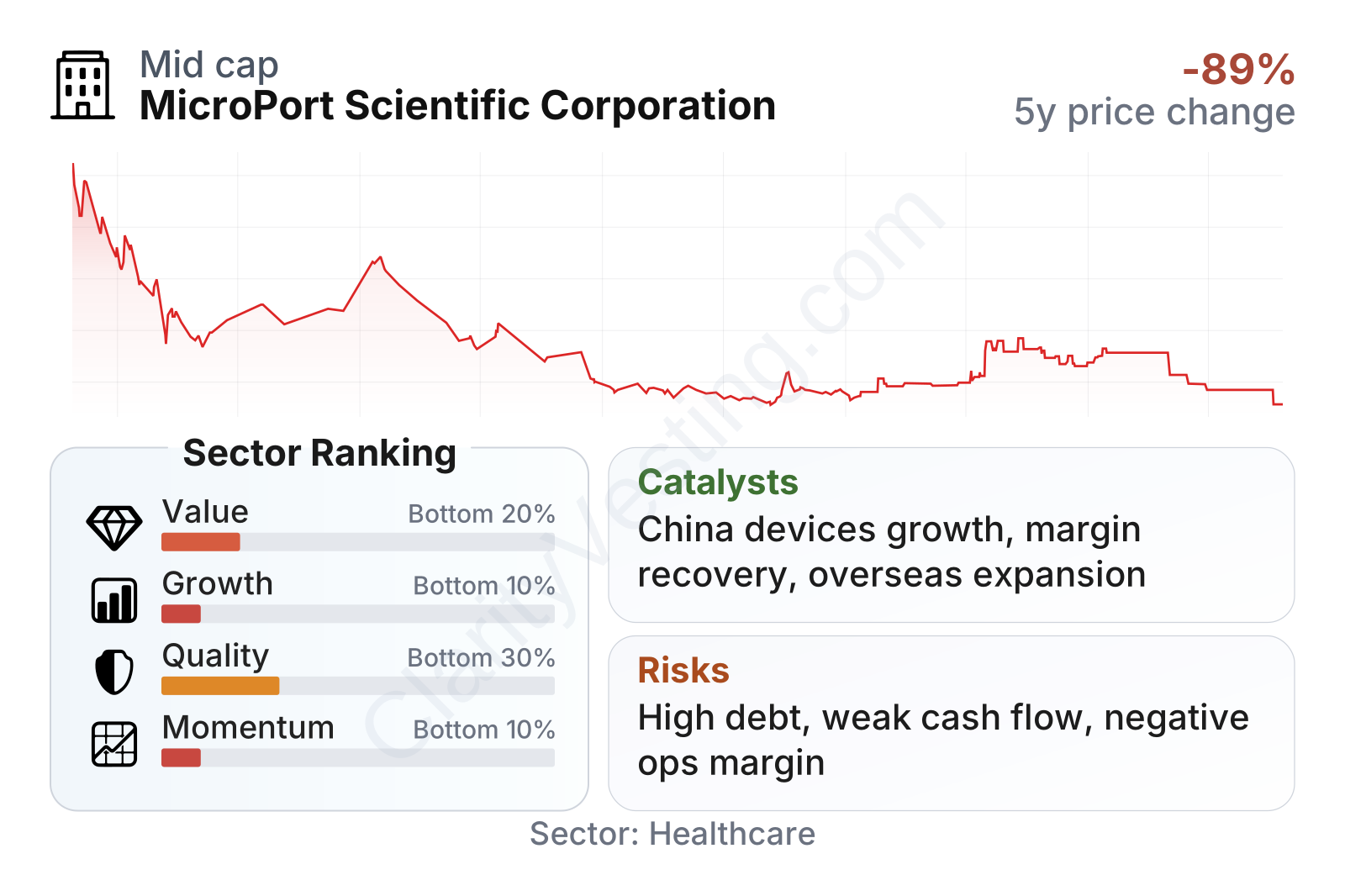
MicroPort is a mid-sized medical device company by market value, and its share price behavior has been much weaker than the broader healthcare equipment group over the last several years. The long decline from 2021 levels, followed by a partial recovery and then another setback in 2026, shows that the market remains unconvinced that the improvement in earnings can become durable.
The latest metrics also paint a mixed picture. Revenue growth has recently been strong, clearly ahead of the sector median, but that strength is offset by weak returns on capital, negative free cash flow, and leverage that is much heavier than most peers. Profit margin has turned positive, yet operating margin is still negative, which suggests that reported earnings have benefited from items outside core operations or from non-recurring effects. Overall, the company looks stronger on top-line momentum than on balance-sheet quality or cash generation.
Growth
MicroPort operates in a sector with attractive long-term demand drivers. Medical devices benefit from aging populations, rising rates of cardiovascular disease, growing access to healthcare in China and other emerging markets, and a gradual shift toward minimally invasive procedures. These are supportive industry conditions that can create a long runway for companies with competitive products and regulatory execution.
The company’s strategy broadly makes sense for future growth because it is positioned across several high-value device categories rather than relying on a single niche. Cardiovascular intervention remains the core engine, but MicroPort has also built optionality in electrophysiology, neurovascular treatment, and robotic surgery. That matters because hospitals tend to favor suppliers with broad product portfolios, established physician relationships, and the ability to support multiple procedure types.
A strong catalyst is the operating reset visible over the last two years. Revenue continued to grow, while research and development and other operating expenses came down materially from 2022 and 2023 levels. If management can keep that balance between innovation spending and cost control, the company could show a more stable path toward core profitability than it did during its earlier expansion phase.
Another potential source of upside is product commercialization outside China. MicroPort has long emphasized international approvals and overseas subsidiaries. If more of its higher-value devices gain adoption in foreign markets, the company could diversify reimbursement and pricing exposure while improving its brand position against larger global rivals.
Recent company reporting also points to continued work on advanced device platforms, especially in areas such as electrophysiology and robotic-assisted surgery. These newer categories are still smaller than the core business, but they matter because they tend to carry higher strategic value and can reshape how the market views the company if adoption improves.
Risks
This article is for informational purposes only and does not constitute financial advice. Some content is AI-generated. See Disclaimer


