Stock Analysis · Moodys Corporation (MCO)
Overview
Moody’s Corporation is a financial information and analytics company best known for its credit ratings. In simple terms, it helps bond investors judge whether a company, bank, government, or structured finance product is likely to repay its debt. That rating business sits alongside a large analytics and software arm that sells data, risk tools, research, and workflow products to financial institutions, corporations, and government clients.
The company operates through two main divisions:
- Moody’s Analytics: about 53% of 2025 revenue. This segment includes decision solutions, research and insights, data and information products, and software used for credit risk, compliance, know-your-customer checks, climate analysis, insurance, and financial modeling.
- Moody’s Investors Service: about 47% of 2025 revenue. This is the ratings business, where Moody’s is paid to rate debt issued by corporations, financial institutions, governments, project finance vehicles, and securitized products.
That mix matters for long-term analysis. The ratings business is highly profitable but cyclical because issuance volumes rise and fall with interest rates and capital market activity. The analytics division is steadier, with more recurring revenue from subscriptions, contracts, and embedded software workflows. Together, they give Moody’s both resilience and upside when debt markets are active.
Over the last several years, revenue, operating income, and net income all recovered strongly after the 2022 slowdown in bond issuance. The business also converts a large share of revenue into profit and cash, which is one reason the market often treats Moody’s as a premium franchise rather than a typical financial stock.
The financial profile shows a business that kept costs relatively controlled while revenue rebounded meaningfully from 2022 through 2025. Profit expansion has been strong, with operating income and net income rising faster than expenses during the recovery.
Key Figures
| Metric | Value | Sector ⓘ |
|---|---|---|
| Date | Oct 17, 2026 | |
| Context | ||
| Sector | Financial Services | |
| Industry | Financial Data & Stock Exchanges | |
| Market Cap ⓘ | $80.14B | |
| Beta ⓘ | 1.35 | |
Value (Cheapness) | ||
| P/E Ratio ⓘ | 29.36 | 12.26 |
| P/B Ratio ⓘ | 29.50 | 1.23 |
| FCF Yield ⓘ | 4.24% | 10.40% |
| Dividend Yield ⓘ | 0.85% | 3.02% |
| EBIT / EV ⓘ | 4.02% | 8.14% |
| PEG ⓘ | 1.64 | |
Growth (Business expansion) | ||
| Revenue Growth ⓘ | 15.10% | 9.35% |
| RPS Growth (5Y CAGR) ⓘ | 6.71% | 12.19% |
| EPS Growth (5Y CAGR) ⓘ | 1.38% | -9.53% |
| BVPS Growth (5Y CAGR) ⓘ | 10.57% | 4.99% |
| Margin Growth (5Y Trend) ⓘ | -3.45% | -3.86% |
| FCF Growth (5Y CAGR) ⓘ | 8.38% | 4.81% |
| DPS Growth (5Y CAGR) ⓘ | 12.14% | 8.79% |
Quality (Business durability) | ||
| ROIC (Latest) ⓘ | 26.20% | 9.49% |
| ROE (Latest) ⓘ | 83.61% | 13.90% |
| ROA (Latest) ⓘ | 18.58% | 1.55% |
| ROIC (5Y Median) ⓘ | 21.06% | 7.86% |
| ROE (5Y Median) ⓘ | 61.24% | 12.17% |
| ROA (5Y Median) ⓘ | 13.66% | 1.30% |
| Net Debt / EBIT (Latest) ⓘ | 1.73 | 0.96 |
| Net Debt / EBIT (5Y Median) ⓘ | 1.44 | 0.73 |
| Net Debt / EBITDA (Latest) ⓘ | 1.51 | 0.92 |
| Operating Margin (Latest) ⓘ | 42.95% | 22.30% |
| Operating Margin (5Y Median) ⓘ | 40.96% | 24.63% |
| Debt to Equity (Latest) ⓘ | 248.66% | 58.56% |
| Profit Margin (Latest) ⓘ | 34.25% | 26.57% |
| Free Cash Flow (Latest) ⓘ | $3.40B | |
Momentum (Price trend) | ||
| 3Y Return ⓘ | +54.19% | +88.33% |
| 12M Return (excl. last month) ⓘ | -7.38% | +19.38% |
| 6M Return ⓘ | +8.74% | +4.75% |
| Price vs. 200-Day MA ⓘ | +3.43% | +3.50% |
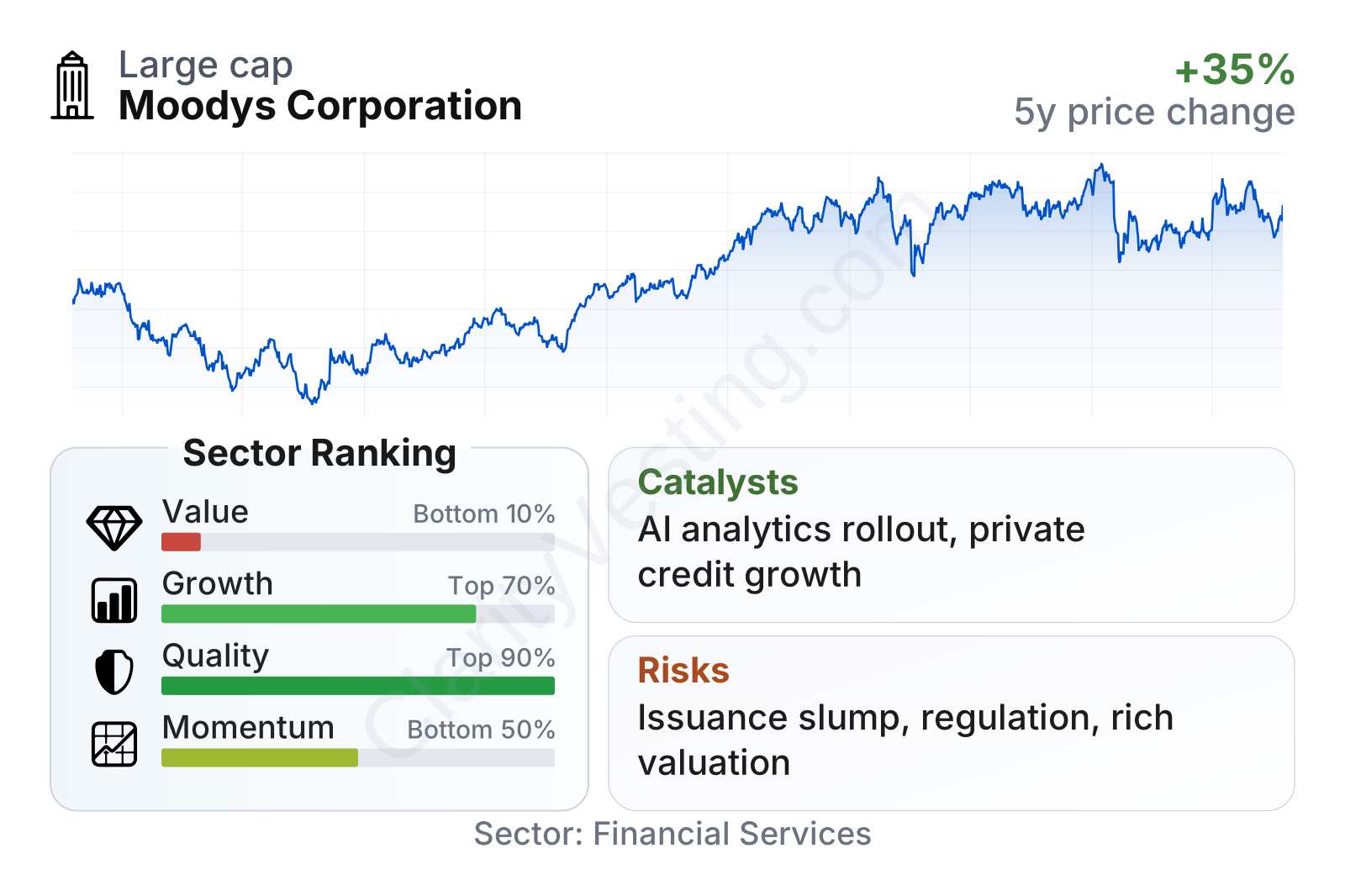
Moody’s stands out for business quality more than for cheapness. Profitability is well above most companies in its sector, with very high returns on capital, strong margins, and solid free cash flow generation. Growth metrics are generally healthy, especially recent revenue growth and cash flow expansion, although the stock’s recent market performance has been less impressive than the broader sector. On valuation measures such as earnings, book value, and cash flow yield, the shares sit near the expensive end of the sector.
The stock price history also reflects the company’s business model. It fell sharply during the 2022 issuance slump, then recovered as debt markets normalized and analytics continued to expand. That pattern is typical for Moody’s: the business is durable, but one of its largest profit engines still depends on the health of global bond issuance.
Growth
Moody’s operates in a sector with favorable long-term drivers. Global debt markets continue to expand over time, financial regulation remains demanding, and institutions increasingly rely on external data, models, and workflow tools. Those trends support both sides of the company: more debt outstanding can mean more ratings activity, while greater complexity in risk, compliance, and analytics can drive demand for subscription-based products.
The strategy also makes sense. Management has spent years reducing dependence on pure ratings volume by building Moody’s Analytics into a larger part of the business. That shift gives the company more recurring revenue and deeper customer relationships. It also broadens Moody’s role from being a periodic service provider at the moment of debt issuance to being part of daily decision-making inside banks, insurers, asset managers, and corporations.
The earnings trend illustrates both the cyclicality and the recovery. Earnings per share dropped in 2022 when issuance slowed, then rebounded strongly in 2023, 2024, and 2025. That suggests the underlying franchise remained intact during the downturn and benefited quickly once market conditions improved.
Book value per share has also moved upward over the past several years. For an asset-light company built on data, software, brands, and market position, book value is not the main measure of strength, but the trend still points to expanding underlying equity even while the company returns capital to shareholders.
A notable catalyst for future growth is the continuing expansion of private credit, structured finance, and cross-border debt financing, which can increase demand for credit assessment and related data tools. Another important driver is the use of artificial intelligence and automation inside analytics products. Moody’s has been integrating generative AI capabilities across research, risk, and workflow offerings, which could improve product value and customer retention rather than simply adding more volume.
Recent company updates have also emphasized demand for integrated risk and compliance solutions, including anti-financial-crime, supply-chain, and third-party risk tools. These are attractive areas because they are less tied to short-term bond issuance and more connected to ongoing corporate and regulatory needs. In other words, Moody’s has visible growth opportunities even if the ratings cycle becomes uneven.
Risks
This article is for informational purposes only and does not constitute financial advice. Some content is AI-generated. See Disclaimer


