Stock Analysis · McKesson Corporation (MCK)
Overview
McKesson Corporation is one of the largest healthcare distribution companies in the United States. Its core role is to move prescription drugs, specialty medicines, medical products, and healthcare technology services through the healthcare system. In simple terms, McKesson sits between drug manufacturers and the places where care is delivered, such as pharmacies, hospitals, physician offices, and specialty clinics. That makes it a critical logistics and infrastructure company within healthcare rather than a drug developer.
The business is built around very high sales volume and very thin margins. McKesson handles enormous amounts of medicine and supplies, so even a low profit margin can still produce meaningful earnings and cash flow when the revenue base is this large. In fiscal 2026, revenue rose above $400 billion, showing how central the company has become in the healthcare supply chain.
Based on McKesson’s latest fiscal year reporting, revenue is heavily concentrated in pharmaceutical distribution and related services.
- U.S. Pharmaceutical: about 91% of revenue. This is the main engine of the company and includes branded, generic, specialty, biosimilar, and over-the-counter pharmaceutical distribution, along with services for retail pharmacies, health systems, and providers.
- Prescription Technology Solutions: about 4% of revenue. This segment includes technology, automation, and support tools that help pharmacies and healthcare participants manage prescriptions and patient access.
- Medical-Surgical Solutions: about 3% of revenue. This business distributes medical supplies and provides laboratory and other products used by physician offices, surgery centers, and alternate care sites.
- International: about 2% of revenue. This includes pharmaceutical distribution and related services outside the United States, with Canada being an important part of the business.
The company’s recent financial profile shows a useful pattern: revenue has expanded steadily, gross profit has also increased, and operating income has improved faster than sales in the latest year. That suggests management is not only growing volume, but also improving the mix and efficiency of the business.
Key Figures
| Metric | Value | Sector ⓘ |
|---|---|---|
| Date | Oct 24, 2026 | |
| Context | ||
| Sector | Healthcare | |
| Industry | Medical Distribution | |
| Market Cap ⓘ | $118.40B | |
| Beta ⓘ | 0.30 | |
Value (Cheapness) | ||
| P/E Ratio ⓘ | 27.61 | 25.42 |
| P/B Ratio ⓘ | N/A | 3.08 |
| FCF Yield ⓘ | 5.22% | 3.12% |
| Dividend Yield ⓘ | 0.32% | 1.85% |
| EBIT / EV ⓘ | 6.45% | 0.56% |
| PEG ⓘ | 1.66 | |
Growth (Business expansion) | ||
| Revenue Growth ⓘ | 7.70% | 7.50% |
| RPS Growth (5Y CAGR) ⓘ | 17.37% | 8.60% |
| EPS Growth (5Y CAGR) ⓘ | -24.02% | -17.73% |
| BVPS Growth (5Y CAGR) ⓘ | N/A | 3.72% |
| Margin Growth (5Y Trend) ⓘ | 0.80% | -0.57% |
| FCF Growth (5Y CAGR) ⓘ | 8.53% | 0.96% |
| DPS Growth (5Y CAGR) ⓘ | 14.32% | 6.69% |
Quality (Business durability) | ||
| ROIC (Latest) ⓘ | 102.05% | 3.17% |
| ROA (Latest) ⓘ | 5.32% | 2.98% |
| ROIC (5Y Median) ⓘ | 101.84% | 4.56% |
| ROA (5Y Median) ⓘ | 4.63% | 1.87% |
| Net Debt / EBIT (Latest) ⓘ | 0.99 | 1.34 |
| Net Debt / EBIT (5Y Median) ⓘ | 0.70 | 1.86 |
| Net Debt / EBITDA (Latest) ⓘ | 0.89 | 1.00 |
| Net Debt / Assets ⓘ | 7.40% | 5.06% |
| EBITDA / Interest ⓘ | 26.69 | 9.55 |
| Operating Margin (Latest) ⓘ | 1.60% | 9.25% |
| Operating Margin (5Y Median) ⓘ | 1.31% | 7.33% |
| Debt to Equity (Latest) ⓘ | -275.97% | 26.68% |
| Profit Margin (Latest) ⓘ | 1.12% | 3.34% |
| Free Cash Flow (Latest) ⓘ | $6.18B | |
Momentum (Price trend) | ||
| 3Y Return ⓘ | +127.97% | +51.61% |
| 12M Return (excl. last month) ⓘ | +28.37% | +19.90% |
| 6M Return ⓘ | +22.35% | +10.10% |
| Price vs. 200-Day MA ⓘ | +18.19% | +6.44% |
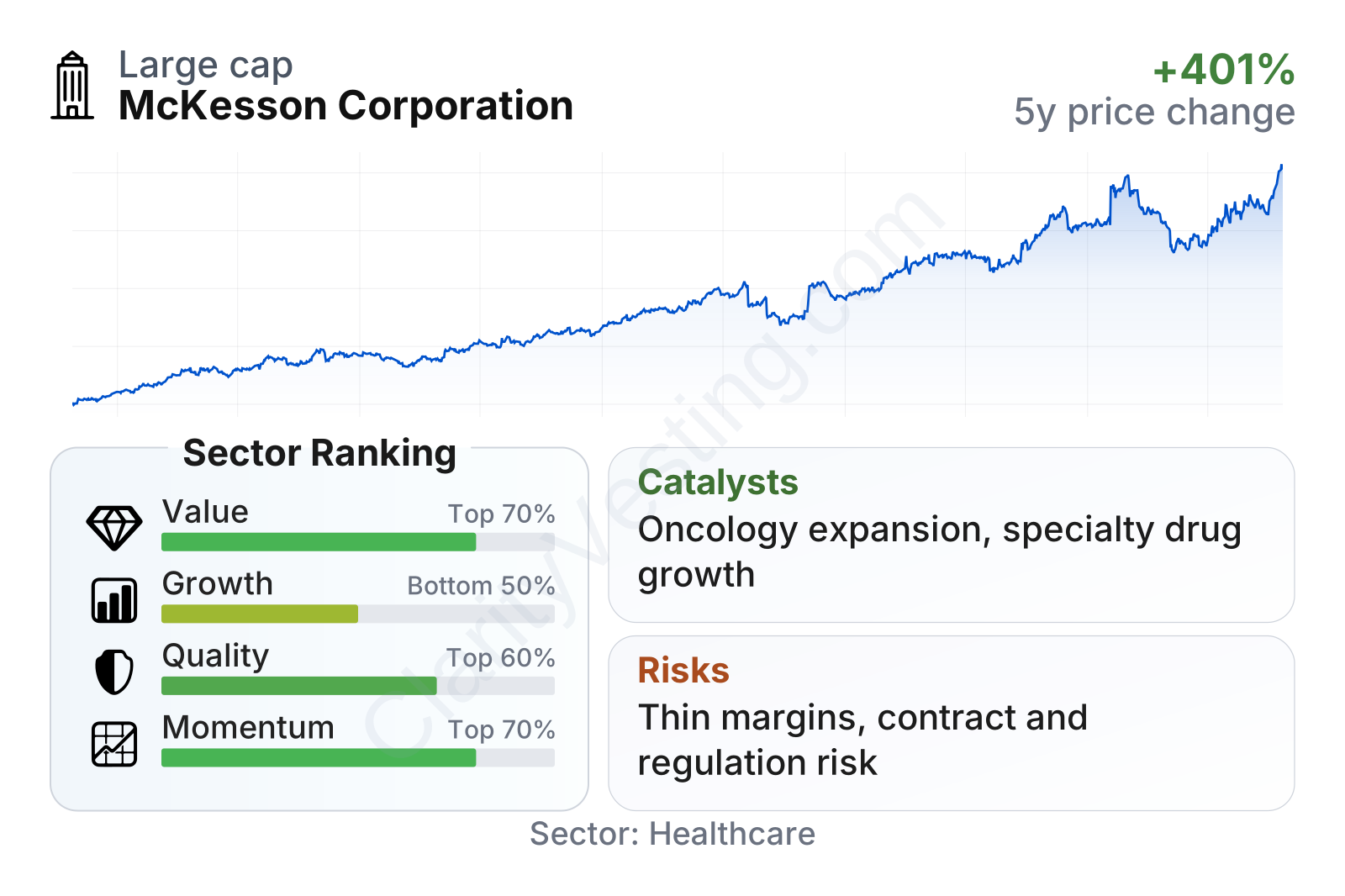
McKesson is a very large healthcare company with unusually low share-price volatility for a stock of its size, as shown by a beta well below 1. The metrics also point to a business that looks stronger in cash generation than in simple accounting margins. Value indicators are generally around the healthcare sector median, while free cash flow yield stands out as better than many peers. Growth and quality rankings look more mixed on the surface, but that partly reflects the economics of drug distribution, where margins are naturally slim and balance sheet ratios can be distorted by large buybacks.
Growth
Healthcare distribution is not the fastest-growing corner of healthcare, but it is a durable one. Demand is supported by aging populations, rising drug utilization, specialty medicines, and the growing complexity of getting therapies from manufacturers to patients. These are long-term industry drivers that do not depend on a single product launch or one-time trend.
McKesson’s strategy appears aligned with those trends. The company has been increasing its focus on specialty pharmaceuticals, oncology, biopharma services, and technology-enabled healthcare workflows. These activities matter because they tend to be more specialized, more embedded in customer operations, and often more profitable than basic commodity distribution. McKesson has also continued reshaping its portfolio over time, which has gradually pushed the company toward areas where scale and expertise create more value.
Revenue growth has not been perfectly smooth from quarter to quarter, which is normal in distribution, but the broader direction has been positive. Recent year-over-year growth has generally remained in the high-single-digit range or better, and the five-year revenue-per-share trend has been materially stronger than the sector median. That indicates the business has been expanding meaningfully even after accounting for changes in share count.
Cash generation is another important growth support. Free cash flow has moved higher over the last several years and is now in the range of more than $5 billion annually. That gives McKesson room to reinvest in strategic areas, pursue acquisitions, and continue returning capital to shareholders without relying heavily on new borrowing.
A notable catalyst is the company’s growing position in oncology and specialty care. McKesson has been building out platforms that support community oncology practices and biopharma commercialization services. Specialty drugs are one of the most important growth areas in healthcare because they are expensive, complex to distribute, and often require closely managed patient support. That plays directly into McKesson’s logistics scale and service capabilities.
Another supportive development is the continued importance of pharmaceutical supply resilience. Drug supply chains have become a bigger strategic issue for health systems, pharmacies, and policymakers. Large distributors with national reach, compliance capabilities, and established relationships are in a favorable position when customers prioritize reliability and execution.
Risks
This article is for informational purposes only and does not constitute financial advice. Some content is AI-generated. See Disclaimer


