Stock Analysis · Macmahon Holdings Limited (MCHHF)
Overview
Macmahon Holdings Limited is an Australia-based mining services contractor. In simple terms, it helps mine owners build, operate, and maintain mines. Its work covers surface mining, underground mining, civil construction, and related support services. The company works mainly with gold, copper, coal, and other mineral projects, with operations centered in Australia and Southeast Asia.
Its revenue is primarily generated from long-term mining contracts rather than from owning mineral deposits itself. That matters for long-term analysis because Macmahon is more exposed to mining activity levels and contract execution than to direct swings in commodity prices.
Based on recent annual disclosures, the business is largely organized around the following revenue sources:
- Surface mining services: approximately 45% to 55% of revenue. This typically includes overburden removal, drill-and-blast support, load-and-haul work, and full open-pit mine operations.
- Underground mining services: approximately 30% to 40% of revenue. This includes mine development, underground production, ore handling, and specialist underground contracting.
- Civil and infrastructure services: approximately 5% to 15% of revenue. This covers mine-related construction, site preparation, and supporting infrastructure.
- Equipment, international associate exposure, and other activities: generally a smaller contribution, usually below 10% combined depending on project mix and reporting period.
Macmahon’s business model is relatively straightforward: secure multi-year contracts, mobilize heavy equipment and labor, execute safely and efficiently, and convert that work into cash flow. The company’s scale is meaningful for a contractor, but it is still much smaller than the largest global mining-service names, which gives it room to grow if it keeps winning projects.
The earnings profile has strengthened over the last several years. Revenue has moved up from roughly $1.7 billion in fiscal 2022 to more than $2.6 billion in fiscal 2026, while net income has risen from about $27 million to around $101 million. That points to a business that is not just growing in size, but also improving its bottom line, even though contracting margins remain relatively thin by nature.
Key Figures
| Metric | Value | Sector ⓘ |
|---|---|---|
| Date | Oct 17, 2026 | |
| Context | ||
| Sector | Basic Materials | |
| Industry | Other Industrial Metals & Mining | |
| Market Cap ⓘ | $1.78B | |
| Beta ⓘ | 0.96 | |
Value (Cheapness) | ||
| P/E Ratio ⓘ | 27.00 | 16.90 |
| P/B Ratio ⓘ | 2.39 | 1.65 |
| FCF Yield ⓘ | 17.43% | 5.76% |
| Dividend Yield ⓘ | 2.72% | 2.13% |
| EBIT / EV ⓘ | N/A | 6.30% |
| PEG ⓘ | N/A | |
Growth (Business expansion) | ||
| Revenue Growth ⓘ | 5.10% | 11.10% |
| RPS Growth (5Y CAGR) ⓘ | 10.51% | 4.49% |
| EPS Growth (5Y CAGR) ⓘ | N/A | -13.47% |
| BVPS Growth (5Y CAGR) ⓘ | 6.35% | 5.51% |
| Margin Growth (5Y Trend) ⓘ | 3.82% | -1.54% |
| FCF Growth (5Y CAGR) ⓘ | N/A | 0.37% |
| DPS Growth (5Y CAGR) ⓘ | 30.31% | 6.08% |
Quality (Business durability) | ||
| ROIC (Latest) ⓘ | N/A | 9.26% |
| ROA (Latest) ⓘ | 10.03% | 4.91% |
| ROIC (5Y Median) ⓘ | 9.35% | 7.70% |
| ROA (5Y Median) ⓘ | 4.11% | 3.86% |
| Net Debt / EBIT (Latest) ⓘ | 0.33 | 1.40 |
| Net Debt / EBIT (5Y Median) ⓘ | 1.65 | 1.70 |
| Net Debt / EBITDA (Latest) ⓘ | 0.15 | 0.95 |
| Net Debt / Assets ⓘ | 6.31% | 13.69% |
| EBITDA / Interest ⓘ | 11.66 | 12.34 |
| Operating Margin (Latest) ⓘ | 6.61% | 13.20% |
| Operating Margin (5Y Median) ⓘ | 4.99% | 11.80% |
| Debt to Equity (Latest) ⓘ | 56.85% | 40.56% |
| Profit Margin (Latest) ⓘ | 3.86% | 6.43% |
| Free Cash Flow (Latest) ⓘ | $310.89M | |
Momentum (Price trend) | ||
| 3Y Return ⓘ | +874.73% | +68.89% |
| 12M Return (excl. last month) ⓘ | +191.96% | +30.21% |
| 6M Return ⓘ | +43.72% | -4.16% |
| Price vs. 200-Day MA ⓘ | +222.91% | -1.27% |
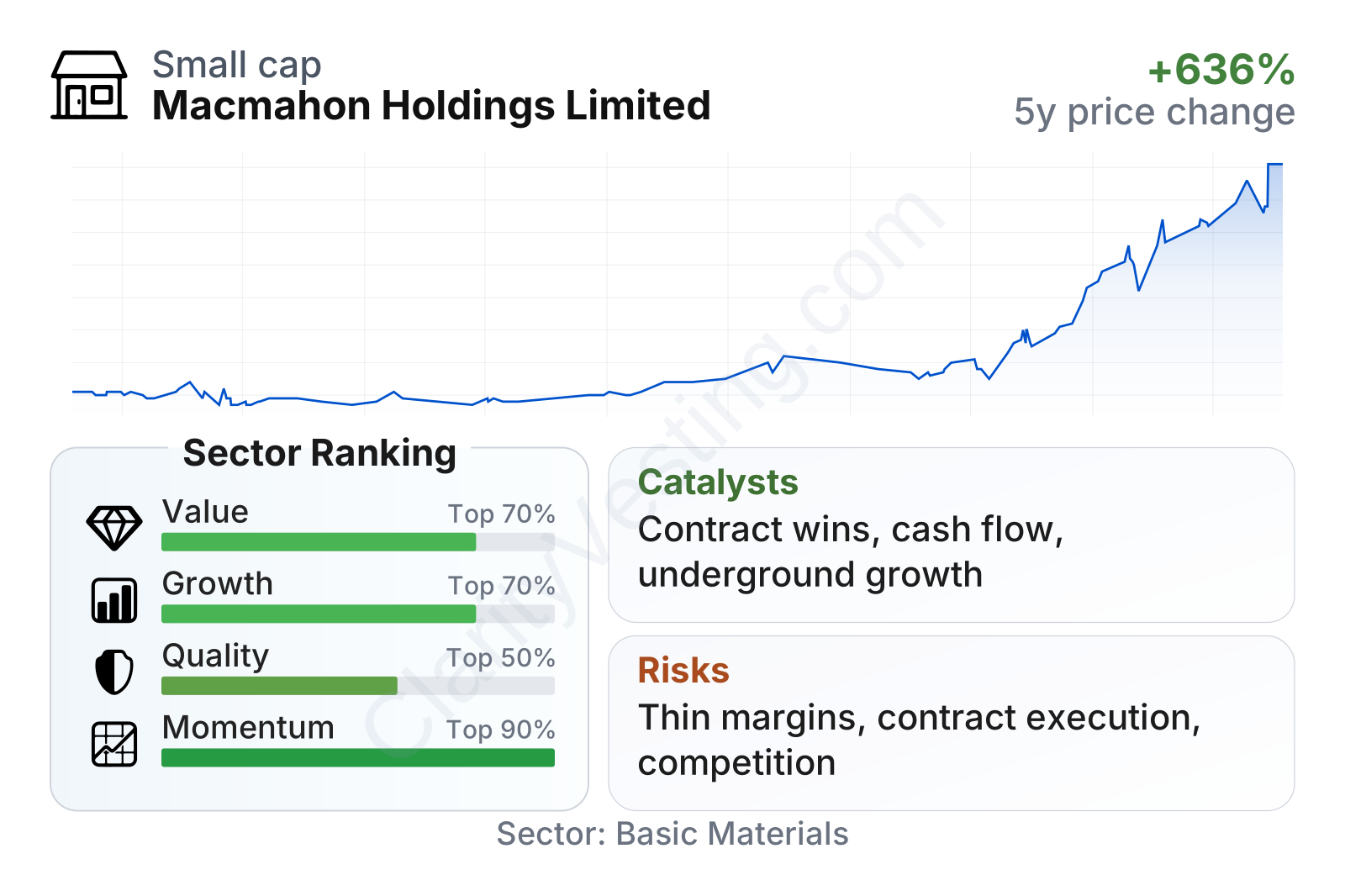
Macmahon stands out most on cash generation, balance-sheet improvement, and share-price momentum. Free cash flow yield is far above the sector median, which suggests the company is producing strong cash relative to its market value. Net debt is low compared with earnings, and interest coverage remains solid, indicating that leverage is currently manageable.
The main trade-off is profitability. Operating margin and profit margin are below the sector median, which is common in contract mining because the work is capital-intensive and pricing can be competitive. On valuation, the stock trades above the sector median on earnings and book value multiples, so the market is already recognizing part of the recent improvement. The share-price record has been exceptionally strong over one, three, and six months, which supports confidence in the trend but also means the market has become more optimistic.
Growth
Macmahon operates in a sector with long-term support from global demand for mined materials. Gold, copper, and other metals remain important for industrial activity, electrification, and energy infrastructure. Even when commodity prices fluctuate, mine owners often continue to rely on contractors to improve flexibility and control capital spending. That creates a durable role for specialized service providers.
The company’s strategy appears coherent for future growth. It has expanded through a mix of contract wins, deeper relationships with mining clients, and exposure to both surface and underground work. That diversification matters because underground contracts can be technically demanding and can create longer-duration revenue streams, while surface mining can add scale. Macmahon also benefits from operating in regions where outsourced mining remains an established model.
Another favorable point is backlog visibility. Mining contractors become more attractive when they have contracted work extending across several years, because that helps support equipment utilization and labor planning. Macmahon has continued to position itself around this type of revenue base rather than relying on one-off assignments.
Recent financial progress also reinforces the growth case. Revenue has continued to rise in fiscal 2026, operating income has expanded strongly, and net income has nearly quadrupled compared with fiscal 2022. Over a five-year view, revenue per share growth has outpaced the sector median, and the operating margin trend has improved while the broader sector’s median trend has moved in the opposite direction.
A practical catalyst is the company’s ability to convert industry demand into new project awards or extensions at existing mines. In contract mining, a few large wins can materially change earnings power. Another catalyst is continued cash generation: if free cash flow remains strong, the company has more room for fleet investment, debt reduction, dividends, and selective expansion.
Risks
This article is for informational purposes only and does not constitute financial advice. Some content is AI-generated. See Disclaimer


