Stock Analysis · Mechanics Bank (MCHB)
Overview
Mechanics Bank is a regional bank serving businesses and individuals, with operations centered in California. Like most banks, it gathers deposits from customers, lends part of that money out, invests in securities, and earns fees from a range of banking services. Its business mix includes commercial banking, consumer banking, residential mortgage activities, and wealth-related services.
For a bank, revenue is not split the same way as it is for an industrial company. The largest source is usually net interest income, which is the difference between what the bank earns on loans and securities and what it pays on deposits and other funding. The remaining portion comes from noninterest income such as service charges, card and treasury fees, mortgage-related income, and other banking fees. Based on the company’s recent financial profile, Mechanics Bank appears to rely mainly on spread-based banking income, with fee income acting as a secondary contributor.
A simple way to think about the revenue mix is:
- Net interest income: approximately 70% to 85% of total revenue in a typical regional bank model. This includes income from commercial loans, real estate loans, consumer loans, and investment securities, minus interest paid on deposits and borrowings.
- Noninterest income: approximately 15% to 30% of total revenue. This generally includes deposit account fees, payment-related fees, mortgage banking income, wealth management or trust-related fees where applicable, and other service revenue.
Over the last several years, the company’s earnings profile has been unusually volatile for a bank. Revenue climbed strongly into 2025 after a weak 2024, but profitability was squeezed in the period of higher funding costs. That matters because a long-term banking case depends less on one strong year of revenue and more on whether the bank can consistently turn its balance sheet into durable returns.
The business flow shows a sharp profit squeeze in 2024 as interest expense surged and net income fell heavily, followed by a strong rebound in 2025 revenue and earnings. The key takeaway is that Mechanics Bank has already gone through a severe margin reset and is now operating from a more normalized, though still not fully steady, base.
Key Figures
| Metric | Value | Sector ⓘ |
|---|---|---|
| Date | Oct 24, 2026 | |
| Context | ||
| Sector | Financial Services | |
| Industry | Banks - Regional | |
| Market Cap ⓘ | $3.24B | |
| Beta ⓘ | 0.14 | |
Value (Cheapness) | ||
| P/E Ratio ⓘ | 11.25 | 12.46 |
| P/B Ratio ⓘ | 1.31 | 1.25 |
| FCF Yield ⓘ | 8.27% | 9.82% |
| Dividend Yield ⓘ | 8.97% | 2.94% |
| EBIT / EV ⓘ | 13.02% | 8.11% |
| PEG ⓘ | N/A | |
Growth (Business expansion) | ||
| Revenue Growth ⓘ | 35.70% | 9.10% |
| RPS Growth (5Y CAGR) ⓘ | -27.68% | 12.31% |
| EPS Growth (5Y CAGR) ⓘ | -40.09% | -6.97% |
| BVPS Growth (5Y CAGR) ⓘ | -21.14% | 5.02% |
| Margin Growth (5Y Trend) ⓘ | -9.27% | -4.00% |
| FCF Growth (5Y CAGR) ⓘ | -10.23% | 4.71% |
| DPS Growth (5Y CAGR) ⓘ | -61.65% | 8.92% |
Quality (Business durability) | ||
| ROIC (Latest) ⓘ | 11.09% | 9.18% |
| ROE (Latest) ⓘ | 10.29% | 13.93% |
| ROA (Latest) ⓘ | 1.28% | 1.57% |
| ROIC (5Y Median) ⓘ | N/A | 7.80% |
| ROE (5Y Median) ⓘ | 28.75% | 12.15% |
| ROA (5Y Median) ⓘ | 1.59% | 1.28% |
| Net Debt / EBIT (Latest) ⓘ | -0.86 | 1.02 |
| Net Debt / EBIT (5Y Median) ⓘ | 0.69 | 0.72 |
| Net Debt / EBITDA (Latest) ⓘ | -0.80 | 0.88 |
| Operating Margin (Latest) ⓘ | 37.82% | 22.30% |
| Operating Margin (5Y Median) ⓘ | 35.66% | 24.50% |
| Debt to Equity (Latest) ⓘ | 7.75% | 59.34% |
| Profit Margin (Latest) ⓘ | 37.88% | 26.42% |
| Free Cash Flow (Latest) ⓘ | $268.00M | |
Momentum (Price trend) | ||
| 3Y Return ⓘ | +245.07% | +95.73% |
| 12M Return (excl. last month) ⓘ | +26.92% | +17.30% |
| 6M Return ⓘ | +5.80% | +6.07% |
| Price vs. 200-Day MA ⓘ | +3.77% | +5.36% |
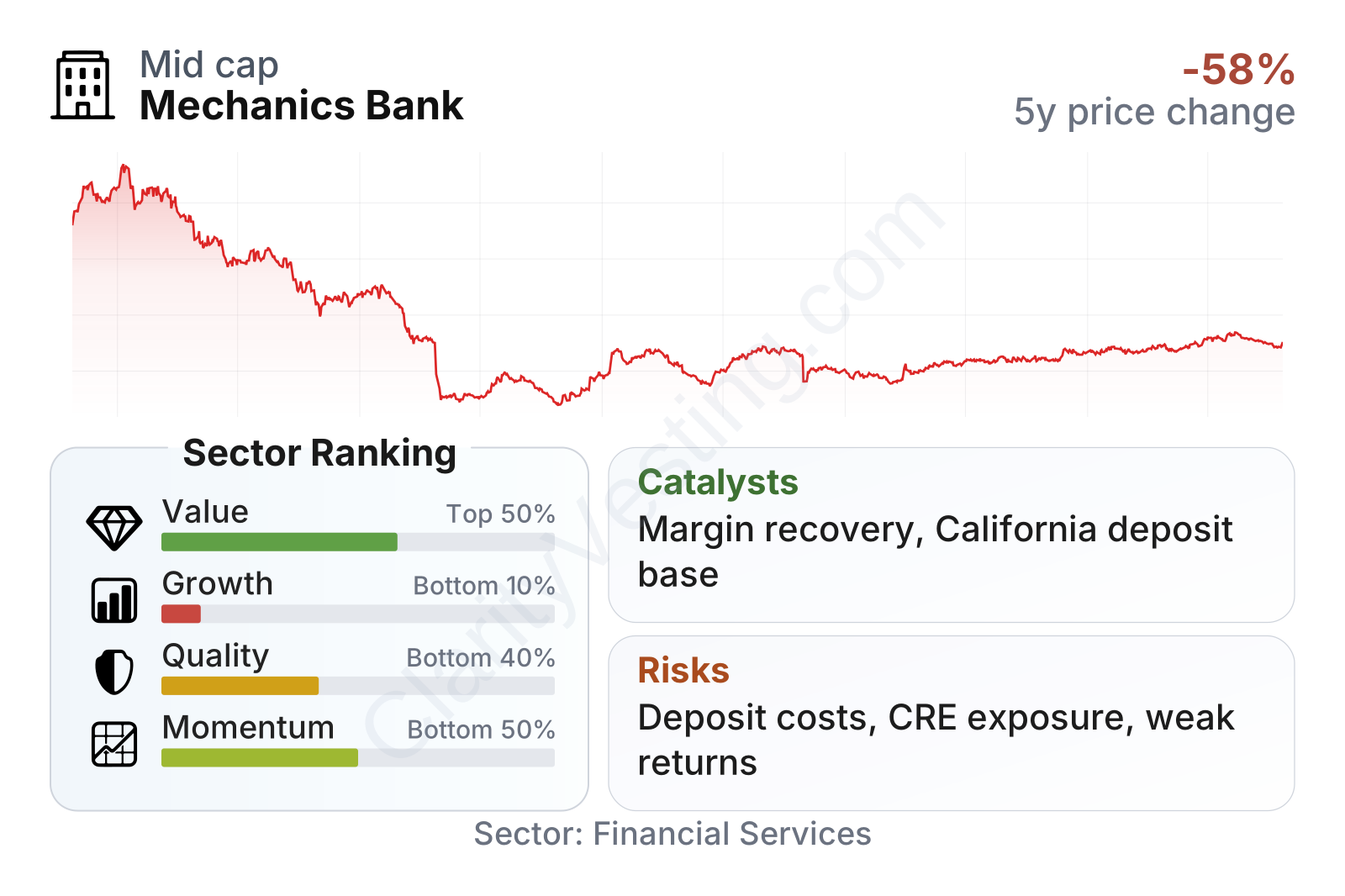
Mechanics Bank is a mid-sized regional bank with a stock that has been far more volatile than its very low beta might suggest, especially during and after the 2023 regional banking shock. The share price has recovered meaningfully from its low point, but the operating profile still looks mixed. On current metrics, profitability is decent rather than standout, growth measures are weak over a multi-year period, and valuation sits close to the sector range rather than at an obvious discount. One metric that stands out is the dividend yield, which is much higher than the sector median, but the history around dividends has also been uneven, so that number should be read in the context of the company’s recent earnings swings.
Growth
Regional banking remains a necessary sector, but it is not a fast-growth industry in the usual sense. Long-term expansion depends on gathering stable deposits, making disciplined loans, preserving credit quality, and improving efficiency. In that context, Mechanics Bank operates in an attractive state market, but one that is also highly competitive and economically sensitive. California can offer strong business formation, real estate activity, and commercial lending opportunities, yet it also brings concentration risk if local conditions weaken.
The company’s recent strategy appears more about recovery and stabilization than aggressive expansion. That is not a negative by itself. After the pressure that hit many regional banks through rising deposit costs and market stress, restoring margins, protecting capital, and rebuilding profitability is a sensible priority. The strongest near-term growth driver is likely not dramatic balance-sheet expansion but better earnings conversion if funding costs stabilize and loan yields remain supportive.
The earnings pattern reflects that transition clearly. Earnings per share fell sharply from 2021 through 2024, turned negative in 2024, and then moved back into positive territory in 2025 and 2026. That is encouraging as a direction of travel, but it still does not amount to a smooth growth record. For long-term analysis, the important point is that the company has moved out of the worst part of the downturn, yet it has not re-established a long stretch of consistent earnings compounding.
Book value per share, a key measure for banks because it represents net asset value attributable to shareholders, also shows why the recovery case is incomplete. It declined materially over the past several years and then improved somewhat. A rebuilding trend would be constructive because durable book value growth usually supports long-term shareholder value in banking. At this stage, the evidence points to partial repair rather than a fully restored growth engine.
As for catalysts, the most meaningful ones are internal and industry-based. If deposit pricing pressure eases, net interest margin can improve. If commercial and consumer credit stays healthy, provisions may remain manageable. If management can keep expenses under control while maintaining customer relationships, profitability could strengthen without requiring rapid asset growth. The recent rebound in revenue and the return to positive earnings suggest there is a real operating recovery underway, even if it is still early.
Risks
This article is for informational purposes only and does not constitute financial advice. Some content is AI-generated. See Disclaimer


