Stock Analysis · MetroCity Bankshares (MCBS)
Overview
MetroCity Bankshares is a regional bank holding company focused on commercial banking. Through its bank subsidiary, it serves businesses, real estate operators, and individual customers, with a meaningful emphasis on commercial real estate lending and relationship-based banking. For a long-term reader, the simplest way to think about the company is that it earns money by gathering deposits, lending those funds at higher rates, and collecting fees from banking services.
Like most regional banks, its revenue mix is led by interest-related income rather than fees. The exact split can move with interest rates and balance sheet changes, but recent annual results indicate that the business is overwhelmingly driven by net interest income, while noninterest income remains a smaller contributor.
- Net interest income: approximately 85% to 95% of total revenue in recent periods. This is the spread between interest earned on loans and securities and interest paid on deposits and other funding sources.
- Noninterest income: approximately 5% to 15% of total revenue. This usually includes service charges, loan-related fees, trade finance activity, and other banking fees.
- Core lending activity: commercial real estate, commercial and industrial lending, residential mortgage lending, and other relationship-based credit products appear to be the main engines behind earning assets.
The broader earnings flow shows a bank that experienced pressure during the 2023 banking stress period, then recovered strongly. Revenue and net income rebounded in 2024 and improved again in 2025, while expenses rose more moderately than revenue over that stretch. That pattern matters because it suggests the bank did not just grow balances; it also restored profitability after a difficult industry year.
The earnings profile improved meaningfully after the 2023 dip. Revenue in 2024 was far above 2023 levels, and net income also recovered, with a further increase in 2025. For a regional bank, that points to a business that has been able to rebuild spreads and maintain credit performance well enough to turn top-line improvement into stronger bottom-line results.
Key Figures
| Metric | Value | Sector ⓘ |
|---|---|---|
| Date | Oct 20, 2026 | |
| Context | ||
| Sector | Financial Services | |
| Industry | Banks - Regional | |
| Market Cap ⓘ | $1.01B | |
| Beta ⓘ | 0.71 | |
Value (Cheapness) | ||
| P/E Ratio ⓘ | 12.22 | 12.26 |
| P/B Ratio ⓘ | 1.76 | 1.23 |
| FCF Yield ⓘ | 7.38% | 10.33% |
| Dividend Yield ⓘ | 3.02% | 3.02% |
| EBIT / EV ⓘ | N/A | 8.14% |
| PEG ⓘ | N/A | |
Growth (Business expansion) | ||
| Revenue Growth ⓘ | 33.90% | 9.25% |
| RPS Growth (5Y CAGR) ⓘ | 13.99% | 12.19% |
| EPS Growth (5Y CAGR) ⓘ | -3.60% | -8.95% |
| BVPS Growth (5Y CAGR) ⓘ | 16.78% | 4.99% |
| Margin Growth (5Y Trend) ⓘ | -22.10% | -3.86% |
| FCF Growth (5Y CAGR) ⓘ | 20.47% | 4.81% |
| DPS Growth (5Y CAGR) ⓘ | 20.23% | 8.79% |
Quality (Business durability) | ||
| ROIC (Latest) ⓘ | N/A | 9.49% |
| ROE (Latest) ⓘ | 15.79% | 13.87% |
| ROA (Latest) ⓘ | 1.96% | 1.54% |
| ROIC (5Y Median) ⓘ | 8.41% | 7.86% |
| ROE (5Y Median) ⓘ | 16.07% | 12.17% |
| ROA (5Y Median) ⓘ | 1.82% | 1.30% |
| Net Debt / EBIT (Latest) ⓘ | N/A | 0.99 |
| Net Debt / EBIT (5Y Median) ⓘ | 2.12 | 0.73 |
| Net Debt / EBITDA (Latest) ⓘ | 1.45 | 0.91 |
| Operating Margin (Latest) ⓘ | N/A | 22.30% |
| Operating Margin (5Y Median) ⓘ | 57.78% | 24.63% |
| Debt to Equity (Latest) ⓘ | 71.02% | 58.32% |
| Profit Margin (Latest) ⓘ | 43.28% | 26.57% |
| Free Cash Flow (Latest) ⓘ | $74.69M | |
Momentum (Price trend) | ||
| 3Y Return ⓘ | +95.41% | +88.67% |
| 12M Return (excl. last month) ⓘ | +24.87% | +19.19% |
| 6M Return ⓘ | +7.38% | +4.70% |
| Price vs. 200-Day MA ⓘ | +7.63% | +3.66% |
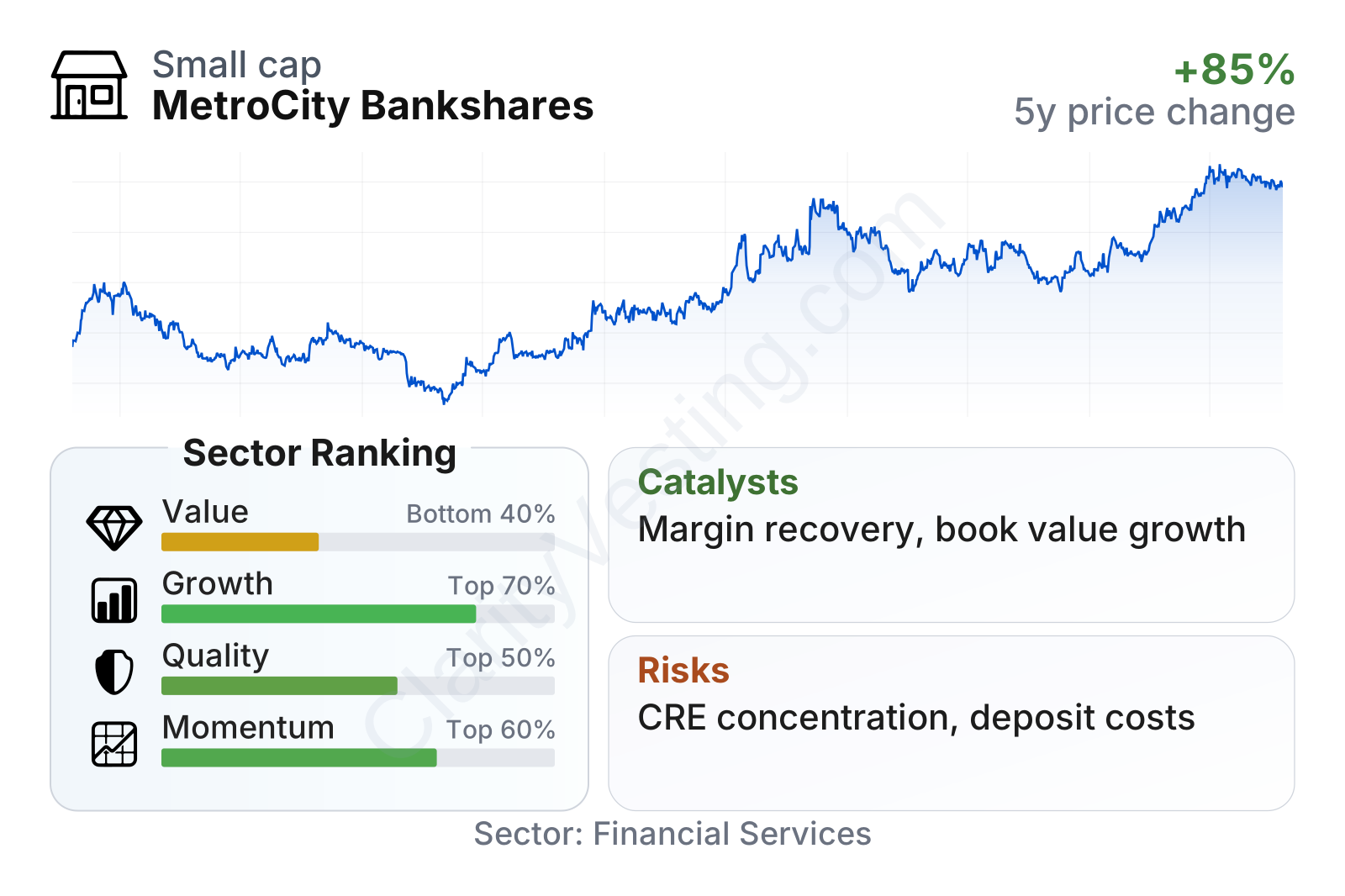
MetroCity Bankshares is a small-cap regional bank with a market value around $1 billion, so it is large enough to have scale but still small compared with national banks. The stock’s beta is below 1, which means its share price has historically moved less violently than the broader market. On valuation, the earnings multiple is close to the regional bank median, while the price-to-book ratio stands above the sector median. On growth and profitability, the company compares well: revenue growth, book value growth, return on equity, and return on assets all look stronger than many peers. The weaker area is classic value screening, because the market is already assigning a premium to book value rather than pricing the bank like a distressed or overlooked lender.
Growth
Regional banking is not a high-growth sector in the way software or semiconductors can be, but it can still produce steady long-term compounding when a bank expands deposits, grows loans carefully, maintains credit quality, and increases book value per share. MetroCity Bankshares appears to fit that framework better than many community and regional peers. Its recent revenue growth is well ahead of the sector median, and its five-year growth in revenue per share and book value per share also compares favorably.
A central point in the growth case is that book value per share has climbed at a strong pace over five years, materially faster than the typical regional bank. That matters because, for banks, book value often serves as a rough scorecard of long-term balance sheet compounding. In MetroCity’s case, that growth has been paired with a recovery in earnings after the 2023 industry disruption rather than simple balance sheet expansion with weak returns.
The earnings trend is not perfectly smooth, but it is constructive. Earnings per share rose in 2022, dropped in 2023 during the more difficult funding environment for banks, then recovered in 2024 and improved again in 2025. That pattern suggests the company has already worked through at least part of the margin pressure that hit the industry when deposit costs rose quickly.
The strategic logic also makes sense. A relationship-driven regional bank can grow by deepening local business ties, adding deposits from commercial customers, and redeploying that funding into higher-yielding loans. If management keeps deposit costs under control while preserving credit quality, future growth does not require dramatic expansion into unfamiliar areas. The strongest practical catalyst is therefore not a headline-grabbing product launch, but continued normalization in funding costs, loan growth in core markets, and ongoing growth in tangible economic value per share.
Recent operating momentum adds support. The share price has trended upward strongly over the last several years, and that usually reflects a market view that earnings power and balance sheet strength have improved. In addition, the company’s dividend per share has grown quickly over five years, which often signals confidence in recurring profitability, provided credit quality stays stable.
Risks
This article is for informational purposes only and does not constitute financial advice. Some content is AI-generated. See Disclaimer


