Stock Analysis · Metropolitan Bank Holding (MCB)
Overview
Metropolitan Bank Holding is the parent company of Metropolitan Commercial Bank, a New York-based bank that serves businesses, entrepreneurs, and retail customers. Its model is more specialized than a typical community bank. In addition to traditional lending and deposit gathering, it has built a meaningful business in payments-related banking services, including global payments, debit card, and deposit platform programs. That mix gives it exposure both to conventional banking activity and to financial infrastructure services used by payment companies and platform partners.
Like most banks, Metropolitan Bank Holding earns the majority of its revenue from the spread between what it earns on loans and securities and what it pays on deposits and borrowings. Based on recent company disclosures, its revenue sources can be described approximately as follows:
- Net interest income: about 70% to 80% of total revenue. This is the core banking engine and includes income from commercial real estate, commercial and industrial, consumer, and specialty finance loans, plus interest from securities and cash balances, minus funding costs.
- Non-interest income: about 20% to 30% of total revenue. This includes fees tied to payments-related deposit programs, global payments activity, service charges, and other banking fees.
- Lending mix: the loan book is concentrated in commercial real estate and commercial lending, with consumer and specialty categories contributing a smaller share. Exact category weights move over time with origination strategy and runoff.
The business has changed noticeably over the past few years. Revenue expanded strongly from 2021 through 2025, but rising funding costs also took a much larger share of income as interest rates climbed. Even so, profitability remained positive, which suggests the bank has been able to preserve earnings despite a more demanding funding environment.
The revenue base has grown substantially over the last five years, but the cost of funding also rose sharply during the period. That is a common pressure point for regional banks in a higher-rate environment, and it helps explain why revenue growth has not translated into equally strong improvement in profitability ratios.
Key Figures
| Metric | Value | Sector ⓘ |
|---|---|---|
| Date | Oct 17, 2026 | |
| Context | ||
| Sector | Financial Services | |
| Industry | Banks - Regional | |
| Market Cap ⓘ | $1.08B | |
| Beta ⓘ | 1.04 | |
Value (Cheapness) | ||
| P/E Ratio ⓘ | 11.14 | 12.26 |
| P/B Ratio ⓘ | 1.04 | 1.23 |
| FCF Yield ⓘ | 9.25% | 10.40% |
| Dividend Yield ⓘ | 0.87% | 3.02% |
| EBIT / EV ⓘ | N/A | 8.14% |
| PEG ⓘ | N/A | |
Growth (Business expansion) | ||
| Revenue Growth ⓘ | 14.00% | 9.35% |
| RPS Growth (5Y CAGR) ⓘ | 23.29% | 12.19% |
| EPS Growth (5Y CAGR) ⓘ | -15.67% | -9.53% |
| BVPS Growth (5Y CAGR) ⓘ | 3.59% | 4.99% |
| Margin Growth (5Y Trend) ⓘ | -26.22% | -3.86% |
| FCF Growth (5Y CAGR) ⓘ | 25.45% | 4.81% |
| DPS Growth (5Y CAGR) ⓘ | -9.41% | 8.79% |
Quality (Business durability) | ||
| ROIC (Latest) ⓘ | N/A | 9.49% |
| ROE (Latest) ⓘ | 10.19% | 13.90% |
| ROA (Latest) ⓘ | 1.01% | 1.55% |
| ROIC (5Y Median) ⓘ | 7.58% | 7.86% |
| ROE (5Y Median) ⓘ | 10.47% | 12.17% |
| ROA (5Y Median) ⓘ | 0.93% | 1.30% |
| Net Debt / EBIT (Latest) ⓘ | N/A | 0.96 |
| Net Debt / EBIT (5Y Median) ⓘ | 0.00 | 0.73 |
| Net Debt / EBITDA (Latest) ⓘ | 0.57 | 0.92 |
| Operating Margin (Latest) ⓘ | N/A | 22.30% |
| Operating Margin (5Y Median) ⓘ | 28.48% | 24.63% |
| Debt to Equity (Latest) ⓘ | 3.78% | 58.56% |
| Profit Margin (Latest) ⓘ | 27.76% | 26.57% |
| Free Cash Flow (Latest) ⓘ | $99.67M | |
Momentum (Price trend) | ||
| 3Y Return ⓘ | +172.86% | +88.33% |
| 12M Return (excl. last month) ⓘ | +15.85% | +19.38% |
| 6M Return ⓘ | -1.37% | +4.75% |
| Price vs. 200-Day MA ⓘ | -2.02% | +3.50% |
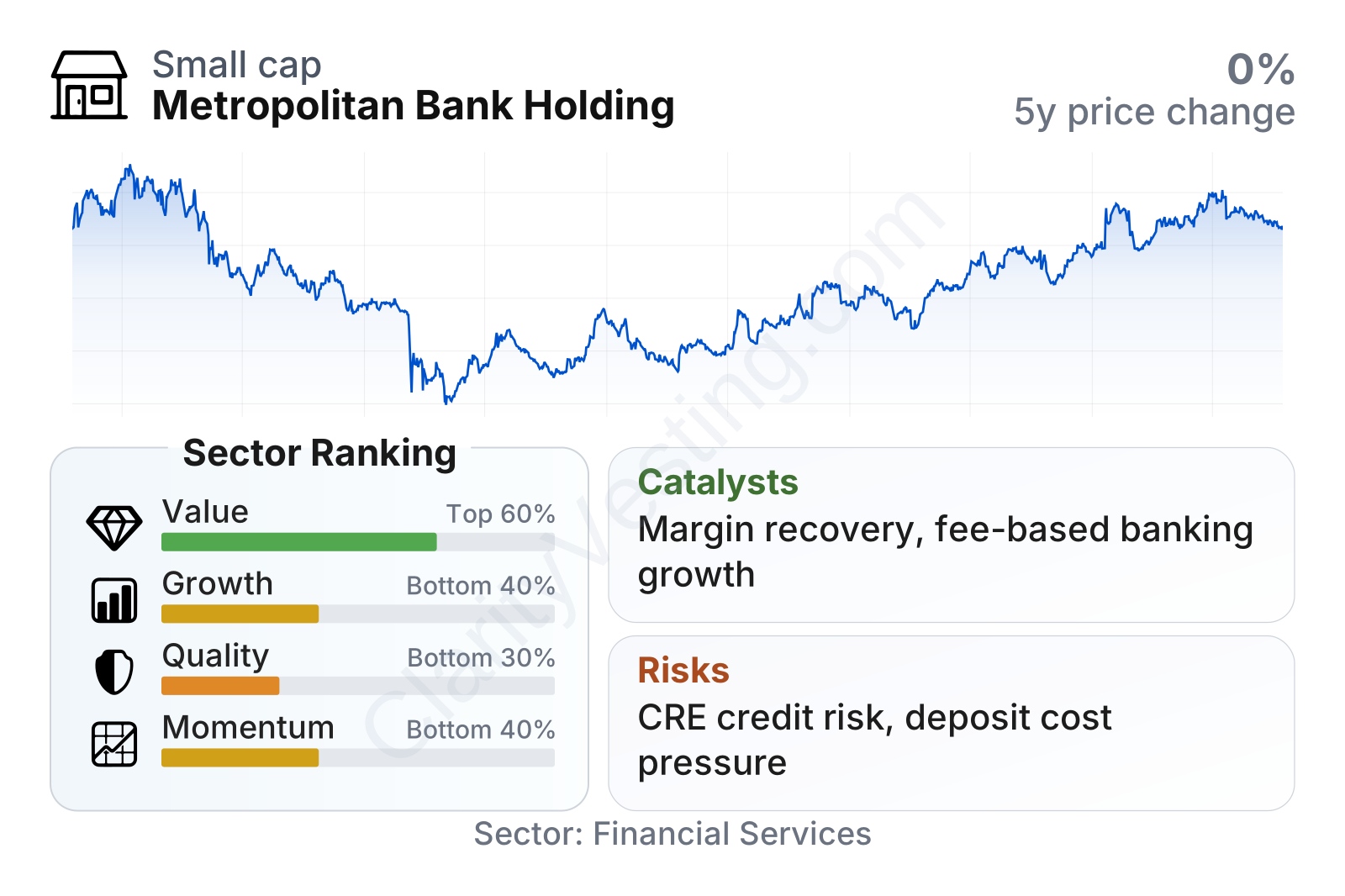
Metropolitan Bank Holding is a mid-sized regional bank by market value, with share-price volatility close to the broader market. The stock’s longer-term performance has been strong since the 2023 regional banking shock, although more recent momentum has been less impressive than the sector median. On valuation, the shares trade around 11 times earnings and about 1.0 times book value, both a bit below typical regional bank levels. On the other hand, profitability measures rank weaker than many peers, with return on equity near 10% and return on assets near 1.0%, while revenue growth has been healthier than the sector median. Overall, the profile is mixed: decent growth and moderate valuation, offset by below-average quality indicators.
Growth
The company operates in a sector that is mature, but still capable of growth when a bank has a clear niche. Metropolitan’s niche is its combination of commercial banking and fee-generating payments-related services. That matters because plain-vanilla regional banking often grows slowly, while specialized deposits, payment flows, and platform relationships can produce faster balance-sheet and revenue expansion when executed well.
Its recent track record shows that top-line growth has been real. Revenue growth over the last year was ahead of the sector median, and revenue per share over five years increased at a much faster pace than many peers. That said, earnings have not followed the same smooth path, because higher deposit costs and margin pressure have reduced the amount of profit retained from each dollar of revenue.
Earnings per share rose strongly into 2022, then softened and have remained relatively stable rather than continuing a steep climb. That pattern suggests the main growth question is no longer whether the company can expand revenue, but whether it can convert that growth into consistently stronger bottom-line performance.
Book value per share has recovered well since the drop seen in 2022 and has continued trending upward. For a bank, this is an important sign because it reflects retained earnings and balance-sheet rebuilding. A rising book value can support future lending capacity and gives the company more room to absorb stress than a stagnant capital base would.
Strategically, the company’s growth case appears to rest on three pillars: disciplined loan growth, stable or improving deposit gathering, and expansion of fee-based banking services tied to payments and platform clients. If interest rates stabilize or move lower, funding pressure could ease and make that model more productive. In that sense, one of the strongest potential catalysts is not just balance-sheet growth, but margin normalization after a period of unusually high deposit competition.
Recent company updates have also emphasized capital strength, continued loan production, and credit discipline. For a bank of this size, that combination can create a meaningful opportunity if management can grow while avoiding the credit problems that often surface late in a rate cycle.
Risks
This article is for informational purposes only and does not constitute financial advice. Some content is AI-generated. See Disclaimer


