Stock Analysis · MBX Biosciences Inc (MBX)
Overview
MBX Biosciences Inc is a clinical-stage biotechnology company focused on endocrine and metabolic diseases. In simple terms, it is trying to develop long-acting peptide medicines for chronic hormone-related conditions, with the goal of reducing how often patients need injections while keeping treatment effective. The company’s work is still in the development phase, so its value today depends mainly on the progress of its drug candidates rather than on current commercial sales.
Its pipeline has centered on programs for rare endocrine disorders, including hypoparathyroidism and post-bariatric hypoglycemia. The company uses what it describes as precision-engineered peptides, designed to improve durability and convenience compared with existing treatment approaches. That matters because many rare-disease markets can support high pricing if a treatment shows meaningful medical benefit and wins regulatory approval.
At this stage, MBX does not have a recurring operating revenue base from marketed products. Based on recent filings, revenue sources are minimal and not yet representative of a commercial business.
- Product revenue: approximately 0%. The company has no approved product sales.
- Collaboration, licensing, or other operating revenue: approximately 0% on a recurring basis from core operations, based on available recent annual financial statements.
- Non-operating cash sources: effectively the business has been funded primarily by equity financing, including IPO proceeds and cash raised to support research and development. This is not revenue, but it is the main source of funding for the company’s activities today.
The financial structure is typical for a young biotech: almost all spending goes into research and development, while losses widen as programs move through clinical testing. Over the last several years, operating expenses have risen materially, led by R&D, which indicates that management has been advancing the pipeline rather than conserving cash.
The business currently shows a classic pre-commercial pattern: essentially no revenue, rapidly rising research spending, and larger annual losses as clinical activity expands.
Key Figures
| Metric | Value | Sector ⓘ |
|---|---|---|
| Date | Oct 24, 2026 | |
| Context | ||
| Sector | Healthcare | |
| Industry | Biotechnology | |
| Market Cap ⓘ | $2.60B | |
| Beta ⓘ | 0.10 | |
Value (Cheapness) | ||
| P/E Ratio ⓘ | N/A | 25.42 |
| P/B Ratio ⓘ | 5.88 | 3.08 |
| FCF Yield ⓘ | -3.28% | 3.12% |
| Dividend Yield ⓘ | N/A | 1.85% |
| EBIT / EV ⓘ | -4.56% | 0.56% |
| PEG ⓘ | N/A | |
Growth (Business expansion) | ||
| Revenue Growth ⓘ | N/A | 7.50% |
| RPS Growth (5Y CAGR) ⓘ | N/A | 8.60% |
| EPS Growth (5Y CAGR) ⓘ | -75.19% | -17.73% |
| BVPS Growth (5Y CAGR) ⓘ | N/A | 3.72% |
| Margin Growth (5Y Trend) ⓘ | N/A | -0.57% |
| FCF Growth (5Y CAGR) ⓘ | N/A | 0.96% |
| DPS Growth (5Y CAGR) ⓘ | N/A | 6.69% |
Quality (Business durability) | ||
| ROIC (Latest) ⓘ | -21.03% | 3.17% |
| ROA (Latest) ⓘ | -24.95% | 2.98% |
| ROIC (5Y Median) ⓘ | N/A | 4.56% |
| ROA (5Y Median) ⓘ | -35.11% | 1.87% |
| Net Debt / EBIT (Latest) ⓘ | N/A | 1.34 |
| Net Debt / EBIT (5Y Median) ⓘ | N/A | 1.86 |
| Net Debt / EBITDA (Latest) ⓘ | N/A | 1.00 |
| Net Debt / Assets ⓘ | -11.65% | 5.06% |
| EBITDA / Interest ⓘ | N/A | 9.55 |
| Operating Margin (Latest) ⓘ | N/A | 9.25% |
| Operating Margin (5Y Median) ⓘ | N/A | 7.33% |
| Debt to Equity (Latest) ⓘ | 0.82% | 26.68% |
| Profit Margin (Latest) ⓘ | N/A | 3.34% |
| Free Cash Flow (Latest) ⓘ | -$85.20M | |
Momentum (Price trend) | ||
| 3Y Return ⓘ | N/A | +51.61% |
| 12M Return (excl. last month) ⓘ | +209.90% | +19.90% |
| 6M Return ⓘ | +50.27% | +10.10% |
| Price vs. 200-Day MA ⓘ | +12.01% | +6.44% |
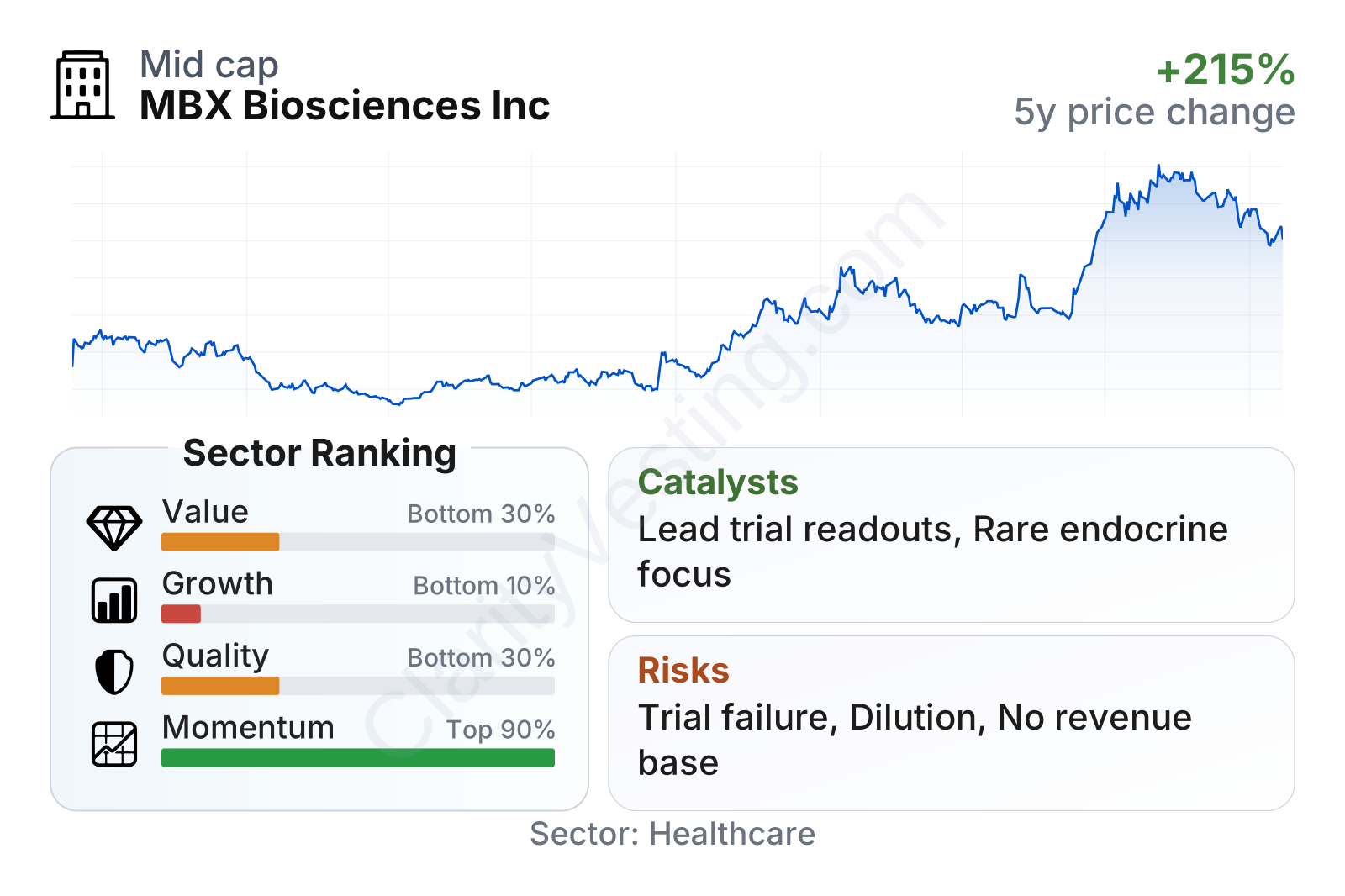
MBX remains a small-to-mid-sized biotech by market value, and its trading pattern has been unusually strong over the last year even by biotechnology standards. Momentum has ranked near the top of the healthcare peer group, with the shares rising several times over from earlier levels. By contrast, value, growth, and quality metrics appear weak relative to the sector, which is not surprising for a company without product revenue and with ongoing losses. The balance sheet stands out in a more favorable way: debt is extremely low, and net cash remains an important support for the company’s operating runway.
Growth
MBX operates in a sector that can produce very large long-term outcomes, but it is also one where growth does not happen gradually. In biotechnology, the biggest value changes usually come from clinical trial results, regulatory milestones, and eventually commercial approvals. That means the company is exposed to a growing area of healthcare innovation, especially in rare endocrine disease, where there is demand for more convenient and more durable therapies.
The strategic logic is coherent. Rare-disease drug development can be attractive because patient populations are smaller, clinical programs can be more targeted, and successful therapies often face less direct pricing pressure than mass-market drugs. MBX’s emphasis on long-acting peptide treatments also fits a broader industry trend: improving adherence and patient convenience can be commercially important when standard therapies require frequent dosing or deliver inconsistent control.
One of the main possible catalysts is continued clinical progress in its lead programs. For a company at this stage, positive data can materially change how the market values future revenue potential. Another meaningful opportunity would be evidence that its candidates can match or improve efficacy while reducing treatment burden. That is the type of improvement that larger pharmaceutical companies also tend to watch closely for partnership or acquisition interest.
Recent market performance suggests that investors have been responding to clinical and pipeline-related progress rather than to near-term financial results. The sharp re-rating in the stock price since late 2025 points to rising expectations around the company’s development path. That does not prove commercial success, but it does show that the market sees a significant opportunity if execution continues.
Cash generation is still negative, which is normal for a clinical-stage biotech, but the trend is still important. Free cash outflow has remained substantial and has moved deeper into negative territory over the last year, showing that future growth depends on trial execution and financing discipline rather than on internally generated cash.
Risks
This article is for informational purposes only and does not constitute financial advice. Some content is AI-generated. See Disclaimer


