Stock Analysis · Mercantile Bank Corporation (MBWM)
Overview
Mercantile Bank Corporation is a regional bank based in Michigan. Through Mercantile Bank of Michigan, it provides traditional banking services to businesses, individuals, and local communities. Its core activities are taking deposits, making loans, earning interest on those loans and securities, and collecting fees from services such as treasury management, mortgage-related activity, and other banking products.
For a bank like Mercantile, revenue is usually best understood through two broad buckets: net interest income and noninterest income. Net interest income is the spread between what the bank earns on loans and investments and what it pays on deposits and other funding. Noninterest income includes service charges, mortgage banking, card and payment fees, and wealth or treasury-related services. Based on recent annual reporting, Mercantile’s revenue mix is still heavily centered on interest income, which is typical for a regional bank.
The main sources of revenue can be summarized as follows:
- Net interest income: approximately 80% to 90% of total revenue. This is the bank’s main engine and includes earnings from commercial loans, commercial real estate loans, residential mortgage lending, consumer lending, and securities, minus funding costs on deposits and borrowings.
- Noninterest income: approximately 10% to 20% of total revenue. This generally includes deposit account service charges, debit and card-related income, mortgage banking revenue, gain on sale activity, treasury management services, and other customer fees.
On the business mix, Mercantile has historically emphasized commercial banking. That matters because business lending and treasury services can create deeper client relationships than simple retail deposit gathering. It also means performance is tied closely to economic activity in its markets, especially in Michigan and nearby areas.
The multi-year financial flow shows a clear expansion in total revenue from 2021 through 2025, while profitability remained solid even as interest expense rose sharply during the higher-rate environment. In other words, the bank grew meaningfully, but a larger share of revenue has recently been absorbed by funding costs than earlier in the cycle.
Key Figures
| Metric | Value | Sector ⓘ |
|---|---|---|
| Date | Oct 17, 2026 | |
| Context | ||
| Sector | Financial Services | |
| Industry | Banks - Regional | |
| Market Cap ⓘ | $1.00B | |
| Beta ⓘ | 0.84 | |
Value (Cheapness) | ||
| P/E Ratio ⓘ | 10.20 | 12.26 |
| P/B Ratio ⓘ | 1.33 | 1.23 |
| FCF Yield ⓘ | 6.80% | 10.40% |
| Dividend Yield ⓘ | 2.62% | 3.02% |
| EBIT / EV ⓘ | 8.16% | 8.14% |
| PEG ⓘ | 1.63 | |
Growth (Business expansion) | ||
| Revenue Growth ⓘ | 18.90% | 9.35% |
| RPS Growth (5Y CAGR) ⓘ | 16.46% | 12.19% |
| EPS Growth (5Y CAGR) ⓘ | -6.52% | -9.53% |
| BVPS Growth (5Y CAGR) ⓘ | 11.77% | 4.99% |
| Margin Growth (5Y Trend) ⓘ | -9.65% | -3.86% |
| FCF Growth (5Y CAGR) ⓘ | -33.97% | 4.81% |
| DPS Growth (5Y CAGR) ⓘ | 6.18% | 8.79% |
Quality (Business durability) | ||
| ROIC (Latest) ⓘ | 7.91% | 9.49% |
| ROE (Latest) ⓘ | 13.48% | 13.90% |
| ROA (Latest) ⓘ | 1.45% | 1.55% |
| ROIC (5Y Median) ⓘ | 7.11% | 7.86% |
| ROE (5Y Median) ⓘ | 13.60% | 12.17% |
| ROA (5Y Median) ⓘ | 1.38% | 1.30% |
| Net Debt / EBIT (Latest) ⓘ | 5.59 | 0.96 |
| Net Debt / EBIT (5Y Median) ⓘ | 3.45 | 0.73 |
| Net Debt / EBITDA (Latest) ⓘ | 5.32 | 0.92 |
| Operating Margin (Latest) ⓘ | 28.78% | 22.30% |
| Operating Margin (5Y Median) ⓘ | 33.84% | 24.63% |
| Debt to Equity (Latest) ⓘ | 91.07% | 58.56% |
| Profit Margin (Latest) ⓘ | 36.08% | 26.57% |
| Free Cash Flow (Latest) ⓘ | $68.20M | |
Momentum (Price trend) | ||
| 3Y Return ⓘ | +108.71% | +88.33% |
| 12M Return (excl. last month) ⓘ | +28.76% | +19.38% |
| 6M Return ⓘ | +11.35% | +4.75% |
| Price vs. 200-Day MA ⓘ | +7.86% | +3.50% |
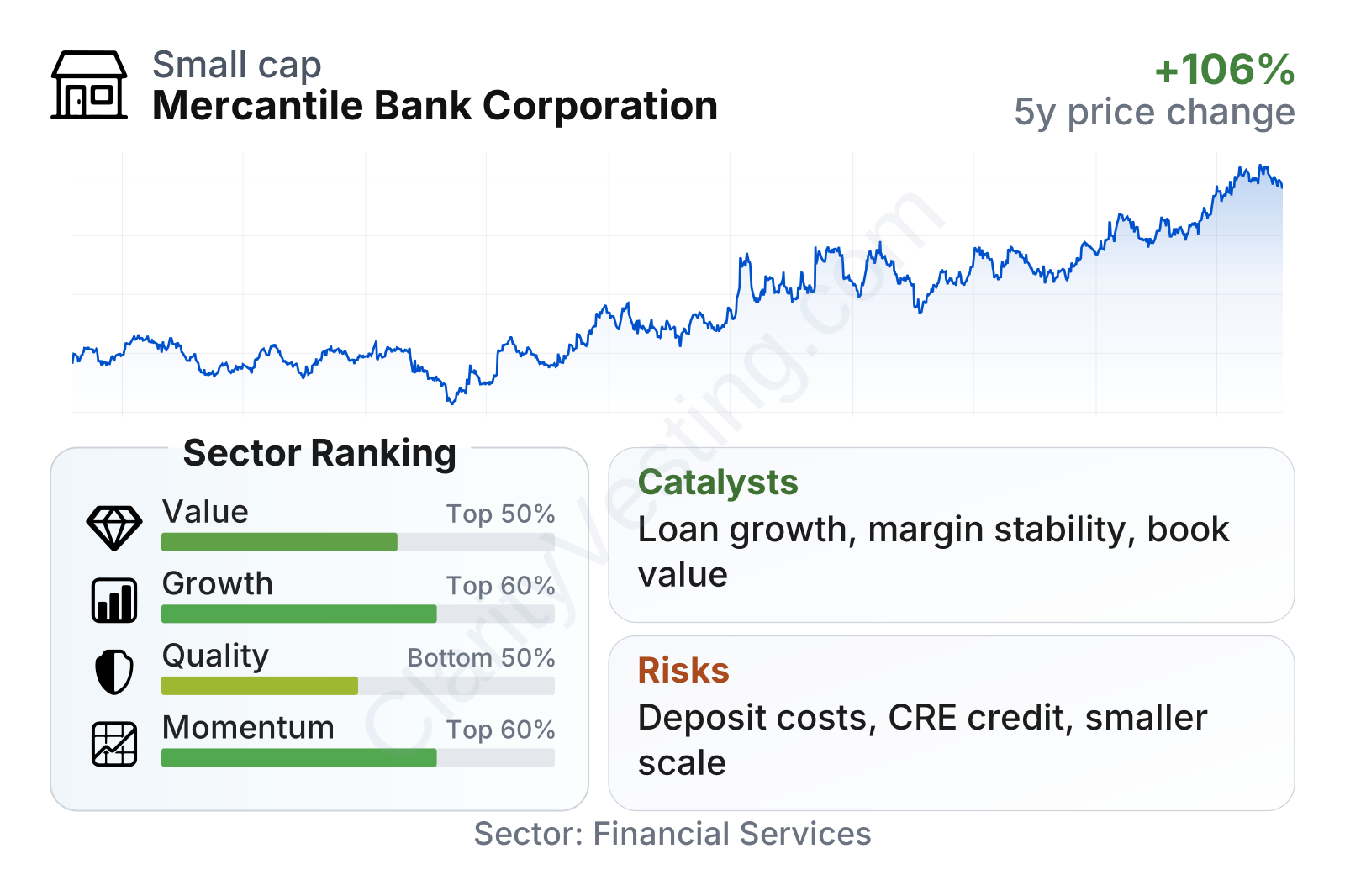
Mercantile sits in the smaller end of the public banking universe, with a market value around $1 billion, and its share price volatility has been lower than the market overall, as shown by a beta below 1. On valuation, the stock trades at an earnings multiple below the sector median, while its price-to-book ratio is modestly above the sector median. That combination suggests the market is recognizing a decent level of quality and profitability, but not assigning an aggressive earnings multiple.
The broader factor picture is fairly balanced. Value and quality rank around the upper half of the regional bank universe, growth is somewhat above average, and momentum has also been favorable. Revenue growth and book value growth stand out more positively than earnings growth over five years, which suggests the franchise has expanded and capital has built up, even if profit progression has not been perfectly smooth year to year.
Growth
Mercantile operates in regional banking, a mature sector rather than a fast-expanding one. That said, growth can still be attractive when a bank gains share in strong local markets, improves its deposit base, expands fee-generating services, and manages credit risk well. Mercantile’s strategy appears aligned with that model: commercial banking relationships, treasury management, disciplined lending, and steady expansion of its balance sheet rather than chasing speculative areas.
One encouraging sign is that revenue growth has recently outpaced the sector median, and over five years revenue per share growth has also been ahead of many peers. That points to a franchise that has been expanding in a tangible way, not just standing still in a slow industry.
Earnings per share have not moved in a straight line, but the overall pattern since 2021 shows resilience. After a softer period around 2022, earnings improved materially in 2023, stayed solid in 2024, and reached a higher level again in 2025. For long-term analysis, that matters more than any single quarter: the business has shown it can recover and compound earnings through changing rate conditions.
Book value per share is another useful measure for banks because it shows how shareholder equity is building over time. Here, Mercantile’s trend is notably constructive. Book value per share has advanced strongly over the last several years, and its five-year growth rate is well above the sector median. That usually signals retained earnings, balance sheet expansion, and a franchise that has been adding capital rather than eroding it.
The main industry catalyst remains interest rates and deposit behavior. If a bank can maintain healthy loan yields while keeping deposit costs under control, profitability can stay strong. A second catalyst is local commercial activity: if business formation, property development, and middle-market borrowing remain healthy in its footprint, Mercantile has room to keep growing loans and fee income. Company updates in 2026 have also continued to reflect regular dividend distributions and normal operating continuity rather than distress, which supports the view of a stable franchise still executing its core plan.
Risks
This article is for informational purposes only and does not constitute financial advice. Some content is AI-generated. See Disclaimer


