Stock Analysis · Maze Therapeutics Inc (MAZE)
Overview
Maze Therapeutics is a clinical-stage biotechnology company focused on medicines for kidney, cardiovascular, and metabolic diseases. Its model is based on using human genetics to identify biological pathways linked to disease and then designing precision medicines for patient groups most likely to benefit. In simple terms, the company is trying to improve drug development odds by starting with genetic evidence rather than broad trial-and-error research.
At this stage, Maze is not yet a commercial drug company. That matters because its economics look very different from established pharmaceutical businesses: revenue can be irregular, research spending is high, and the value of the business depends heavily on the progress of its drug pipeline and partnerships.
The company’s revenue sources have been highly concentrated and episodic rather than recurring. Based on recent filings, the mix has looked like this:
- Collaboration and license revenue: about 100% in years when revenue is recorded. This has come from partnership-related payments rather than product sales.
- Product revenue: 0%. Maze does not currently sell approved medicines.
- Other revenue: negligible based on available public filings.
A notable feature is that reported revenue dropped back to 0% of total revenue from products or recurring commercial operations after a partnership-driven revenue event in 2024. That makes current results less about ongoing sales and more about cash resources, research progress, and the likelihood of future milestone payments or successful clinical development.
The business profile shows how uneven biotech revenue can be. Maze posted a sharp revenue spike in 2024 tied to collaboration activity, while 2025 returned to a pre-revenue structure with research and development remaining the largest expense line. That pattern is common for emerging biotech companies, but it also means headline profitability from one year may not reflect the underlying earning power of the business.
Key Figures
| Metric | Value | Sector ⓘ |
|---|---|---|
| Date | Oct 03, 2026 | |
| Context | ||
| Sector | Healthcare | |
| Industry | Biotechnology | |
| Market Cap ⓘ | $1.51B | |
| Beta ⓘ | N/A | |
Value (Cheapness) | ||
| P/E Ratio ⓘ | N/A | 24.06 |
| P/B Ratio ⓘ | 3.47 | 3.08 |
| FCF Yield ⓘ | -7.08% | 3.07% |
| Dividend Yield ⓘ | N/A | 2.05% |
| EBIT / EV ⓘ | -10.91% | 0.63% |
| PEG ⓘ | N/A | |
Growth (Business expansion) | ||
| Revenue Growth ⓘ | N/A | 7.50% |
| RPS Growth (5Y CAGR) ⓘ | N/A | 8.70% |
| EPS Growth (5Y CAGR) ⓘ | -78.90% | -18.20% |
| BVPS Growth (5Y CAGR) ⓘ | 52.74% | 3.95% |
| Margin Growth (5Y Trend) ⓘ | N/A | -0.58% |
| FCF Growth (5Y CAGR) ⓘ | N/A | 0.88% |
| DPS Growth (5Y CAGR) ⓘ | N/A | 6.80% |
Quality (Business durability) | ||
| ROIC (Latest) ⓘ | -25.59% | 3.29% |
| ROA (Latest) ⓘ | -28.02% | 3.02% |
| ROIC (5Y Median) ⓘ | N/A | 4.75% |
| ROA (5Y Median) ⓘ | -41.12% | 1.93% |
| Net Debt / EBIT (Latest) ⓘ | N/A | 1.33 |
| Net Debt / EBIT (5Y Median) ⓘ | N/A | 1.83 |
| Net Debt / EBITDA (Latest) ⓘ | N/A | 0.99 |
| Net Debt / Assets ⓘ | -26.75% | 5.33% |
| EBITDA / Interest ⓘ | N/A | 9.63 |
| Operating Margin (Latest) ⓘ | -658.97% | 9.25% |
| Operating Margin (5Y Median) ⓘ | N/A | 7.80% |
| Debt to Equity (Latest) ⓘ | 13.33% | 28.99% |
| Profit Margin (Latest) ⓘ | N/A | 3.60% |
| Free Cash Flow (Latest) ⓘ | -$106.84M | |
Momentum (Price trend) | ||
| 3Y Return ⓘ | N/A | +37.48% |
| 12M Return (excl. last month) ⓘ | +83.09% | +20.85% |
| 6M Return ⓘ | -8.26% | +9.73% |
| Price vs. 200-Day MA ⓘ | -19.38% | +4.69% |
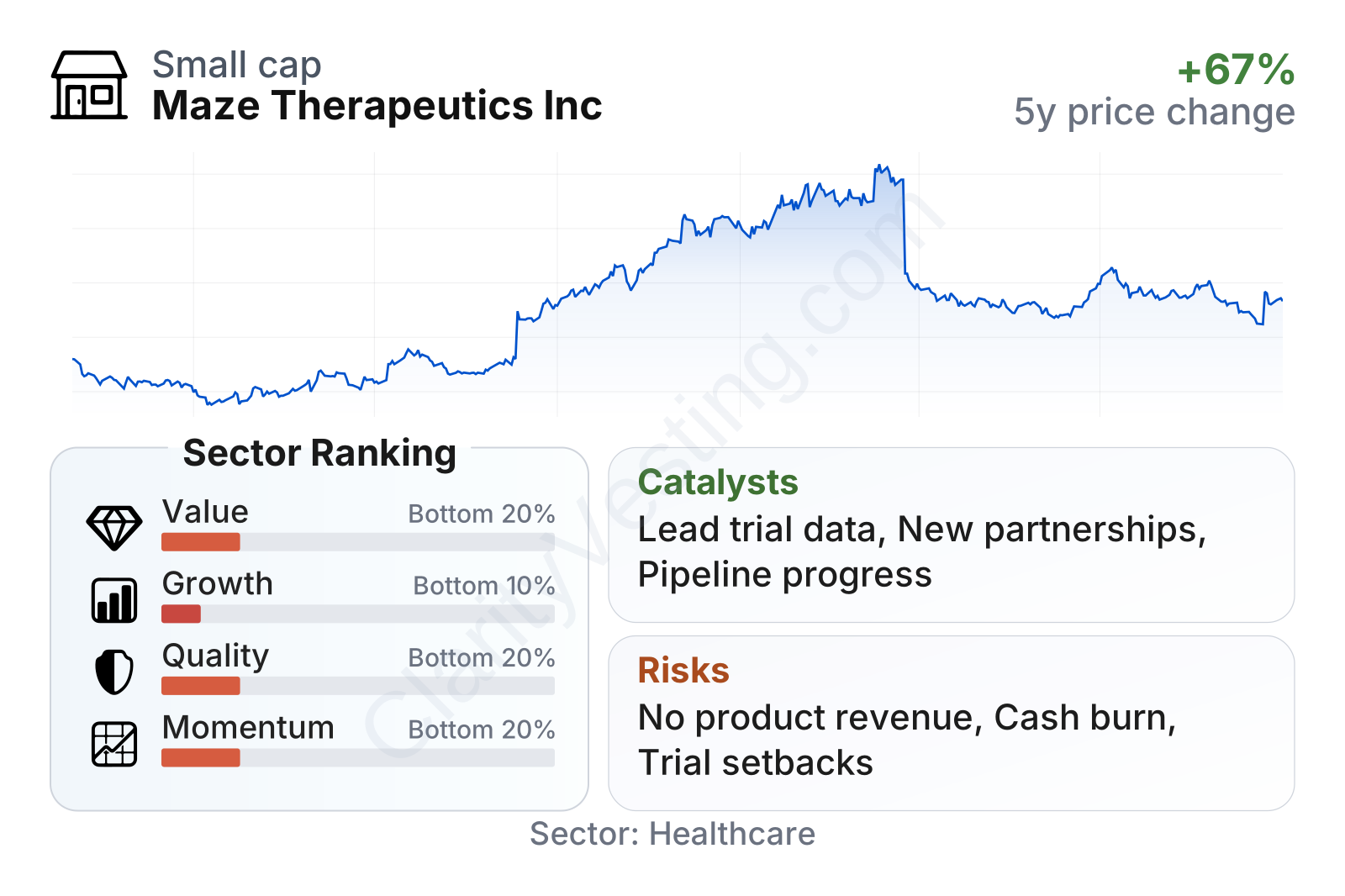
Maze is still in the phase where traditional valuation and profitability measures look weak relative to the broader healthcare sector. It ranks in the lower tier on value, growth, quality, and momentum, largely because it has no recurring revenue base, negative free cash flow, and deeply negative operating margins. At the same time, its balance sheet is less burdened by debt than many peers, which is an important stabilizer for a development-stage biotech company. The stock has also been volatile: it had a very strong run over a 12-month period before pulling back and trading below its longer-term average, a reminder that sentiment around clinical-stage biotech can shift quickly.
Growth
Maze operates in a part of healthcare that remains attractive over the long term. Precision medicine, genetics-led drug discovery, and targeted therapies continue to draw capital and partnership interest because large drugmakers want assets with clearer biological validation. Kidney and cardiometabolic diseases are also large markets with significant unmet need, so even a single successful program could materially change the company’s scale.
The core strategic logic is sensible. By selecting targets supported by human genetic data, Maze is trying to improve the probability that its drug candidates will matter clinically. For long-term business building, that is a stronger framework than simply pursuing crowded targets without a clear patient-selection approach. The challenge is timing: a sound scientific strategy does not automatically lead to near-term revenue, and clinical progress can take years.
Recent company communications have centered on advancing its lead programs and building out the broader pipeline. For a company like Maze, the strongest catalysts usually come from clinical trial starts, proof-of-concept data, regulatory milestones, and new partnership economics. A favorable readout in any lead program could have an outsized effect because the current business still reflects development-stage uncertainty rather than product-level cash generation.
Cash burn remains a defining feature. Free cash flow has stayed deeply negative and appears to have worsened into early 2026, which is normal for a company funding research without product sales, but it also means growth depends on either existing cash reserves, new partnerships, or future capital raising. In other words, Maze’s growth potential is real, but it is still largely scientific and strategic rather than financial at this point.
Risks
This article is for informational purposes only and does not constitute financial advice. Some content is AI-generated. See Disclaimer