Stock Analysis · Matson Inc (MATX)
Overview
Matson, Inc. is a U.S. ocean transportation and logistics company best known for moving containerized freight between the U.S. mainland, Hawaii, Alaska, Guam, and other Pacific markets. It also operates a premium expedited service linking China and the U.S. West Coast. In simple terms, Matson makes money by carrying goods by sea and by providing related logistics services such as transportation management, warehousing, and supply chain coordination.
The business is organized into two main segments, with Ocean Transportation clearly dominating results and Logistics providing a smaller but complementary contribution. Based on recent company reporting, revenue is approximately distributed as follows:
- Ocean Transportation: about 85% to 90% of revenue. This includes container shipping in Hawaii, Alaska, Guam, Micronesia, and China service, plus some tanker and terminal-related activities.
- Logistics: about 10% to 15% of revenue. This segment includes highway brokerage, rail intermodal, warehousing, freight forwarding, and supply chain services.
Within Ocean Transportation, the largest earnings driver is often not just volume but the mix of routes. Hawaii is the core domestic market, while the China service can have an outsized effect on profits because faster transit times can command premium rates when shippers need speed and reliability. That helps explain why Matson can sometimes earn much stronger margins than a typical shipping company, even though shipping is usually a cyclical industry.
The company’s revenue and profit profile also shows how exposed it is to freight conditions. Revenue surged during the pandemic-era shipping disruption, then normalized, and later stabilized at levels still above pre-boom years. Costs of revenue remain the largest outflow by far, which is normal for a shipping operator, but Matson has preserved solid operating profitability even after the extraordinary 2021-2022 period faded.
The long-term pattern is a business that experienced exceptional earnings in 2021 and 2022, then gave back part of that windfall as freight markets cooled, while still remaining profitable and operationally disciplined.
Key Figures
| Metric | Value | Sector ⓘ |
|---|---|---|
| Date | Oct 24, 2026 | |
| Context | ||
| Sector | Industrials | |
| Industry | Marine Shipping | |
| Market Cap ⓘ | $7.10B | |
| Beta ⓘ | 1.30 | |
Value (Cheapness) | ||
| P/E Ratio ⓘ | 15.96 | 22.29 |
| P/B Ratio ⓘ | 2.57 | 1.98 |
| FCF Yield ⓘ | 1.74% | 6.26% |
| Dividend Yield ⓘ | 0.62% | 1.92% |
| EBIT / EV ⓘ | 7.72% | 4.83% |
| PEG ⓘ | 2.01 | |
Growth (Business expansion) | ||
| Revenue Growth ⓘ | 16.70% | 9.30% |
| RPS Growth (5Y CAGR) ⓘ | 4.30% | 7.76% |
| EPS Growth (5Y CAGR) ⓘ | -32.51% | -13.17% |
| BVPS Growth (5Y CAGR) ⓘ | 23.13% | 6.13% |
| Margin Growth (5Y Trend) ⓘ | -13.95% | 0.74% |
| FCF Growth (5Y CAGR) ⓘ | -30.50% | 10.79% |
| DPS Growth (5Y CAGR) ⓘ | 7.97% | 9.41% |
Quality (Business durability) | ||
| ROIC (Latest) ⓘ | N/A | 10.75% |
| ROA (Latest) ⓘ | 9.96% | 5.41% |
| ROIC (5Y Median) ⓘ | 18.40% | 9.37% |
| ROA (5Y Median) ⓘ | 10.72% | 4.95% |
| Net Debt / EBIT (Latest) ⓘ | 1.07 | 2.04 |
| Net Debt / EBIT (5Y Median) ⓘ | 0.79 | 2.27 |
| Net Debt / EBITDA (Latest) ⓘ | 0.69 | 1.39 |
| Net Debt / Assets ⓘ | 12.67% | 19.27% |
| EBITDA / Interest ⓘ | 130.71 | 9.58 |
| Operating Margin (Latest) ⓘ | 16.14% | 10.49% |
| Operating Margin (5Y Median) ⓘ | 17.74% | 10.30% |
| Debt to Equity (Latest) ⓘ | 25.83% | 64.82% |
| Profit Margin (Latest) ⓘ | 13.41% | 6.67% |
| Free Cash Flow (Latest) ⓘ | $123.70M | |
Momentum (Price trend) | ||
| 3Y Return ⓘ | +178.94% | +67.77% |
| 12M Return (excl. last month) ⓘ | +128.33% | +12.05% |
| 6M Return ⓘ | +38.25% | 0.00% |
| Price vs. 200-Day MA ⓘ | +24.32% | +0.67% |
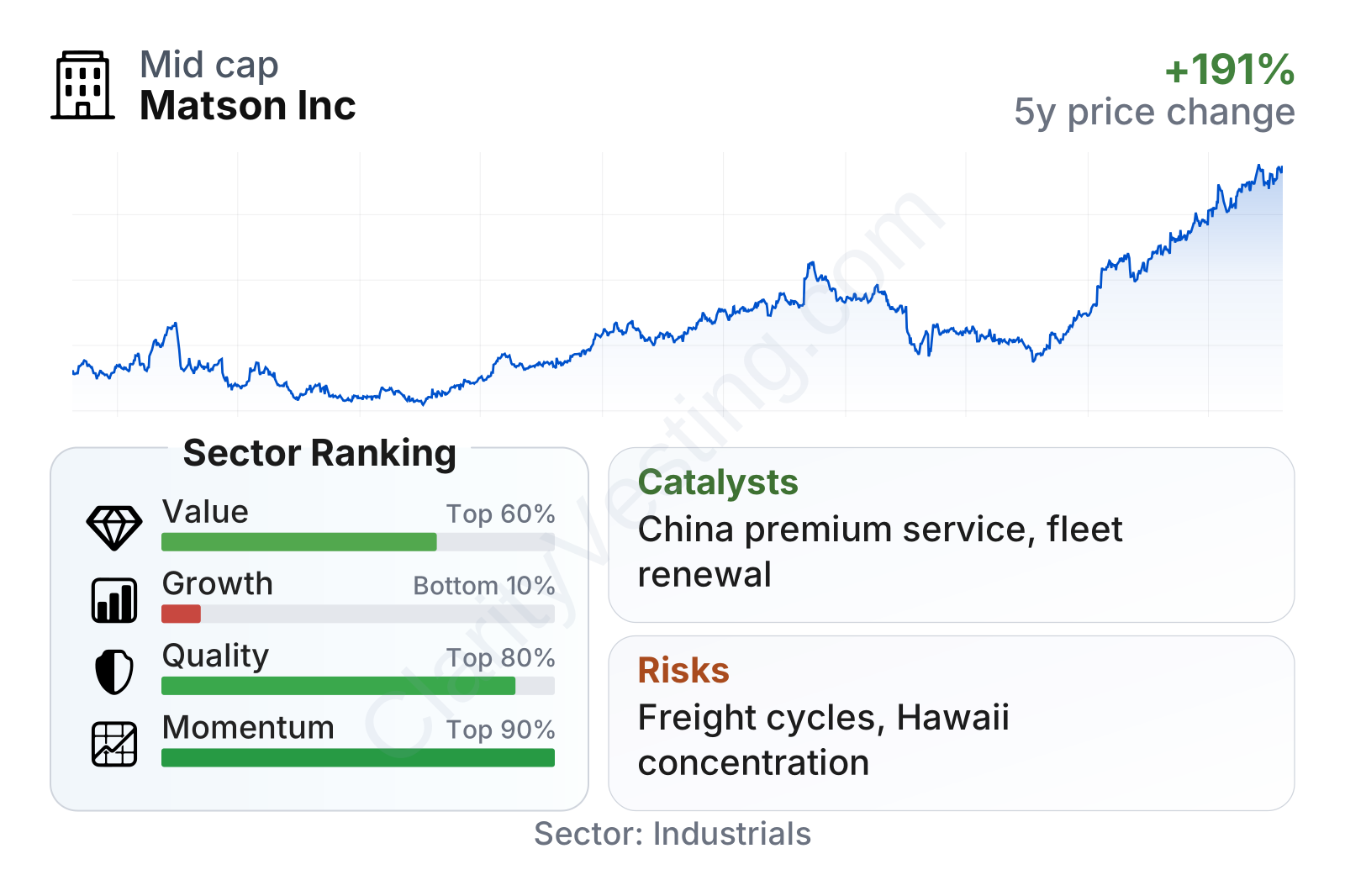
Matson stands out more for quality and market performance than for classic growth metrics. Profitability remains comfortably above sector medians, leverage is modest, and interest coverage is exceptionally strong. The weaker area is growth consistency: short-term revenue has improved, but five-year earnings and free cash flow trends still reflect the post-pandemic normalization from unusually high base levels.
The share price history has been volatile, which is typical for a shipping-related company, but the multi-year direction has been strong. Recent momentum is far ahead of the broader sector, showing that the market has rewarded Matson’s resilience, route mix, and disciplined capital structure.
Growth
Matson operates in a sector that is essential rather than structurally fast-growing. Shipping demand tends to follow trade flows, consumer goods volumes, inventory cycles, and economic activity. That means the company is not in a high-growth industry in the same way as software or semiconductors, but it does serve routes with durable demand. Hawaii, Alaska, and Guam are strategically important non-contiguous U.S. markets that depend heavily on ocean freight, giving Matson a steadier base than many global spot-market shipping operators.
Its strategy for future growth is centered on reliability, premium service, and protected market positions rather than scale at any cost. This makes sense for a long-term view. In domestic Jones Act trades, Matson benefits from barriers to entry because operators must use U.S.-built, U.S.-flagged, and U.S.-crewed vessels. In transpacific shipping, its expedited China service is differentiated by speed, which can matter for higher-value or time-sensitive cargo.
Revenue growth has been uneven over the last several years, which is normal in shipping. The latest year-over-year reading shows a rebound, but the bigger picture is a business moving through cycles rather than following a smooth upward path. That said, recent growth compares favorably with the sector median, suggesting Matson has been recovering better than many industrial peers.
Cash generation has also been cyclical. Free cash flow remains positive, but it is far below the extraordinary levels reached during the freight boom. This does not necessarily signal deterioration on its own; it mainly reflects normalization and capital spending needs. What matters more is that Matson has continued to generate enough cash to support dividends, vessel investment, and balance sheet flexibility.
One meaningful catalyst is fleet renewal. Matson has been investing in newer vessels, including the Aloha Class and Kanaloa Class programs, which can improve fuel efficiency, service quality, and regulatory compliance over time. Another catalyst is any period of supply chain disruption or tighter capacity in Pacific lanes, since Matson’s premium service can become more valuable when speed and schedule integrity matter most.
Recent company updates have also pointed to continued strength in its China service and relatively resilient domestic demand in Hawaii. Those are important signals because they support the idea that Matson is not relying only on one temporary windfall; it still has business lines with differentiated demand drivers.
Risks
This article is for informational purposes only and does not constitute financial advice. Some content is AI-generated. See Disclaimer


