Stock Analysis · Atlas Arteria Limited (MAQAF)
Overview
Atlas Arteria Limited is an infrastructure owner and operator focused on toll roads. Rather than manufacturing products or selling consumer services, it owns stakes in long-life transportation assets that generate cash when drivers use them. Its portfolio is concentrated in developed markets and includes major road concessions in France, Germany, and the United States. The business model is generally built around traffic volumes, contracted concession rights, and in some cases inflation-linked toll pricing, which can make revenue more predictable than in many other industrial businesses.
The company’s economic exposure is heavily concentrated in a small number of toll road assets. Based on recent company reporting, the main sources of value and cash generation are approximately:
- APRR and ADELAC in France: about 65% to 75% of portfolio value. These are mature motorway concessions with large traffic bases and regulated toll frameworks.
- Dulles Greenway in the United States: about 15% to 25%. This is a toll road in Virginia with traffic linked to regional commuting and local economic activity.
- Warnow Tunnel in Germany: about 5% to 10%. This is a smaller asset and contributes far less than the French roads.
- Corporate and other items: typically a small residual portion, including holding company costs and balance sheet items.
At the reported earnings level, accounting revenue can look unusual because Atlas Arteria uses equity-accounted investments for major assets. In practice, what matters most is the cash distributions it receives from those toll road holdings, especially the French network, which remains the core engine of the group.
The business has shown a clear long-term pattern of rising revenue and strong bottom-line contributions from its portfolio, although reported operating figures can swing because of accounting treatment, asset-level financing, and one-off items. Interest expense remains a meaningful cost, which is typical for infrastructure companies that use debt to fund long-duration assets.
The broad trend is that cash generation has remained solid even while reported operating line items have been uneven. That is common for listed infrastructure owners: the most useful lens is often distributions, debt servicing capacity, and concession life rather than simple sales growth alone.
Key Figures
| Metric | Value | Sector ⓘ |
|---|---|---|
| Date | Oct 24, 2026 | |
| Context | ||
| Sector | Industrials | |
| Industry | Infrastructure Operations | |
| Market Cap ⓘ | $3.84B | |
| Beta ⓘ | 0.55 | |
Value (Cheapness) | ||
| P/E Ratio ⓘ | 52.80 | 22.29 |
| P/B Ratio ⓘ | 0.73 | 1.98 |
| FCF Yield ⓘ | 18.19% | 6.26% |
| Dividend Yield ⓘ | 6.78% | 1.92% |
| EBIT / EV ⓘ | N/A | 4.83% |
| PEG ⓘ | N/A | |
Growth (Business expansion) | ||
| Revenue Growth ⓘ | -4.10% | 9.30% |
| RPS Growth (5Y CAGR) ⓘ | 12.27% | 7.76% |
| EPS Growth (5Y CAGR) ⓘ | -55.54% | -13.17% |
| BVPS Growth (5Y CAGR) ⓘ | -2.99% | 6.13% |
| Margin Growth (5Y Trend) ⓘ | 19.96% | 0.74% |
| FCF Growth (5Y CAGR) ⓘ | N/A | 10.79% |
| DPS Growth (5Y CAGR) ⓘ | 20.65% | 9.41% |
Quality (Business durability) | ||
| ROIC (Latest) ⓘ | N/A | 10.75% |
| ROA (Latest) ⓘ | 7.77% | 5.41% |
| ROIC (5Y Median) ⓘ | 2.41% | 9.37% |
| ROA (5Y Median) ⓘ | 3.94% | 4.95% |
| Net Debt / EBIT (Latest) ⓘ | 4.29 | 2.04 |
| Net Debt / EBIT (5Y Median) ⓘ | N/A | 2.27 |
| Net Debt / EBITDA (Latest) ⓘ | 3.00 | 1.39 |
| Net Debt / Assets ⓘ | 19.57% | 19.27% |
| EBITDA / Interest ⓘ | 2.69 | 9.58 |
| Operating Margin (Latest) ⓘ | 104.77% | 10.49% |
| Operating Margin (5Y Median) ⓘ | 257.45% | 10.30% |
| Debt to Equity (Latest) ⓘ | 30.78% | 64.82% |
| Profit Margin (Latest) ⓘ | 171.37% | 6.67% |
| Free Cash Flow (Latest) ⓘ | $698.14M | |
Momentum (Price trend) | ||
| 3Y Return ⓘ | -1.96% | +67.77% |
| 12M Return (excl. last month) ⓘ | +12.49% | +12.05% |
| 6M Return ⓘ | -10.77% | 0.00% |
| Price vs. 200-Day MA ⓘ | -9.32% | +0.67% |
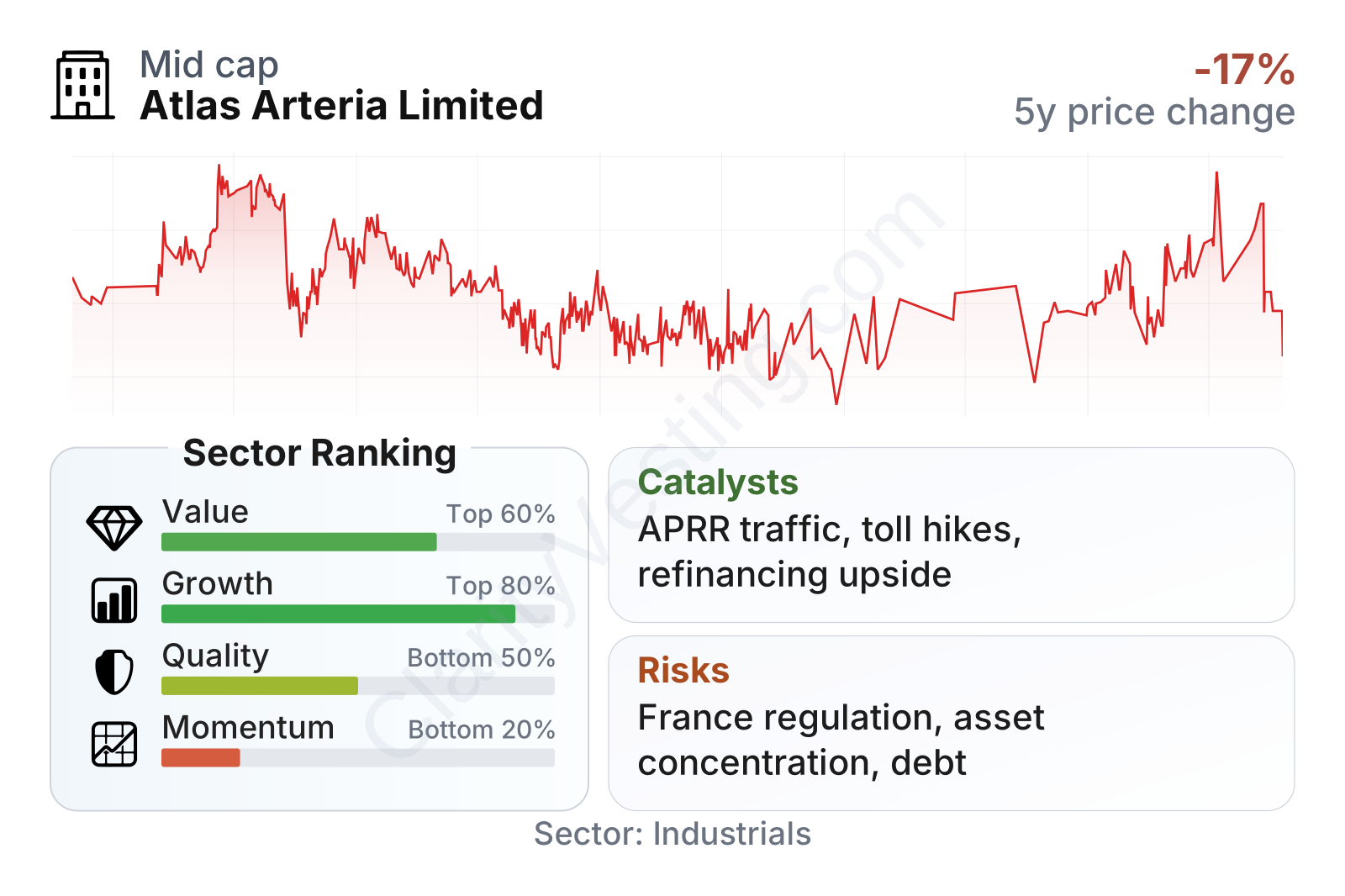
Atlas Arteria sits in the mid-cap range and has shown relatively low share-price volatility, with a beta around 0.5. The table points to a mixed profile: income and cash generation look strong relative to the sector, but leverage and interest coverage are weaker than many peers. Free cash flow yield and dividend yield stand well above sector medians, which fits the company’s infrastructure profile. Growth is less straightforward: the latest year showed a revenue decline of roughly 4%, but the five-year trend in revenue per share and dividends has been stronger than the sector. Share-price momentum has been modest, reflecting a business that the market appears to treat more as a cash-generating asset owner than a fast-expanding industrial operator.
The stock history also shows that the shares have moved within a fairly narrow band over several years. That fits the underlying business: stable assets, visible cash flows, and fewer dramatic growth re-ratings than sectors driven by technology or cyclical demand.
Growth
Atlas Arteria operates in a sector that benefits from long-term structural support. Roads remain essential infrastructure, and toll roads in particular can benefit from population growth, freight movement, commuting patterns, and inflation-linked tariff mechanisms. This is not a high-growth industry in the traditional sense, but it can deliver gradual expansion in cash flow when traffic rises and toll rates reset upward.
The company’s strategy is coherent for that environment. It focuses on scarce, hard-to-replicate assets with regulated or concession-based economics. That can support long asset lives and reasonable visibility on future cash generation. In Atlas Arteria’s case, the strongest growth lever is still its French motorway exposure, where toll increases and sustained traffic demand can lift distributions even without large capital expansion.
One important catalyst is the continued normalization and growth of traffic on key roads after earlier disruptions from inflation shocks and changing mobility patterns. Another is the company’s ability to recycle or optimize capital at the holding-company level while maintaining distributions from its core assets. If financing conditions become more favorable over time, that could also improve equity value because infrastructure businesses are sensitive to interest costs and discount rates.
Recent company updates have also kept attention on concession frameworks, refinancing activity, and asset-level performance rather than transformative acquisitions. That matters because Atlas Arteria’s future is likely to come more from maximizing existing assets than from aggressive dealmaking. For long-term analysis, that can be a positive feature: it reduces execution risk, but it also means growth is likely to be steady rather than explosive.
Risks
This article is for informational purposes only and does not constitute financial advice. Some content is AI-generated. See Disclaimer


