Stock Analysis · ManpowerGroup Inc (MAN)
Overview
ManpowerGroup is a global staffing and workforce solutions company. In simple terms, it helps businesses find workers, place them in temporary or permanent jobs, manage recruitment processes, and provide talent-related services such as outsourcing and career transition support. The company operates through well-known brands including Manpower, Experis, and Talent Solutions, and its business is spread across North America, Southern Europe, Northern Europe, and Asia Pacific, Middle East, and other markets.
Its revenue mainly comes from placing people into jobs and charging client companies for those services. Based on the company’s recent annual reporting structure, the main sources of revenue are approximately:
- Staffing Intermediary Services via Manpower: about 65% to 70% of revenue. This is the traditional temporary staffing business, where companies hire workers through ManpowerGroup for office, industrial, and other operational roles.
- Professional Resourcing and Project-Based Work via Experis: about 15% to 20% of revenue. This unit focuses on higher-skilled talent, especially information technology, engineering, and finance-related roles.
- Talent Solutions: about 15% to 20% of revenue. This includes recruitment process outsourcing, managed service provider programs, career management, assessment, and other human capital solutions.
The business model naturally produces very large revenue but relatively thin margins because much of the revenue is passed through as wages and related costs for placed workers. Over the last several years, revenue has drifted down from above $20 billion in 2021 to just under $18 billion in 2024, while operating profit has been much more volatile. That pattern matters because even small shifts in demand or pricing can have an outsized effect on earnings.
The cost structure shows the basic economics clearly: most revenue is absorbed by direct labor costs, and another large share goes to selling and administrative expenses. Gross profit has remained substantial in absolute dollars, but the drop in operating income and net income over the last few years shows how sensitive the company is to weaker hiring activity and higher financing costs.
Key Figures
| Metric | Value | Sector ⓘ |
|---|---|---|
| Date | Oct 19, 2026 | |
| Context | ||
| Sector | Industrials | |
| Industry | Staffing & Employment Services | |
| Market Cap ⓘ | $1.93B | |
| Beta ⓘ | 0.67 | |
Value (Cheapness) | ||
| P/E Ratio ⓘ | 16.40 | 22.10 |
| P/B Ratio ⓘ | 0.93 | 1.97 |
| FCF Yield ⓘ | 7.48% | 6.42% |
| Dividend Yield ⓘ | 3.29% | 1.94% |
| EBIT / EV ⓘ | 9.38% | 4.79% |
| PEG ⓘ | 0.94 | |
Growth (Business expansion) | ||
| Revenue Growth ⓘ | 4.40% | 9.30% |
| RPS Growth (5Y CAGR) ⓘ | 0.74% | 7.81% |
| EPS Growth (5Y CAGR) ⓘ | -27.78% | -13.06% |
| BVPS Growth (5Y CAGR) ⓘ | -0.64% | 6.14% |
| Margin Growth (5Y Trend) ⓘ | -1.88% | 0.88% |
| FCF Growth (5Y CAGR) ⓘ | N/A | 11.01% |
| DPS Growth (5Y CAGR) ⓘ | -12.71% | 9.41% |
Quality (Business durability) | ||
| ROIC (Latest) ⓘ | 4.68% | 10.84% |
| ROA (Latest) ⓘ | 1.38% | 5.41% |
| ROIC (5Y Median) ⓘ | 6.22% | 9.38% |
| ROA (5Y Median) ⓘ | 1.70% | 4.95% |
| Net Debt / EBIT (Latest) ⓘ | 3.35 | 2.08 |
| Net Debt / EBIT (5Y Median) ⓘ | 2.08 | 2.27 |
| Net Debt / EBITDA (Latest) ⓘ | 2.73 | 1.40 |
| Net Debt / Assets ⓘ | 14.88% | 19.29% |
| EBITDA / Interest ⓘ | 3.57 | 9.56 |
| Operating Margin (Latest) ⓘ | 1.94% | 10.50% |
| Operating Margin (5Y Median) ⓘ | 1.94% | 10.29% |
| Debt to Equity (Latest) ⓘ | 68.32% | 65.48% |
| Profit Margin (Latest) ⓘ | 0.64% | 6.67% |
| Free Cash Flow (Latest) ⓘ | $144.40M | |
Momentum (Price trend) | ||
| 3Y Return ⓘ | -35.50% | +61.68% |
| 12M Return (excl. last month) ⓘ | +58.83% | +12.58% |
| 6M Return ⓘ | +36.96% | 0.00% |
| Price vs. 200-Day MA ⓘ | +7.02% | 0.00% |
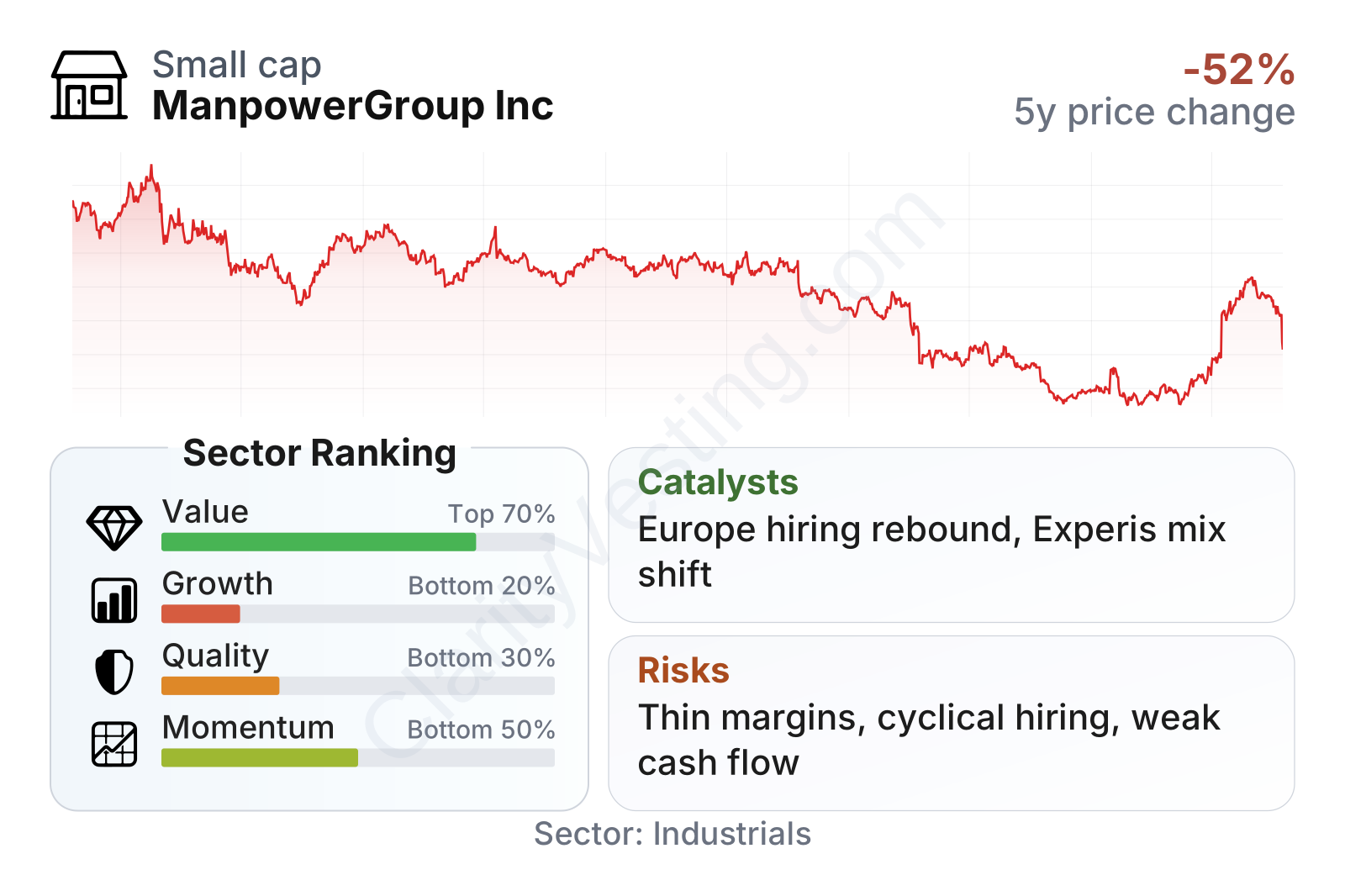
ManpowerGroup is a mid-sized public company with a beta below 1, which suggests its share price has been somewhat less volatile than the broader market. On valuation measures, it screens cheaper than the sector median on earnings and book value multiples, while its free cash flow yield and dividend yield are above typical sector levels. The weaker side of the table is growth and quality: revenue growth, returns on capital, margins, and earnings trends all rank below much of the sector. In other words, the stock looks inexpensive relative to peers, but that discount lines up with a business that has recently produced lower profitability and slower growth.
The share price history also reflects that tension. The stock fell sharply from 2022 into early 2026 before staging a strong rebound in mid-2026. That rebound points to improving expectations, but the longer view still shows how cyclical sentiment around the company can be.
Growth
ManpowerGroup operates in staffing and employment services, which is a real long-term market because companies increasingly want flexible hiring, specialized talent, outsourced recruitment, and better workforce planning. Within that broad market, the more attractive areas tend to be higher-skill staffing, IT talent, project-based solutions, and outsourced talent management rather than traditional general staffing alone. That makes the company’s strategy logical on paper: it has been trying to expand its mix toward Experis and Talent Solutions, which generally carry better strategic value than basic temporary staffing.
Even so, recent business momentum has been uneven. Revenue contracted for much of 2022 through 2025 before turning positive again in 2025 and strengthening in 2026.
The return to positive year-over-year growth in 2026 is an encouraging operational shift because it suggests hiring demand has improved after a prolonged weak period. The challenge is that growth rates remain modest compared with many industrial-sector peers, and the company still needs to show that renewed revenue expansion can translate into stronger earnings rather than only stabilizing sales.
Another important point for long-term analysis is cash generation.
Free cash flow has deteriorated sharply from healthy positive levels to negative territory over the last two years. For a staffing company, working capital swings can be meaningful, so one weak period does not automatically define the long-term picture. Still, weaker cash conversion reduces flexibility and raises the bar for management execution.
As for catalysts, the clearest one is a broader recovery in labor demand, especially in Europe where ManpowerGroup has major exposure. A second catalyst is mix improvement: if higher-value services such as Experis and Talent Solutions account for a larger share of revenue, margins could improve even without dramatic top-line growth. A third catalyst is operational discipline. The company has already reduced some expenses, and if hiring volumes recover at the same time, earnings can improve quickly because staffing businesses are highly sensitive to utilization and pricing.
Recent company communications in 2026 have pointed to stabilization and renewed growth in parts of the business, which helps explain the stock’s rebound. The key question is whether this marks the start of a durable cycle improvement or only a short recovery after a difficult period.
Risks
This article is for informational purposes only and does not constitute financial advice. Some content is AI-generated. See Disclaimer


