Stock Analysis · Mineral Resources Limited (MALRF)
Overview
Mineral Resources Limited is an Australian mining and mining-services company with a business model that is broader than a typical single-commodity producer. It develops and operates iron ore and lithium assets, and it also provides critical mining infrastructure and contract services such as crushing, processing, transport, and export logistics. That mix matters for long-term analysis because the company is exposed not only to commodity prices, but also to the physical systems that move material from mine to customer.
In practice, the company earns money from a combination of commodity production and services linked to mining operations. Based on recent company reporting, the revenue base is centered on iron ore, followed by mining services, with lithium contributing but remaining more volatile because of pricing swings and project timing. Approximate revenue mix can be summarized as follows:
- Iron ore – about 45% to 55%: sales from the company’s iron ore operations in Western Australia.
- Mining services – about 30% to 40%: crushing, processing, logistics, road haulage, and related infrastructure services provided to internal projects and external customers.
- Lithium – about 10% to 20%: spodumene and lithium-related operations, including exposure to joint ventures and downstream development plans.
This structure gives Mineral Resources more diversity than a pure iron ore or pure lithium operator, but the business is still heavily tied to the resources cycle. Over the last several years, revenue has expanded meaningfully, yet earnings have been much less stable because cost inflation, project spending, and weaker lithium conditions have weighed on profitability at different times.
The long-term picture shows a company that has grown sales strongly, with revenue rising from roughly A$3.7 billion in fiscal 2022 to more than A$6.4 billion in fiscal 2026. However, that growth has not flowed smoothly into profits. Operating income and net income fell sharply in fiscal 2023 through fiscal 2025 before rebounding in fiscal 2026, which highlights how sensitive results are to commodity prices, asset impairments, project timing, and financing costs.
Key Figures
| Metric | Value | Sector ⓘ |
|---|---|---|
| Date | Oct 24, 2026 | |
| Context | ||
| Sector | Basic Materials | |
| Industry | Other Industrial Metals & Mining | |
| Market Cap ⓘ | $9.03B | |
| Beta ⓘ | 1.11 | |
Value (Cheapness) | ||
| P/E Ratio ⓘ | 12.56 | 16.92 |
| P/B Ratio ⓘ | 2.35 | 1.66 |
| FCF Yield ⓘ | -19.16% | 5.83% |
| Dividend Yield ⓘ | 1.83% | 2.07% |
| EBIT / EV ⓘ | N/A | 6.38% |
| PEG ⓘ | N/A | |
Growth (Business expansion) | ||
| Revenue Growth ⓘ | 56.20% | 11.25% |
| RPS Growth (5Y CAGR) ⓘ | 13.16% | 4.49% |
| EPS Growth (5Y CAGR) ⓘ | 51.15% | -15.24% |
| BVPS Growth (5Y CAGR) ⓘ | 3.58% | 5.49% |
| Margin Growth (5Y Trend) ⓘ | -25.40% | -1.54% |
| FCF Growth (5Y CAGR) ⓘ | N/A | 0.37% |
| DPS Growth (5Y CAGR) ⓘ | -22.39% | 5.91% |
Quality (Business durability) | ||
| ROIC (Latest) ⓘ | N/A | 9.59% |
| ROA (Latest) ⓘ | 1.23% | 4.92% |
| ROIC (5Y Median) ⓘ | 6.36% | 7.91% |
| ROA (5Y Median) ⓘ | 3.00% | 3.92% |
| Net Debt / EBIT (Latest) ⓘ | 4.49 | 1.36 |
| Net Debt / EBIT (5Y Median) ⓘ | 2.91 | 1.69 |
| Net Debt / EBITDA (Latest) ⓘ | 1.29 | 0.93 |
| Net Debt / Assets ⓘ | 33.12% | 13.69% |
| EBITDA / Interest ⓘ | 4.49 | 12.38 |
| Operating Margin (Latest) ⓘ | 8.69% | 13.24% |
| Operating Margin (5Y Median) ⓘ | 12.20% | 11.82% |
| Debt to Equity (Latest) ⓘ | 134.28% | 40.30% |
| Profit Margin (Latest) ⓘ | 16.42% | 6.38% |
| Free Cash Flow (Latest) ⓘ | -$1.73B | |
Momentum (Price trend) | ||
| 3Y Return ⓘ | +15.45% | +73.47% |
| 12M Return (excl. last month) ⓘ | +103.77% | +27.59% |
| 6M Return ⓘ | +19.53% | -4.02% |
| Price vs. 200-Day MA ⓘ | +22.87% | -0.65% |
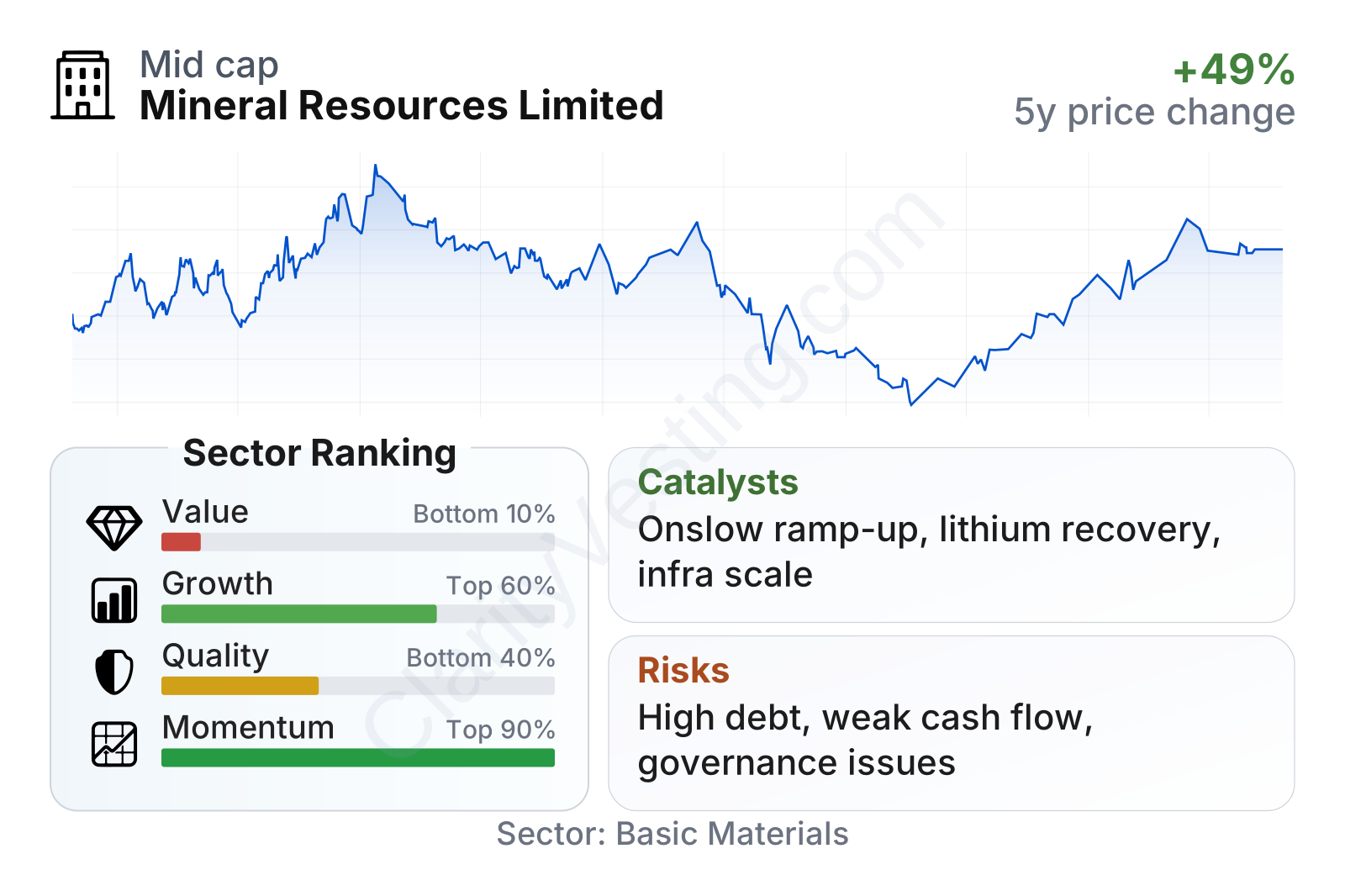
Mineral Resources sits in the large-cap range within its industry, and its share price has been volatile rather than steadily compounding. The stock is far below its 2023 peak, even after a strong rebound over the last year. In factor terms, the company currently looks weak on classic value measures, not because its earnings multiple is high, but because free cash flow is deeply negative and the balance sheet has become more stretched. Growth metrics are stronger, especially revenue and earnings growth over multi-year periods, while quality remains mixed due to leverage and pressure on returns on assets and capital.
Growth
Mineral Resources operates in two sectors that can support long-term expansion, but with very different risk profiles. Iron ore remains a mature but large market tied to steel demand and Chinese industrial activity. Lithium is structurally attractive because it is linked to batteries and electric vehicles, yet it has recently been one of the most cyclical parts of the mining market. That means the company is exposed to a commodity with strong long-run relevance, but also severe short-term price swings.
The company’s broader strategy is logically built around integration. Instead of only digging ore out of the ground, it also invests in crushing capacity, haul roads, ports, and energy and transport systems. That can create better control over costs and schedules, and it can make new projects more valuable if the infrastructure can support multiple mines over time. This is one of the main reasons Mineral Resources has often been viewed as more than a standard miner.
Recent growth metrics look strong on the surface. Revenue growth over the last year is well above the sector median, and five-year growth in revenue per share and earnings per share is also ahead of many peers. Still, that should be read carefully: fast top-line growth does not automatically mean strong shareholder economics when margins are under pressure and capital spending is elevated.
That tension is most visible in cash flow. The company is currently generating negative trailing free cash flow, reflecting heavy spending on expansion projects and infrastructure. If these projects ramp successfully, that spending could support a much larger operating base in future years. The most important catalysts are therefore operational rather than purely financial: successful ramp-up of major iron ore developments, stabilization or recovery in lithium prices, and improved use of the company’s integrated logistics network.
Recent company updates also point to asset reshaping and operational changes designed to improve performance and funding flexibility. For a business like Mineral Resources, those developments matter because even modest changes in realized commodity prices, shipping efficiency, or project execution can move earnings sharply.
Risks
This article is for informational purposes only and does not constitute financial advice. Some content is AI-generated. See Disclaimer


