Stock Analysis · Macerich Company (MAC)
Overview
Macerich Company is a real estate investment trust, or REIT, focused on owning, operating, and redeveloping large shopping centers in the United States. Its portfolio is centered on high-sales malls and mixed-use retail properties located mainly in dense and higher-income markets. In simple terms, Macerich makes money by controlling retail destinations where stores, restaurants, entertainment venues, and other tenants pay to use space.
The business is still primarily a landlord model, but management has also been working to improve value through redevelopment, re-leasing, and adding uses beyond traditional retail. That includes restaurants, fitness, entertainment, office, residential, hotel, and other mixed-use components around its properties where local conditions support that approach.
Based on the company’s filings, Macerich’s revenue is mainly generated from property operations. The largest sources are:
- Minimum rents: typically the largest revenue stream, representing rent paid under long-term leases by tenants occupying mall and retail space.
- Tenant recoveries and other property revenues: reimbursements for common area maintenance, utilities, security, real estate taxes, and other operating costs, plus parking, specialty leasing, and miscellaneous property income.
- Percentage rents: additional rent tied to tenant sales above specified thresholds, usually a smaller source than base rent.
- Management, leasing, and other fees: a smaller contribution from services and partnership-related arrangements where applicable.
- Gain on asset sales or financing-related items: these can affect results in certain periods, but they are not the core recurring source of revenue.
Revenue has moved gradually higher over the last several years, rising from roughly $850 million in 2021 to just above $1.0 billion in 2025. However, the flow from revenue to profit has been uneven, with interest expense remaining a major drag on bottom-line results. That means the company’s operating platform has shown resilience, but the balance sheet still heavily influences what shareholders ultimately see in earnings.
The broad pattern is encouraging on the top line, but much of that improvement has not translated cleanly into net income. The main reason is financing cost: interest expense has remained large relative to operating profit, which helps explain why accounting earnings have stayed under pressure even as revenue recovered.
Key Figures
| Metric | Value | Sector ⓘ |
|---|---|---|
| Date | Oct 17, 2026 | |
| Context | ||
| Sector | Real Estate | |
| Industry | REIT - Retail | |
| Market Cap ⓘ | $6.54B | |
| Beta ⓘ | 2.10 | |
Value (Cheapness) | ||
| P/E Ratio ⓘ | N/A | 17.38 |
| P/B Ratio ⓘ | 2.30 | 0.85 |
| FCF Yield ⓘ | 3.23% | 7.38% |
| Dividend Yield ⓘ | 3.02% | 4.85% |
| EBIT / EV ⓘ | 0.47% | 3.78% |
| PEG ⓘ | 4.80 | |
Growth (Business expansion) | ||
| Revenue Growth ⓘ | 1.20% | 5.30% |
| RPS Growth (5Y CAGR) ⓘ | -1.94% | 6.02% |
| EPS Growth (5Y CAGR) ⓘ | N/A | -11.37% |
| BVPS Growth (5Y CAGR) ⓘ | -11.97% | 0.45% |
| Margin Growth (5Y Trend) ⓘ | -21.58% | -0.22% |
| FCF Growth (5Y CAGR) ⓘ | 2.94% | 5.40% |
| DPS Growth (5Y CAGR) ⓘ | 0.32% | 5.02% |
Quality (Business durability) | ||
| ROIC (Latest) ⓘ | 0.85% | 5.69% |
| ROE (Latest) ⓘ | -6.55% | 7.56% |
| ROA (Latest) ⓘ | -2.00% | 2.85% |
| ROIC (5Y Median) ⓘ | 0.40% | 4.22% |
| ROE (5Y Median) ⓘ | -7.74% | 6.03% |
| ROA (5Y Median) ⓘ | -2.33% | 2.44% |
| Net Debt / EBIT (Latest) ⓘ | 88.98 | 7.59 |
| Net Debt / EBIT (5Y Median) ⓘ | 79.90 | 8.40 |
| Net Debt / EBITDA (Latest) ⓘ | 11.30 | 5.27 |
| Net Debt / Assets ⓘ | 54.21% | 37.76% |
| EBITDA / Interest ⓘ | 1.45 | 4.10 |
| Operating Margin (Latest) ⓘ | 5.15% | 35.29% |
| Operating Margin (5Y Median) ⓘ | 3.88% | 37.31% |
| Debt to Equity (Latest) ⓘ | 171.48% | 88.87% |
| Profit Margin (Latest) ⓘ | -16.50% | 19.61% |
| Free Cash Flow (Latest) ⓘ | $211.26M | |
Momentum (Price trend) | ||
| 3Y Return ⓘ | +135.76% | +30.75% |
| 12M Return (excl. last month) ⓘ | +27.73% | +4.36% |
| 6M Return ⓘ | +8.84% | -2.52% |
| Price vs. 200-Day MA ⓘ | +6.51% | -2.34% |
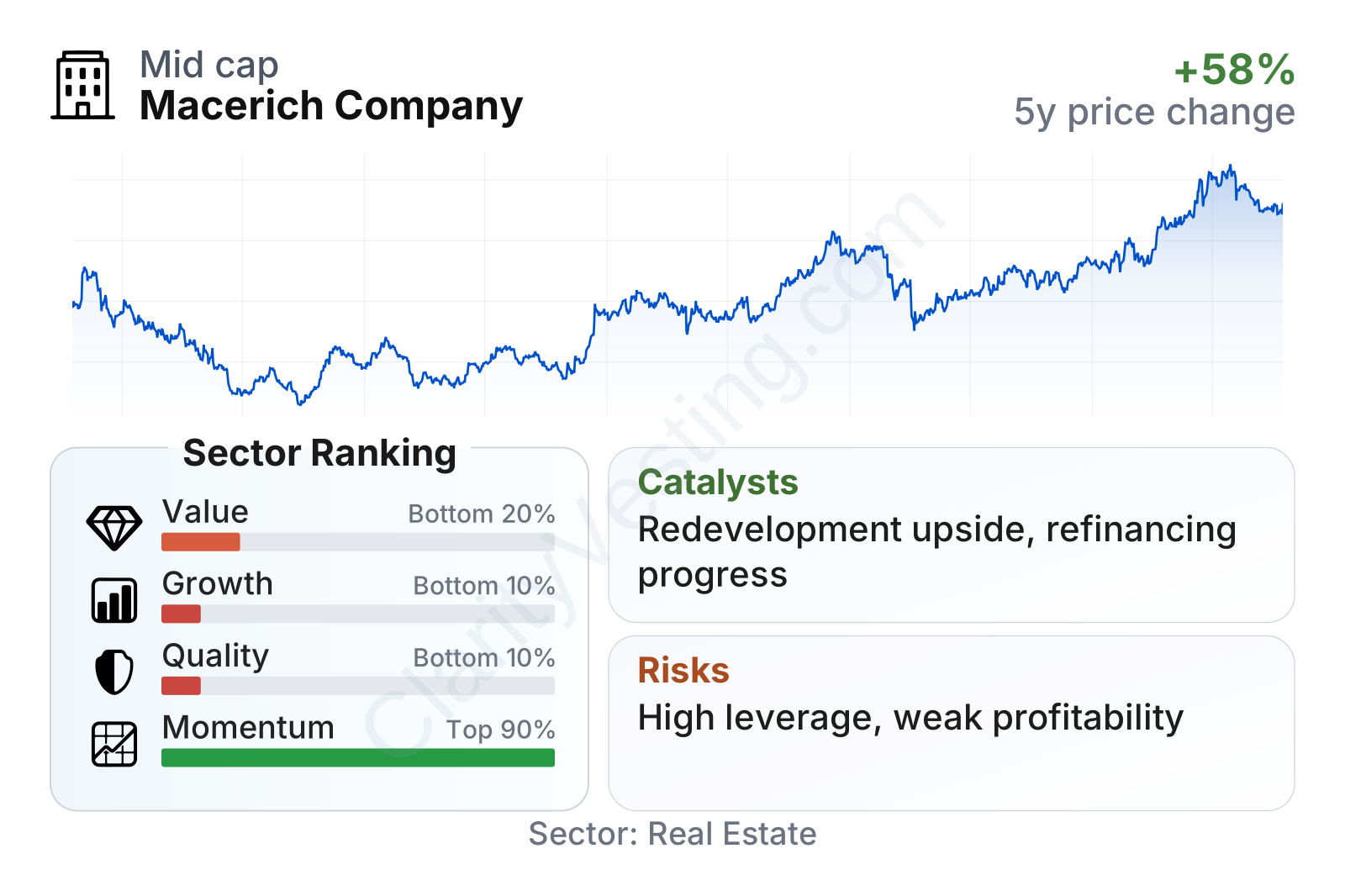
Macerich is a mid-sized public REIT with above-average stock volatility, as shown by a beta a little above 2. The factor profile is mixed: share-price momentum has been very strong, but value, growth, and quality metrics rank near the weaker end of the real estate sector. In other words, the market has recently become much more optimistic, while the underlying fundamentals still look challenged compared with many peers.
The stock’s multi-year rebound has been dramatic after a deep decline in 2022. That recovery suggests the market is increasingly pricing in stabilization in mall operations and a better outlook for refinancing pressure, rather than rewarding current profitability alone.
Growth
Macerich operates in a part of real estate that has looked structurally difficult for years, because brick-and-mortar retail has had to adapt to e-commerce and changing consumer habits. Even so, the highest-quality malls have proven more durable than weaker shopping centers. The sector is no longer simply about store rent; stronger assets are becoming mixed-use destinations that combine shopping, food, entertainment, and services. That trend supports Macerich’s strategy because its portfolio is concentrated in higher-productivity properties where redevelopment can potentially create more value than in lower-tier retail real estate.
The company’s long-term growth case depends less on opening many new properties and more on extracting higher income from existing assets. That includes replacing weaker tenants, signing leases at better economics, adding non-retail uses, and redeveloping vacant or underused spaces. This is a sensible strategy for a mature REIT, especially one that owns irreplaceable land in major metro areas.
Revenue per share has been uneven rather than steadily compounding. That matters because total revenue growth alone can be misleading when a company also faces dilution, asset sales, or financing pressures. The recent pattern points more to stabilization than to a strong growth engine.
The dividend has also been variable over the last five years. There has been some recovery from prior cuts, but the payout has not returned to a smooth upward path. For a REIT, that is an important signal: cash generation exists, yet management still appears to be balancing shareholder distributions against debt reduction, property investment, and refinancing needs.
A major catalyst for future improvement is the continued normalization of mall leasing and tenant demand at top properties. If occupancy, tenant sales, and rent spreads continue to improve, even modest operating gains can have a meaningful effect because these assets are already built and located in supply-constrained markets. Another possible catalyst is redevelopment execution: converting excess land or older space into mixed-use formats can lift traffic, diversify income, and potentially improve property values over time.
Recent company communications have also emphasized balance sheet actions, refinancing, and capital allocation discipline. For Macerich, these are not side issues. If management can keep extending maturities and reduce funding pressure while maintaining property performance, that could materially improve the company’s financial flexibility.
Risks
This article is for informational purposes only and does not constitute financial advice. Some content is AI-generated. See Disclaimer


