Stock Analysis · Mastercard Inc (MA)
Overview
Mastercard is one of the world’s largest electronic payments companies. It does not mainly act as a lender like a traditional bank. Instead, it operates a global payment network that connects consumers, merchants, banks, governments, and businesses. When a cardholder makes a purchase with a Mastercard-branded card, Mastercard helps route the transaction, authorize it, clear it, and settle it between the financial institutions involved.
This business model is attractive because Mastercard benefits from the growth of digital payments without usually taking direct consumer credit risk on card balances. Its role is closer to that of a toll-road operator for payments: the more transactions move across its network, the more revenue it can generate.
Based on Mastercard’s recent annual reporting structure, revenue comes from five main sources:
- Domestic assessments: about 27% — fees based on the dollar volume of activity on cards and other payment products within the country where the transaction takes place.
- Cross-border volume fees: about 26% — fees earned when cardholders make purchases in a different country from the issuer. This is one of Mastercard’s most valuable categories because cross-border transactions typically carry higher yields.
- Transaction processing: about 24% — fees linked to the number of switched transactions routed through Mastercard’s network, including authorization, clearing, settlement, and related switching services.
- Value-added services and solutions: about 23% — services such as cybersecurity, fraud prevention, data analytics, consulting, loyalty, open banking, and account-to-account capabilities. This area has become increasingly important because it diversifies revenue beyond card spending.
- Other revenue: a very small share — smaller items that do not materially change the overall business mix.
The revenue mix matters because it shows a business that is not dependent on one single fee stream. Mastercard is still centered on payments volume, but its service layers around the network are becoming a larger part of the model and can support growth even when some payment categories temporarily slow.
The financial profile has strengthened over time. Revenue, operating income, and net income have all risen materially in recent years, while costs have grown more slowly than sales. That operating leverage helps explain why Mastercard remains one of the most profitable large companies in financial services.
Key Figures
Metric Value Sector ⓘ Date Oct 04, 2026 Context Sector Financial Services Industry Credit Services Market Cap ⓘ $483.79B Beta ⓘ 0.73 P/E Ratio ⓘ 30.39 12.60 P/B Ratio ⓘ 86.83 1.23 FCF Yield ⓘ 3.40% 10.15% Dividend Yield ⓘ 0.61% 2.96% EBIT / EV ⓘ 4.15% 7.77% PEG ⓘ 1.46 Revenue Growth ⓘ 14.10% 9.50% RPS Growth (5Y CAGR) ⓘ 17.43% 12.10% EPS Growth (5Y CAGR) ⓘ -2.62% -9.45% BVPS Growth (5Y CAGR) ⓘ 3.97% 5.01% Margin Growth (5Y Trend) ⓘ 1.99% -4.07% FCF Growth (5Y CAGR) ⓘ 18.25% 4.96% DPS Growth (5Y CAGR) ⓘ 14.74% 8.79% ROIC (Latest) ⓘ 61.55% 9.60% ROE (Latest) ⓘ 240.76% 13.84% ROA (Latest) ⓘ 29.30% 1.53% ROIC (5Y Median) ⓘ 54.35% 7.86% ROE (5Y Median) ⓘ 170.90% 12.20% ROA (5Y Median) ⓘ 27.58% 1.29% Net Debt / EBIT (Latest) ⓘ 0.64 0.91 Net Debt / EBIT (5Y Median) ⓘ 0.57 0.74 Net Debt / EBITDA (Latest) ⓘ 0.60 0.97 Operating Margin (Latest) ⓘ 59.63% 22.12% Operating Margin (5Y Median) ⓘ 56.63% 24.39% Debt to Equity (Latest) ⓘ 439.19% 60.37% Profit Margin (Latest) ⓘ 46.34% 26.62% Free Cash Flow (Latest) ⓘ $16.45B 3Y Return ⓘ +43.77% +89.55% 12M Return (excl. last month) ⓘ -0.01% +17.35% 6M Return ⓘ +12.30% +9.93% Price vs. 200-Day MA ⓘ +3.98% +3.73%
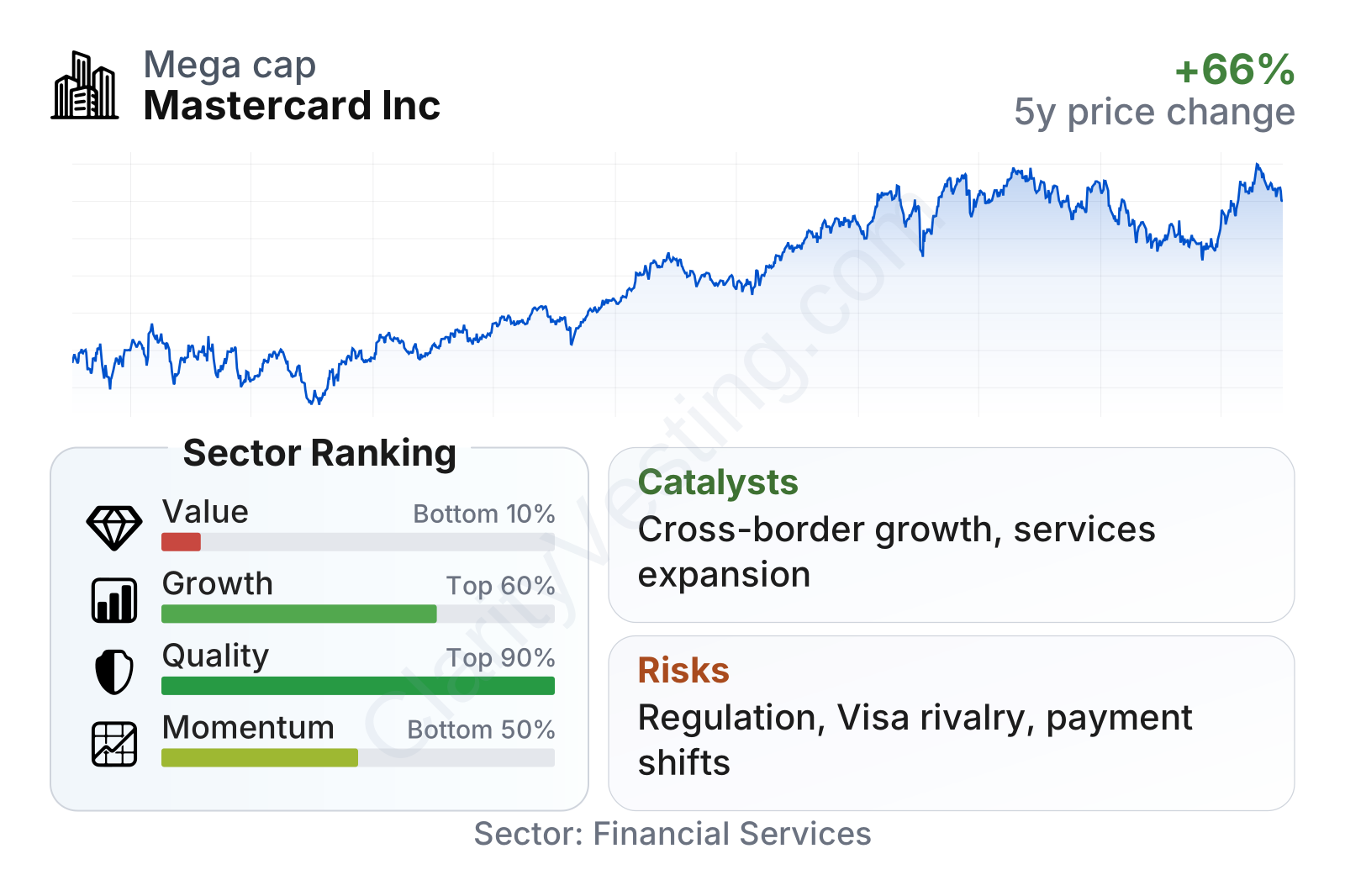
Mastercard is a very large company with relatively low share-price volatility, as shown by a beta below 1. The quality profile stands out the most: profitability, returns on capital, and margins are far above sector norms. Growth is also solid, with revenue and free cash flow expanding faster than many peers over the last five years. The weakest area is valuation, where the stock trades at clear premiums on earnings, book value, and cash flow measures versus the broader financial sector. Momentum has been mixed: the longer-term trend is positive, but shorter periods have been less impressive compared with the sector median.
Growth
Mastercard operates in a sector with durable structural tailwinds. Cash usage continues to decline in many economies, e-commerce keeps expanding, digital wallets still rely heavily on underlying card rails, and many countries remain underpenetrated in electronic payments. On top of that, more business-to-business payments, government disbursements, and real-time account-based transfers are moving into digital formats. That gives the company several paths to grow beyond traditional card swipes.
Its strategy is also coherent. Mastercard is not relying only on higher consumer spending. It is investing in services that sit around the transaction, including fraud detection, cybersecurity, analytics, identity, and open banking tools. Those businesses can deepen client relationships and are often less tied to day-to-day spending volumes than pure payment fees. The combination of network scale and value-added services creates a broader platform than the company had a decade ago.
Earnings per share have shown a strong upward trajectory over the past several years, reflecting both healthy revenue growth and very high margins. That trend suggests Mastercard has been able to convert payment volume growth into bottom-line expansion efficiently, even while continuing to invest in new capabilities.
Book value per share is a less useful measure for Mastercard than for a traditional bank because the company’s real strengths are its network, brand, software capabilities, and customer relationships rather than a large balance sheet of loans or physical assets. Even so, the longer-term direction shows that capital has continued to build despite ongoing share repurchases and shareholder distributions.
A major catalyst remains cross-border travel and commerce. Cross-border transactions are especially profitable, and continued normalization in international travel, together with growth in online purchases from foreign merchants, can support revenue growth faster than domestic spending alone. Another catalyst is commercial and government payment digitization, where checks and manual processes are still common. Mastercard also continues to expand account-to-account and open banking capabilities, which can help it capture payment flows that do not run through a card at all.
Recent company updates have also pointed to continued demand for value-added services and resilient switched transaction growth. That matters because it shows Mastercard is growing not only from consumer card spending, but also from a widening set of payment and software-like services.
Risks
This article is for informational purposes only and does not constitute financial advice. Some content is AI-generated. See Disclaimer


