Stock Analysis · LyondellBasell Industries NV (LYB)
Overview
LyondellBasell Industries NV is one of the world’s largest chemical companies. It makes plastics, chemicals, and refining products that are used in everyday items such as food packaging, automotive parts, medical supplies, pipes, construction materials, detergents, fuels, and industrial equipment. The company also licenses process technologies used by other chemical producers and has been expanding its recycling activities, especially mechanical and advanced recycling for plastic waste.
Its business is organized by operating segments rather than by consumer brands, which is typical for the chemical industry. Based on the company’s recent annual reporting structure, revenue is mainly generated from the following activities:
- Olefins and Polyolefins – Americas: about 35% to 40% of revenue. This includes polyethylene and polypropylene resins, plus olefins and co-products sold across North and Latin America.
- Olefins and Polyolefins – Europe, Asia, International: about 20% to 25% of revenue. This covers similar products outside the Americas, including packaging, consumer goods, and industrial applications.
- Intermediates and Derivatives: about 20% to 25% of revenue. This segment includes propylene oxide and derivatives, oxyfuels, and intermediates used in insulation, solvents, transportation fluids, and home products.
- Advanced Polymer Solutions: about 10% to 15% of revenue. This business supplies engineered compounds and specialized polymers used in cars, electronics, appliances, and infrastructure.
- Refining: about 5% to 10% of revenue. This is mainly fuels and refined products from its Houston refinery operations.
- Technology: usually below 5% of revenue. It earns licensing and services income from proprietary chemical production technologies and catalysts.
The overall picture is that LyondellBasell is a large-scale industrial materials producer whose earnings depend heavily on production volumes, raw material costs, and selling prices for commodity chemicals and plastics. Over the last several years, revenue has declined from the 2022 peak, while profitability has compressed much more sharply than sales, showing how sensitive the business is to industry cycles.
The long-term trend visible here is margin compression rather than just weaker sales. Revenue fell from the post-pandemic high, but operating income and net income dropped much faster, which suggests pricing pressure, weaker spreads, and a less favorable operating environment. Costs of goods remain the dominant outflow, a normal feature for a commodity chemicals producer.
Key Figures
| Metric | Value | Sector ⓘ |
|---|---|---|
| Date | Oct 17, 2026 | |
| Context | ||
| Sector | Basic Materials | |
| Industry | Specialty Chemicals | |
| Market Cap ⓘ | $19.39B | |
| Beta ⓘ | 0.35 | |
Value (Cheapness) | ||
| P/E Ratio ⓘ | N/A | 16.90 |
| P/B Ratio ⓘ | 1.87 | 1.65 |
| FCF Yield ⓘ | 17.83% | 5.76% |
| Dividend Yield ⓘ | 6.93% | 2.13% |
| EBIT / EV ⓘ | 1.50% | 6.30% |
| PEG ⓘ | 1.53 | |
Growth (Business expansion) | ||
| Revenue Growth ⓘ | 19.80% | 11.10% |
| RPS Growth (5Y CAGR) ⓘ | -9.28% | 4.49% |
| EPS Growth (5Y CAGR) ⓘ | -22.48% | -13.47% |
| BVPS Growth (5Y CAGR) ⓘ | -3.39% | 5.51% |
| Margin Growth (5Y Trend) ⓘ | -16.50% | -1.54% |
| FCF Growth (5Y CAGR) ⓘ | -49.13% | 0.37% |
| DPS Growth (5Y CAGR) ⓘ | 5.34% | 6.08% |
Quality (Business durability) | ||
| ROIC (Latest) ⓘ | 1.55% | 9.26% |
| ROA (Latest) ⓘ | -1.02% | 4.91% |
| ROIC (5Y Median) ⓘ | 10.45% | 7.70% |
| ROA (5Y Median) ⓘ | 5.76% | 3.86% |
| Net Debt / EBIT (Latest) ⓘ | 25.03 | 1.40 |
| Net Debt / EBIT (5Y Median) ⓘ | 2.64 | 1.70 |
| Net Debt / EBITDA (Latest) ⓘ | 6.14 | 0.95 |
| Net Debt / Assets ⓘ | 33.61% | 13.69% |
| EBITDA / Interest ⓘ | 3.84 | 12.34 |
| Operating Margin (Latest) ⓘ | 1.48% | 13.20% |
| Operating Margin (5Y Median) ⓘ | 7.55% | 11.80% |
| Debt to Equity (Latest) ⓘ | 133.26% | 40.56% |
| Profit Margin (Latest) ⓘ | -1.13% | 6.43% |
| Free Cash Flow (Latest) ⓘ | $3.46B | |
Momentum (Price trend) | ||
| 3Y Return ⓘ | -19.71% | +68.89% |
| 12M Return (excl. last month) ⓘ | +20.80% | +30.21% |
| 6M Return ⓘ | -14.75% | -4.16% |
| Price vs. 200-Day MA ⓘ | -0.86% | -1.27% |
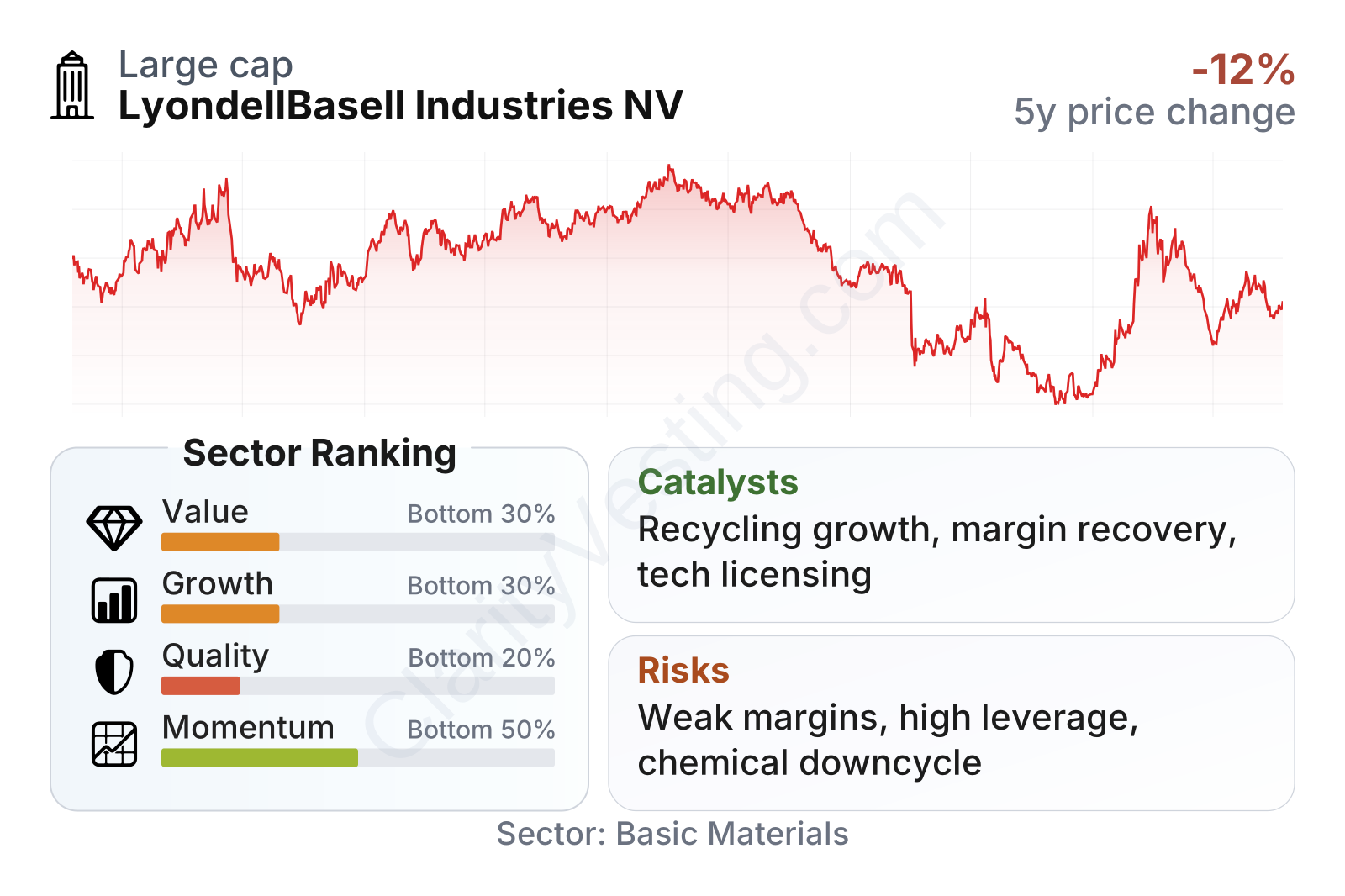
LyondellBasell remains a large company in its sector, but the current financial profile looks mixed. Income-oriented metrics stand out: free cash flow yield and dividend yield are both well above sector norms. At the same time, quality, growth, and momentum rank in the lower part of the sector. That combination usually points to a business that looks statistically inexpensive in some areas, but only because profits and market sentiment have weakened materially.
The stock’s historical pattern has also been volatile. After trading much higher in 2024, it dropped sharply through 2025, then rebounded in early 2026 before pulling back again. That kind of movement fits a cyclical company whose valuation changes quickly as the market reassesses demand, margins, and the timing of a recovery.
Growth
LyondellBasell operates in a sector with long-term underlying demand growth, but not always smooth growth. Plastics, packaging, mobility, construction, and industrial production tend to expand over time with population and economic activity. However, chemical producers often face periods of oversupply, especially when new global capacity comes online faster than demand. That means the sector can grow over the long run while individual years remain very difficult.
For future growth, the company’s strategy has a logical industrial basis. It is focusing on three areas that matter: improving the core chemical and polymer portfolio, expanding into higher-value and more specialized materials, and building circular economy exposure through recycling and technology. The technology segment is relatively small today, but it is attractive because licensing can be less capital-intensive than making commodity chemicals. Recycling is also strategically important because brand owners and regulators increasingly want recycled content in packaging and products.
Recent sales trends show how uneven the cycle has been. Revenue contracted for an extended period, then returned to positive year-over-year growth by mid-2026. That recovery is encouraging, but it follows a very weak base and does not by itself prove that earnings power has normalized. For LyondellBasell, volume recovery matters, but margin recovery matters even more.
Cash generation has held up better than accounting profits. Free cash flow weakened materially from 2022 levels, then improved again in 2026. That resilience is important because it gives the company room to keep investing in projects, maintain shareholder distributions, and manage debt even during a downcycle. In a capital-intensive industry, the ability to still produce billions of dollars in free cash flow during a weak earnings phase is a meaningful support for the business model.
A notable catalyst is the company’s push into circular and low-carbon solutions. LyondellBasell has been building mechanical recycling capacity and developing advanced recycling capabilities, while also using its technology business to serve third-party producers. Another catalyst is any improvement in global chemical spreads, especially if feedstock advantages in North America reassert themselves. If demand in packaging, automotive, and durable goods improves while industry capacity additions slow, earnings can recover much faster than revenue.
Recent company communications have also emphasized portfolio simplification, cost control, and disciplined capital allocation. In a cyclical business, these actions do not create demand on their own, but they can improve the earnings rebound when the cycle turns.
Risks
This article is for informational purposes only and does not constitute financial advice. Some content is AI-generated. See Disclaimer


