Stock Analysis · LXP Industrial Trust (LXP)
Overview
LXP Industrial Trust is a real estate investment trust focused on industrial properties in the United States. In simple terms, it owns logistics and warehouse buildings and earns money mainly by leasing those properties to tenants. The company has spent several years reshaping its portfolio away from older office exposure and toward single-tenant and selective multi-tenant industrial assets, with a clear emphasis on modern distribution facilities.
Its revenue is overwhelmingly tied to rental income from industrial real estate. Based on recent company filings, the business is best understood through a few core streams:
- Rental revenue from industrial properties: approximately 95%+. This is the recurring rent paid by tenants occupying warehouses, distribution centers, and other industrial buildings.
- Reimbursement and other tenant-related income: approximately 1% to 4%. This can include recoveries for property-level costs and other lease-related billings.
- Fee, interest, land sale, and other miscellaneous income: typically a low-single-share of total revenue. These items are not the core earnings engine and can vary from period to period.
The business model is straightforward: acquire or develop industrial properties, keep them occupied under long leases, collect rent, and use a mix of debt and equity to expand the portfolio. The appeal of that model depends heavily on occupancy, rent growth, tenant quality, financing costs, and management’s discipline in recycling capital.
The financial flow over the last few years shows a business with fairly stable revenue, but one where net income has been much more volatile because depreciation, property transactions, and financing costs can materially affect reported earnings. Interest expense has also become more important as rates moved higher, which matters for any property owner using leverage.
Key Figures
| Metric | Value | Sector ⓘ |
|---|---|---|
| Date | Oct 17, 2026 | |
| Context | ||
| Sector | Real Estate | |
| Industry | REIT - Industrial | |
| Market Cap ⓘ | $3.60B | |
| Beta ⓘ | 1.04 | |
Value (Cheapness) | ||
| P/E Ratio ⓘ | 60.43 | 17.38 |
| P/B Ratio ⓘ | 1.83 | 0.85 |
| FCF Yield ⓘ | 4.83% | 7.38% |
| Dividend Yield ⓘ | 4.55% | 4.85% |
| EBIT / EV ⓘ | 2.65% | 3.78% |
| PEG ⓘ | 3.15 | |
Growth (Business expansion) | ||
| Revenue Growth ⓘ | 0.40% | 5.30% |
| RPS Growth (5Y CAGR) ⓘ | 49.50% | 6.02% |
| EPS Growth (5Y CAGR) ⓘ | 1.71% | -11.37% |
| BVPS Growth (5Y CAGR) ⓘ | 45.83% | 0.45% |
| Margin Growth (5Y Trend) ⓘ | -75.26% | -0.22% |
| FCF Growth (5Y CAGR) ⓘ | -5.47% | 5.40% |
| DPS Growth (5Y CAGR) ⓘ | 58.31% | 5.02% |
Quality (Business durability) | ||
| ROIC (Latest) ⓘ | 3.62% | 5.69% |
| ROE (Latest) ⓘ | 3.09% | 7.56% |
| ROA (Latest) ⓘ | 1.81% | 2.85% |
| ROIC (5Y Median) ⓘ | 4.49% | 4.22% |
| ROE (5Y Median) ⓘ | 4.82% | 6.03% |
| ROA (5Y Median) ⓘ | 2.82% | 2.44% |
| Net Debt / EBIT (Latest) ⓘ | 10.37 | 7.59 |
| Net Debt / EBIT (5Y Median) ⓘ | 8.18 | 8.40 |
| Net Debt / EBITDA (Latest) ⓘ | 4.93 | 5.27 |
| Net Debt / Assets ⓘ | 39.24% | 37.76% |
| EBITDA / Interest ⓘ | 4.92 | 4.10 |
| Operating Margin (Latest) ⓘ | 37.69% | 35.29% |
| Operating Margin (5Y Median) ⓘ | 50.64% | 37.31% |
| Debt to Equity (Latest) ⓘ | 70.70% | 88.87% |
| Profit Margin (Latest) ⓘ | 18.66% | 19.61% |
| Free Cash Flow (Latest) ⓘ | $173.72M | |
Momentum (Price trend) | ||
| 3Y Return ⓘ | +69.98% | +30.75% |
| 12M Return (excl. last month) ⓘ | +42.92% | +4.36% |
| 6M Return ⓘ | +24.38% | -2.52% |
| Price vs. 200-Day MA ⓘ | +14.75% | -2.34% |
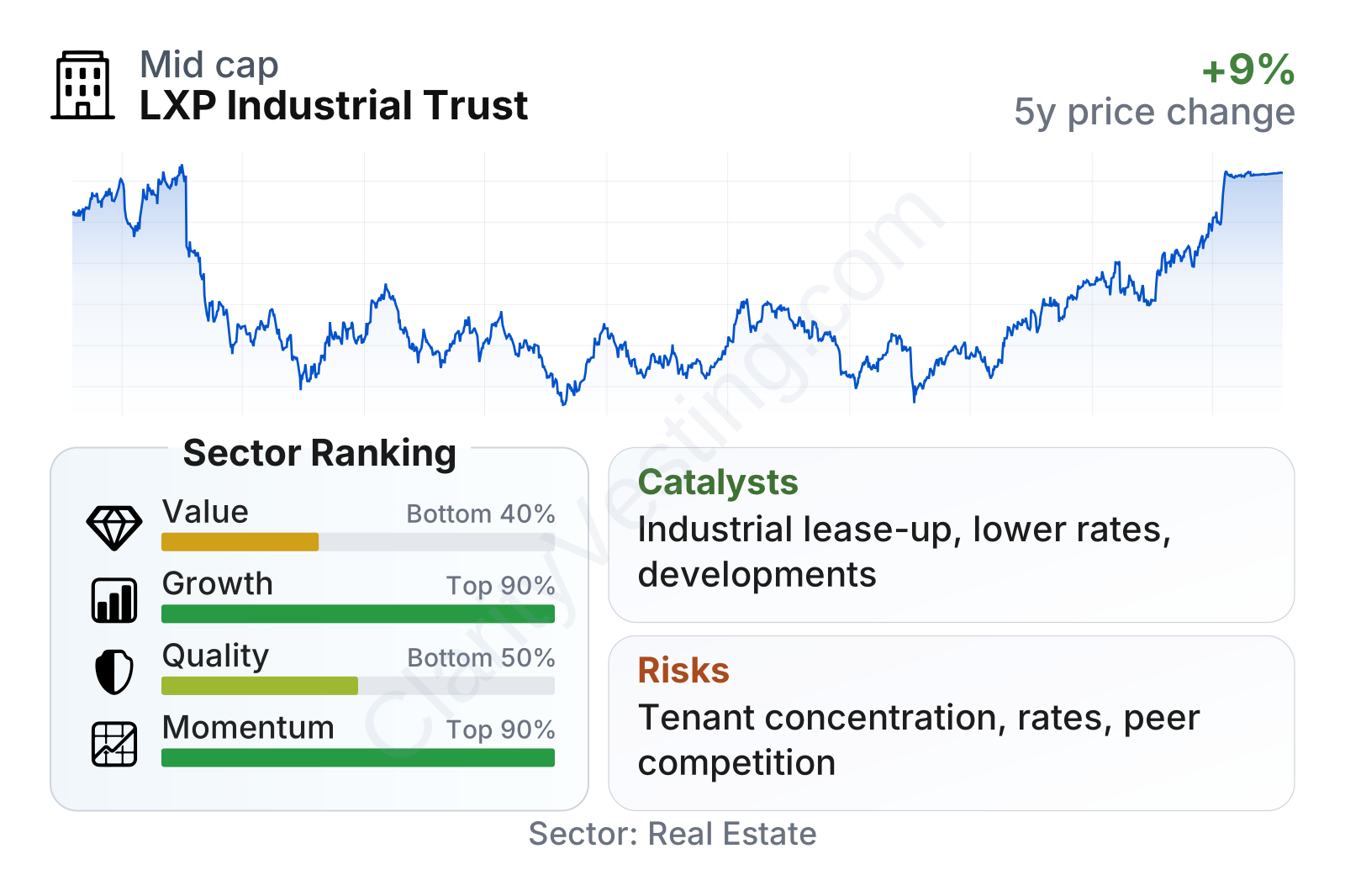
LXP is a mid-sized industrial REIT with a market value in the mid-single-digit billions of dollars and a stock volatility close to the broader market. The overall picture is mixed. Growth and market momentum rank strongly versus much of the real estate sector, while value and quality measures look less favorable. The company’s valuation multiples sit above sector medians, and its current dividend yield is close to the sector average rather than notably higher. Profitability remains positive, but returns on capital and assets are below many peers, which suggests the market is paying up more for portfolio positioning and industrial exposure than for exceptional operating efficiency.
The share price path has also been uneven rather than linear. After a sharp reset during the real estate downturn, the stock recovered strongly into 2026. That rebound suggests sentiment toward industrial REITs and toward LXP specifically has improved, but it also means part of the easy re-rating has likely already happened.
Growth
Industrial real estate remains one of the more attractive corners of the property market for long-term growth. Demand has been supported by e-commerce, supply-chain redesign, inventory repositioning, and the need for well-located distribution space near population centers and transport networks. Even though the sector is no longer in the exceptionally tight phase seen earlier in the cycle, the long-run drivers still look more favorable than in office and several other commercial property categories.
LXP’s strategy broadly fits that environment. Management has been simplifying the business around industrial assets and reducing exposure to less favored segments. That makes strategic sense because it gives the company a clearer identity, easier peer comparison, and a portfolio aligned with the part of commercial real estate that has shown the best structural demand over recent years.
Revenue per share has risen sharply over the past five years, reflecting both the portfolio transition and the income contribution from industrial assets. However, recent year-over-year revenue growth has been modest, so the company now appears to be in a phase where the portfolio is more established and incremental growth depends more on leasing spreads, development completions, acquisitions, and occupancy discipline than on dramatic repositioning.
The dividend profile has also changed meaningfully over time, with dividend per share much higher than it was several years ago. For a REIT, that matters because it signals that the company’s industrial focus has translated into more distributable cash flow capacity. The current yield is still around the sector norm, so the key point is not an unusually high payout, but the stronger base of recurring property income behind it.
A meaningful catalyst is LXP’s exposure to modern logistics real estate at a time when many occupiers still favor efficient, newer facilities. Another potential opportunity comes from development and lease-up activity: if newly developed or recently acquired properties stabilize at attractive rents, cash flow growth can outpace headline revenue growth. In addition, if interest rates ease or credit markets remain open, industrial REITs can benefit from lower financing pressure and stronger property values.
Recent company updates have continued to emphasize leasing activity, industrial portfolio management, and balance-sheet positioning rather than any radical change in direction. That is generally consistent with a REIT seeking durable long-term compounding through disciplined execution rather than through highly speculative expansion.
Risks
This article is for informational purposes only and does not constitute financial advice. Some content is AI-generated. See Disclaimer


