Stock Analysis · Lamb Weston Holdings Inc (LW)
Overview
Lamb Weston Holdings is one of the world’s best-known potato processors. The company makes frozen french fries, potato products, sweet potato items, appetizers, and some vegetable-based side dishes for restaurants, quick-service chains, foodservice distributors, and retail grocery channels. Its products are sold in North America and internationally, and the business is closely tied to away-from-home eating, especially large restaurant chains.
The company’s revenue mainly comes from selling frozen potato products rather than from a broad mix of unrelated food categories. Based on recent annual reporting, the business can be understood through a few major buckets:
- North America foodservice: approximately 60% to 70% of revenue. This includes sales of frozen fries and related potato products to quick-service restaurants, casual dining chains, and distributors.
- International foodservice and global markets: approximately 20% to 30% of revenue. This includes restaurant and distributor sales outside the United States and Canada.
- Retail: approximately 10% to 15% of revenue. This covers branded and private-label frozen potato products sold through grocery stores and mass retail.
- Other products: a small share of revenue from appetizers, sweet potato products, and vegetable items, usually included within the segments above rather than disclosed as a large standalone line.
Lamb Weston’s business model is relatively easy to understand: buy potatoes and other inputs, process them at scale, and sell standardized products to customers that value reliability, taste consistency, and supply security. That makes scale, plant efficiency, customer relationships, and agricultural sourcing especially important.
Over the last several years, revenue has climbed meaningfully, but earnings have become more pressured. Sales have held near record levels, while a larger share of that revenue has been absorbed by production costs, selling expenses, and interest expense. That gap between steady sales and weaker bottom-line conversion is one of the key themes in the company today.
Key Figures
| Metric | Value | Sector ⓘ |
|---|---|---|
| Date | Oct 17, 2026 | |
| Context | ||
| Sector | Consumer Defensive | |
| Industry | Packaged Foods | |
| Market Cap ⓘ | $6.98B | |
| Beta ⓘ | 0.47 | |
Value (Cheapness) | ||
| P/E Ratio ⓘ | 27.70 | 17.88 |
| P/B Ratio ⓘ | 3.97 | 1.29 |
| FCF Yield ⓘ | 8.71% | 12.39% |
| Dividend Yield ⓘ | 3.01% | 2.85% |
| EBIT / EV ⓘ | 5.90% | 6.43% |
| PEG ⓘ | 0.74 | |
Growth (Business expansion) | ||
| Revenue Growth ⓘ | 0.70% | 4.10% |
| RPS Growth (5Y CAGR) ⓘ | 14.05% | 6.18% |
| EPS Growth (5Y CAGR) ⓘ | -43.05% | -13.59% |
| BVPS Growth (5Y CAGR) ⓘ | 51.80% | 3.20% |
| Margin Growth (5Y Trend) ⓘ | -1.64% | -0.15% |
| FCF Growth (5Y CAGR) ⓘ | 7.40% | 4.10% |
| DPS Growth (5Y CAGR) ⓘ | 12.62% | 6.79% |
Quality (Business durability) | ||
| ROIC (Latest) ⓘ | 7.16% | 12.34% |
| ROA (Latest) ⓘ | 3.48% | 6.30% |
| ROIC (5Y Median) ⓘ | 10.13% | 10.49% |
| ROA (5Y Median) ⓘ | 4.84% | 5.44% |
| Net Debt / EBIT (Latest) ⓘ | 6.53 | 1.96 |
| Net Debt / EBIT (5Y Median) ⓘ | 5.13 | 2.35 |
| Net Debt / EBITDA (Latest) ⓘ | 4.58 | 1.38 |
| Net Debt / Assets ⓘ | 51.37% | 21.51% |
| EBITDA / Interest ⓘ | 4.58 | 9.46 |
| Operating Margin (Latest) ⓘ | 8.98% | 8.87% |
| Operating Margin (5Y Median) ⓘ | 10.58% | 9.53% |
| Debt to Equity (Latest) ⓘ | 217.45% | 72.35% |
| Profit Margin (Latest) ⓘ | 3.85% | 5.40% |
| Free Cash Flow (Latest) ⓘ | $608.60M | |
Momentum (Price trend) | ||
| 3Y Return ⓘ | -32.88% | +20.92% |
| 12M Return (excl. last month) ⓘ | -12.57% | +2.13% |
| 6M Return ⓘ | +24.90% | +1.26% |
| Price vs. 200-Day MA ⓘ | +14.57% | +1.39% |
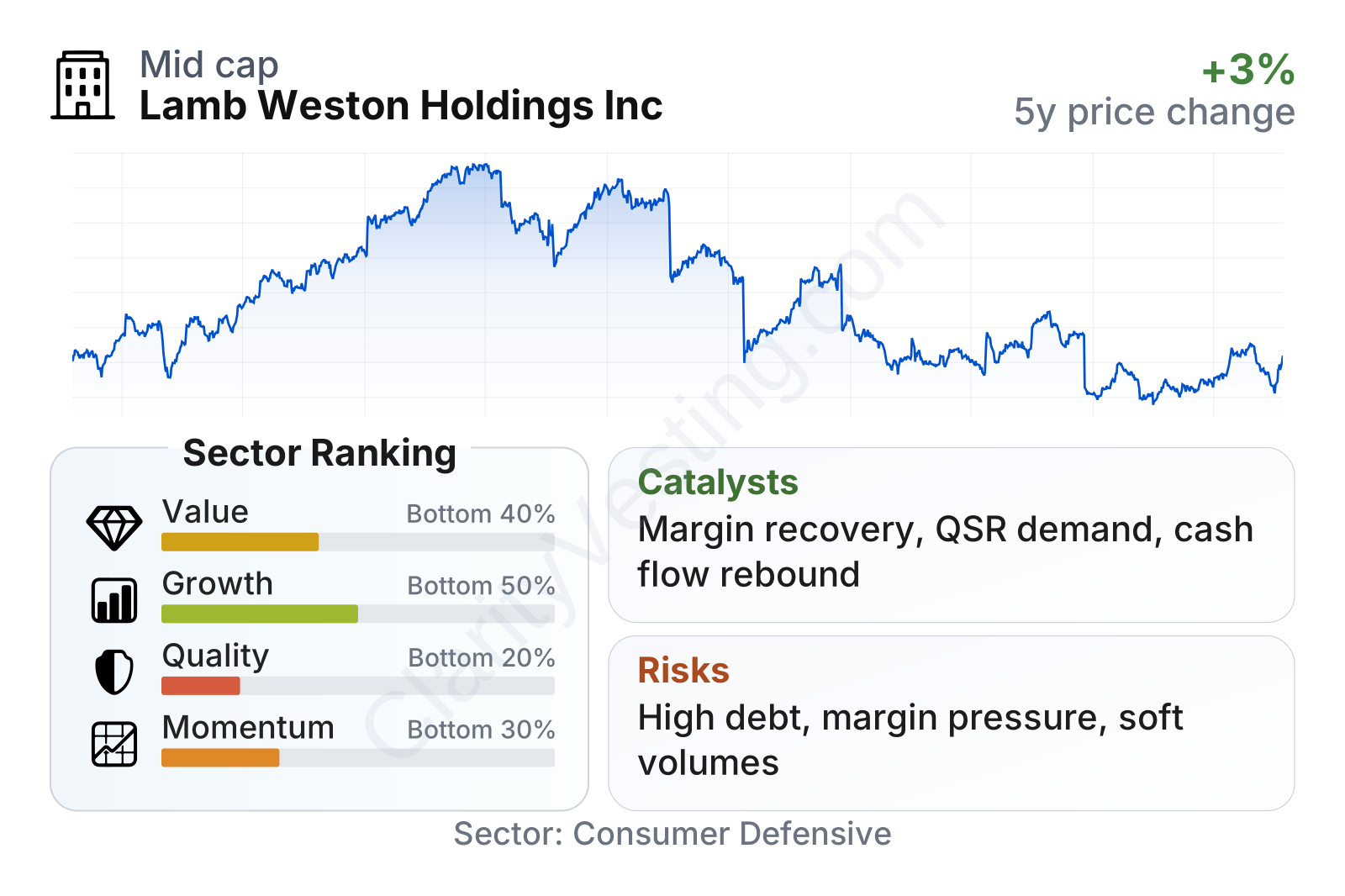
Lamb Weston is a mid-sized packaged food company with a relatively low share-price volatility profile, as shown by its beta below 0.5. The factor table points to a mixed picture. Valuation metrics look weaker than much of the sector, with a higher earnings multiple and book multiple than the median. Growth is also uneven: long-term revenue per share has been solid, but recent sales growth has slowed and earnings growth over five years has been poor. Quality measures are the weakest area, mainly because leverage is high and returns on capital are below many peers. Momentum has been soft over longer periods, although the more recent six-month trend has improved.
Growth
Frozen potato products remain part of a durable food category. Demand is supported by restaurant traffic, the global popularity of french fries, and the need for kitchens to use convenient, standardized products. This is not a fast-changing technology market, but it can still grow through population growth, more quick-service restaurant penetration, menu expansion, and rising demand in international markets.
Lamb Weston’s strategy broadly makes sense for this type of industry. The company focuses on scale manufacturing, long customer relationships, and product innovation around fry formats, coatings, and menu-oriented offerings. These are practical growth drivers in a category where consistency matters as much as branding. The business also has room to benefit when restaurant customers expand unit counts or when international demand grows faster than mature domestic markets.
The growth pattern has been unusual. Revenue growth was exceptionally strong in fiscal 2023, then slowed sharply, turned negative for part of fiscal 2024, and has since returned to low single-digit growth. That suggests the company has moved past an earlier period driven by pricing and recovery effects, and is now operating in a more normal environment where volume, mix, and execution matter more.
Cash generation has also improved after a weak period. Free cash flow moved from very low or negative territory to a much stronger level more recently, which matters because this business is capital-intensive. Stronger cash generation can help fund plant investment, dividends, and debt management. Still, one stronger period does not fully remove the concern created by profit compression.
A meaningful catalyst is the company’s exposure to large restaurant chains and global foodservice demand. When major quick-service operators grow traffic or add locations, suppliers with established product approval and logistics capabilities can benefit. Another potential support is operational normalization: if agricultural costs, manufacturing utilization, and customer order patterns become more favorable, earnings could recover faster than revenue. Recent company updates have also emphasized actions to improve productivity and align capacity with demand, which could become important if execution improves.
Risks
This article is for informational purposes only and does not constitute financial advice. Some content is AI-generated. See Disclaimer


