Stock Analysis · Intuitive Machines Inc (LUNR)
Overview
Intuitive Machines is a U.S. space infrastructure company focused on the Moon and nearby space. Its activities include lunar delivery missions, spacecraft and systems engineering, and communications and navigation services intended to support future government and commercial operations beyond Earth. The company became widely known through NASA-related lunar programs and its efforts to build a broader cislunar infrastructure business, meaning services operating in the space between Earth and the Moon.
For long-term analysis, the key point is that Intuitive Machines is not simply a one-product company. It is trying to position itself across several parts of the lunar economy: transporting payloads, building mission systems, and eventually providing recurring infrastructure such as communications and navigation. That strategy matters because launch-and-landing missions can be irregular, while infrastructure services could become more repeatable if the market develops.
Based on company disclosures, revenue is mainly tied to U.S. government contracts, especially NASA programs. The business can be understood through these main sources:
- Lunar access and delivery services: a major revenue driver tied to lunar lander missions, payload delivery, mission services, and related engineering work for NASA and other customers.
- Space products and infrastructure: spacecraft components, orbital transfer and mission systems, lunar terrain and data-related capabilities, and other hardware or program work connected to exploration architecture.
- Communications and navigation services: developing relay, communications, and positioning capabilities for lunar missions. This area appears strategically important, although it is still earlier-stage than the company’s mission delivery work.
- Other engineering and contract services: technical services performed under government-directed programs and adjacent aerospace contracts.
The company does not always present revenue in a stable product-by-product split that allows a clean percentage ranking across all periods, because contract mix can shift sharply from one quarter to the next depending on milestone timing. What is clearer is that NASA and other government-backed programs account for the large majority of sales, making customer concentration a central feature of the business model.
The income flow over recent years shows a business that scaled revenue quickly in 2024 but did not translate that into consistent profitability. Gross profit turned positive in 2024 after weaker earlier periods, yet operating costs also rose sharply, and losses remained significant in 2025. That pattern suggests a company still in heavy buildout mode rather than a mature aerospace contractor with stable margins.
The financial picture points to rapid expansion in activity, but also to a cost base that has risen almost as fast as revenue. For a long-term view, that makes execution on larger contracts and follow-on programs more important than simple top-line growth.
Key Figures
| Metric | Value | Sector ⓘ |
|---|---|---|
| Date | Oct 24, 2026 | |
| Context | ||
| Sector | Industrials | |
| Industry | Aerospace & Defense | |
| Market Cap ⓘ | $1.70B | |
| Beta ⓘ | 1.86 | |
Value (Cheapness) | ||
| P/E Ratio ⓘ | N/A | 22.29 |
| P/B Ratio ⓘ | N/A | 1.98 |
| FCF Yield ⓘ | -11.20% | 6.26% |
| Dividend Yield ⓘ | N/A | 1.92% |
| EBIT / EV ⓘ | -6.65% | 4.83% |
| PEG ⓘ | N/A | |
Growth (Business expansion) | ||
| Revenue Growth ⓘ | 309.80% | 9.30% |
| RPS Growth (5Y CAGR) ⓘ | -18.63% | 7.76% |
| EPS Growth (5Y CAGR) ⓘ | N/A | -13.17% |
| BVPS Growth (5Y CAGR) ⓘ | N/A | 6.13% |
| Margin Growth (5Y Trend) ⓘ | N/A | 0.74% |
| FCF Growth (5Y CAGR) ⓘ | N/A | 10.79% |
| DPS Growth (5Y CAGR) ⓘ | N/A | 9.41% |
Quality (Business durability) | ||
| ROIC (Latest) ⓘ | N/A | 10.75% |
| ROA (Latest) ⓘ | -9.91% | 5.41% |
| ROIC (5Y Median) ⓘ | N/A | 9.37% |
| ROA (5Y Median) ⓘ | -14.97% | 4.95% |
| Net Debt / EBIT (Latest) ⓘ | N/A | 2.04 |
| Net Debt / EBIT (5Y Median) ⓘ | N/A | 2.27 |
| Net Debt / EBITDA (Latest) ⓘ | N/A | 1.39 |
| Net Debt / Assets ⓘ | 3.31% | 19.27% |
| EBITDA / Interest ⓘ | N/A | 9.58 |
| Operating Margin (Latest) ⓘ | -34.19% | 10.49% |
| Operating Margin (5Y Median) ⓘ | -22.96% | 10.30% |
| Debt to Equity (Latest) ⓘ | -151.50% | 64.82% |
| Profit Margin (Latest) ⓘ | -26.64% | 6.67% |
| Free Cash Flow (Latest) ⓘ | -$190.51M | |
Momentum (Price trend) | ||
| 3Y Return ⓘ | +253.07% | +67.77% |
| 12M Return (excl. last month) ⓘ | +61.89% | +12.05% |
| 6M Return ⓘ | -60.78% | 0.00% |
| Price vs. 200-Day MA ⓘ | -45.57% | +0.67% |
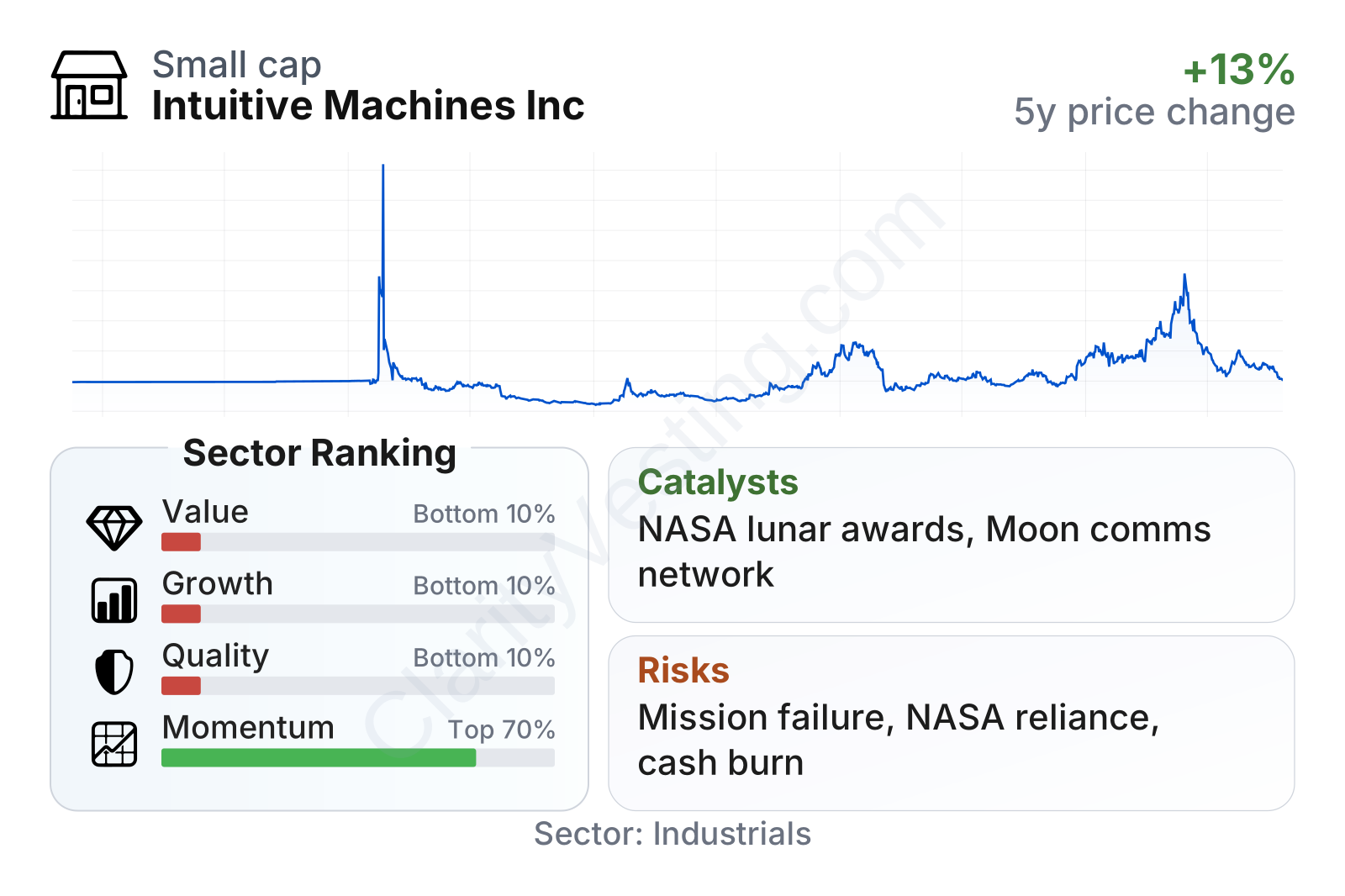
Intuitive Machines is a small-cap aerospace company with very high share-price volatility, reflected in a beta near 1.9 and a trading history marked by sharp swings. The broader factor profile is weak in value, growth, and quality relative to the sector, while momentum remains better over multi-year periods despite a much weaker recent trend. The most striking points are extremely fast recent revenue growth, deeply negative cash generation, and profitability measures that remain far below industry norms.
Growth
Intuitive Machines operates in a sector with real long-term expansion potential. Lunar exploration is moving from occasional demonstration missions toward a more structured development cycle driven by NASA’s Artemis framework, commercial lunar payload services, defense interest in space infrastructure, and the possibility of communications and navigation networks beyond Earth orbit. Even if this market remains small today, it is strategically important and supported by public funding priorities.
The company’s strategy broadly makes sense for future growth because it is trying to move from mission-by-mission work into infrastructure layers that could become harder to replace. A lunar lander business can create visibility and credibility, but communications, navigation, and related space services could eventually offer a more durable role if the Moon becomes a sustained operating environment rather than a series of isolated missions.
Recent revenue growth has been exceptionally strong, with year-over-year increases running far above the sector median. That said, the pattern is uneven, which is common for contract-based aerospace businesses. Revenue can surge when milestones are achieved and then slow when programs transition. For that reason, growth should be viewed through program backlog, awards, and mission cadence rather than quarter-by-quarter smoothness.
Cash flow is the biggest counterweight to the growth narrative. Free cash flow has been deeply negative and has worsened materially over time, showing that expansion still requires heavy funding. In practice, this means top-line progress has not yet translated into self-financing operations. For a company in an emerging space market, that is not unusual, but it does raise the bar for future execution.
A meaningful catalyst is the company’s role in lunar services tied to NASA programs and the broader push to establish communications and navigation around the Moon. If Intuitive Machines secures additional contract wins, executes upcoming missions successfully, and proves that it can convert development efforts into repeat business, its position in the lunar economy could become more important than its current size suggests. Recent business momentum also indicates that the market is assigning value to those future possibilities, even though the financial statements still show a company in transition.
Risks
This article is for informational purposes only and does not constitute financial advice. Some content is AI-generated. See Disclaimer


