Stock Analysis · Landstar System Inc (LSTR)
Overview
Landstar System is a freight transportation and logistics company that connects shippers with truck capacity and other transportation services. Instead of owning a large fleet of trucks and trailers, it mainly operates an asset-light network model. The company works through independent sales agents and a large base of third-party capacity providers, including truck owner-operators and other transportation carriers. This structure matters because it can reduce fixed costs and make the business more flexible when freight demand changes.
In practical terms, Landstar helps customers move goods across North America and, to a lesser extent, internationally. It serves industries such as manufacturing, retail, construction, energy, and government. Its service offering covers truckload freight, less-than-truckload, rail intermodal, air and ocean cargo, expedited deliveries, heavy haul, and specialized transportation.
Based on the company’s recent annual reporting structure, Landstar’s revenue is dominated by truck transportation brokerage and related logistics services. A simple way to think about the business is the following:
- Truck transportation services: approximately 90% to 95% of revenue. This includes van, flatbed, unsided/platform, temperature-controlled, heavy haul, expedited, and other over-the-road services arranged through third-party capacity providers.
- Other transportation modes and logistics services: approximately 5% to 10% of revenue. This includes rail intermodal, air and ocean freight, customs brokerage, warehouse-related services, and other supply chain solutions.
The financial flow also shows how the model works: a very large portion of revenue is passed through to purchased transportation, while Landstar keeps a smaller gross profit spread for arranging and managing freight. Over the last several years, revenue and profit climbed strongly in the freight upcycle, then retreated as the transportation market softened, showing how cyclical this business can be.
Key Figures
| Metric | Value | Sector ⓘ |
|---|---|---|
| Date | Oct 24, 2026 | |
| Context | ||
| Sector | Industrials | |
| Industry | Integrated Freight & Logistics | |
| Market Cap ⓘ | $5.77B | |
| Beta ⓘ | 0.89 | |
Value (Cheapness) | ||
| P/E Ratio ⓘ | 44.02 | 22.29 |
| P/B Ratio ⓘ | 6.95 | 1.98 |
| FCF Yield ⓘ | 3.05% | 6.26% |
| Dividend Yield ⓘ | 0.95% | 1.92% |
| EBIT / EV ⓘ | 3.62% | 4.83% |
| PEG ⓘ | 0.91 | |
Growth (Business expansion) | ||
| Revenue Growth ⓘ | 18.10% | 9.30% |
| RPS Growth (5Y CAGR) ⓘ | -5.46% | 7.76% |
| EPS Growth (5Y CAGR) ⓘ | -33.13% | -13.17% |
| BVPS Growth (5Y CAGR) ⓘ | 0.41% | 6.13% |
| Margin Growth (5Y Trend) ⓘ | -4.51% | 0.74% |
| FCF Growth (5Y CAGR) ⓘ | -4.03% | 10.79% |
| DPS Growth (5Y CAGR) ⓘ | 5.25% | 9.41% |
Quality (Business durability) | ||
| ROIC (Latest) ⓘ | 17.00% | 10.75% |
| ROA (Latest) ⓘ | 7.74% | 5.41% |
| ROIC (5Y Median) ⓘ | 24.23% | 9.37% |
| ROA (5Y Median) ⓘ | 14.16% | 4.95% |
| Net Debt / EBIT (Latest) ⓘ | -0.78 | 2.04 |
| Net Debt / EBIT (5Y Median) ⓘ | -1.03 | 2.27 |
| Net Debt / EBITDA (Latest) ⓘ | -0.64 | 1.39 |
| Net Debt / Assets ⓘ | -8.94% | 19.27% |
| EBITDA / Interest ⓘ | 135.66 | 9.58 |
| Operating Margin (Latest) ⓘ | 4.00% | 10.49% |
| Operating Margin (5Y Median) ⓘ | 6.39% | 10.30% |
| Debt to Equity (Latest) ⓘ | 16.57% | 64.82% |
| Profit Margin (Latest) ⓘ | 2.64% | 6.67% |
| Free Cash Flow (Latest) ⓘ | $175.65M | |
Momentum (Price trend) | ||
| 3Y Return ⓘ | +5.99% | +67.77% |
| 12M Return (excl. last month) ⓘ | +39.92% | +12.05% |
| 6M Return ⓘ | -3.74% | 0.00% |
| Price vs. 200-Day MA ⓘ | -2.76% | +0.67% |
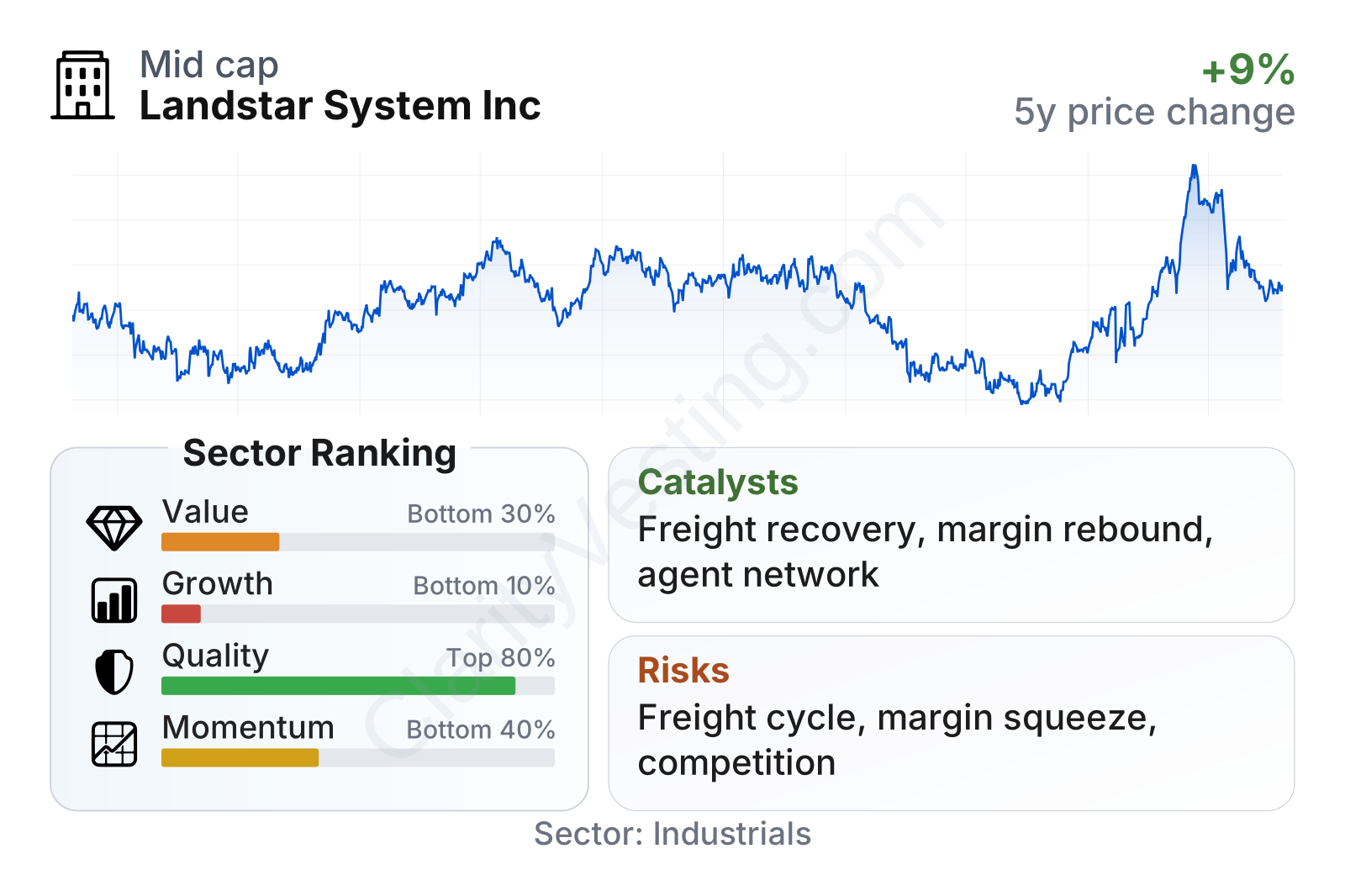
Landstar is a mid-sized industrial company with a market value in the multi-billion-dollar range and a stock volatility slightly below the broader market. The table points to a mixed profile. Business quality remains relatively strong, especially on returns on capital and balance-sheet strength, but growth metrics over the last five years are weak and valuation looks demanding compared with the sector. Recent share-price performance has improved over the past year, yet the longer three-year record has lagged many peers.
Growth
Landstar operates in freight brokerage and logistics, a sector that should remain important over the long run because supply chains still need flexible, outsourced transportation capacity. The broad trend toward using third-party logistics providers supports companies that can match shippers with capacity efficiently. Landstar’s asset-light structure fits that need well: it can expand service capacity without making the same level of equipment investment required by asset-heavy trucking companies.
Its strategy also has a clear logic for future growth. The company relies on a wide network of independent commission sales agents and carrier capacity providers, which can help it reach niche freight markets and specialized shipments without building a large direct sales force or fleet. This model can work particularly well in complex shipments such as flatbed, oversized, project cargo, and time-sensitive freight, where execution matters more than pure scale.
Recent revenue trends suggest the business may be emerging from a weak freight cycle. Growth was deeply negative through much of 2023 and 2024, stayed soft in 2025, and then turned positive again in 2026, with a much sharper improvement by mid-year. That pattern is consistent with a logistics business tied closely to freight volumes and pricing: recovery can look slow at first and then improve quickly if customer demand and carrier pricing stabilize.
Cash generation remains one of the more useful things to watch here. Free cash flow has come down from earlier highs but is still positive, which supports Landstar’s ability to fund operations, dividends, and share repurchases without leaning heavily on debt. That matters because freight markets can change quickly, and financial flexibility is especially valuable in cyclical industries.
A meaningful catalyst is a broader recovery in U.S. industrial production and truck freight demand. If shipping volumes improve and excess carrier capacity leaves the market, brokerage spreads can recover. Landstar may also benefit from customers wanting dependable partners for specialized freight, cross-border transportation, and project-based shipments. In addition, its low-capital business model gives it room to pursue growth without needing large balance-sheet expansion.
Recent company updates in 2026 have shown improving year-over-year revenue conditions, which strengthens the case that the downturn phase may be moderating. That does not automatically translate into a full earnings rebound, but it does suggest the operating environment is better than it was during the sharp contraction period.
Risks
This article is for informational purposes only and does not constitute financial advice. Some content is AI-generated. See Disclaimer


