Stock Analysis · Lisi S.A (LSIIF)
Overview
Lisi S.A. is a French industrial manufacturer focused on highly engineered fastening and assembly components. The group mainly serves three end markets: aerospace, automotive, and medical. In simple terms, it makes critical small parts that customers need to keep aircraft, vehicles, and surgical procedures functioning safely and reliably. Its products are rarely visible to end users, but they are often essential, tightly specified, and embedded in customers’ production systems.
The business is organized around three divisions. Based on the company’s latest annual reporting, revenue is mainly distributed as follows:
- Aerospace: about 59% of revenue. This division produces fastening systems and structural components for aircraft and engines, supplying major commercial aerospace and defense programs.
- Automotive: about 30% of revenue. It mainly makes fastening solutions and mechanical safety components for vehicle manufacturers and suppliers, with exposure to both traditional and electrified vehicles.
- Medical: about 11% of revenue. This segment produces implants and instrument solutions, especially for orthopedic applications.
That mix matters for long-term analysis. Aerospace is currently the main profit engine because it benefits from high qualification barriers, long program cycles, and strong aircraft production demand. Automotive brings larger volumes but is usually more cyclical and more competitive on pricing. Medical adds diversification and can support steadier demand, although it remains the smallest contributor.
Lisi’s model combines precision manufacturing, certification know-how, and long customer relationships. This tends to create recurring business once parts are designed into a platform, especially in aerospace where switching suppliers can be difficult and time-consuming. Revenue has expanded materially over the last few years, and the business has also improved operating income, even if margins still remain below the best performers in the broader industrial sector.
The long-term trend is clearly upward at the revenue level, with a notable improvement in operating income by 2024 and 2025. Some line items appear volatile from year to year, so the most useful takeaway is the broad direction: Lisi has grown meaningfully since 2021 and has recently converted a larger portion of sales into operating profit.
Key Figures
| Metric | Value | Sector ⓘ |
|---|---|---|
| Date | Oct 24, 2026 | |
| Context | ||
| Sector | Industrials | |
| Industry | Aerospace & Defense | |
| Market Cap ⓘ | $3.07B | |
| Beta ⓘ | 1.08 | |
Value (Cheapness) | ||
| P/E Ratio ⓘ | 43.64 | 22.29 |
| P/B Ratio ⓘ | 2.76 | 1.98 |
| FCF Yield ⓘ | 4.76% | 6.26% |
| Dividend Yield ⓘ | 0.68% | 1.92% |
| EBIT / EV ⓘ | N/A | 4.83% |
| PEG ⓘ | N/A | |
Growth (Business expansion) | ||
| Revenue Growth ⓘ | 4.40% | 9.30% |
| RPS Growth (5Y CAGR) ⓘ | 14.73% | 7.76% |
| EPS Growth (5Y CAGR) ⓘ | -44.91% | -13.17% |
| BVPS Growth (5Y CAGR) ⓘ | 4.33% | 6.13% |
| Margin Growth (5Y Trend) ⓘ | 3.49% | 0.74% |
| FCF Growth (5Y CAGR) ⓘ | 10.96% | 10.79% |
| DPS Growth (5Y CAGR) ⓘ | 29.08% | 9.41% |
Quality (Business durability) | ||
| ROIC (Latest) ⓘ | 17.70% | 10.75% |
| ROA (Latest) ⓘ | 10.22% | 5.41% |
| ROIC (5Y Median) ⓘ | 4.52% | 9.37% |
| ROA (5Y Median) ⓘ | 2.62% | 4.95% |
| Net Debt / EBIT (Latest) ⓘ | 0.83 | 2.04 |
| Net Debt / EBIT (5Y Median) ⓘ | 3.27 | 2.27 |
| Net Debt / EBITDA (Latest) ⓘ | 0.52 | 1.39 |
| Net Debt / Assets ⓘ | 11.91% | 19.27% |
| EBITDA / Interest ⓘ | 4.84 | 9.58 |
| Operating Margin (Latest) ⓘ | 8.85% | 10.49% |
| Operating Margin (5Y Median) ⓘ | 6.25% | 10.30% |
| Debt to Equity (Latest) ⓘ | 44.87% | 64.82% |
| Profit Margin (Latest) ⓘ | 8.86% | 6.67% |
| Free Cash Flow (Latest) ⓘ | $146.20M | |
Momentum (Price trend) | ||
| 3Y Return ⓘ | +155.13% | +67.77% |
| 12M Return (excl. last month) ⓘ | +32.31% | +12.05% |
| 6M Return ⓘ | +15.66% | 0.00% |
| Price vs. 200-Day MA ⓘ | +3.14% | +0.67% |
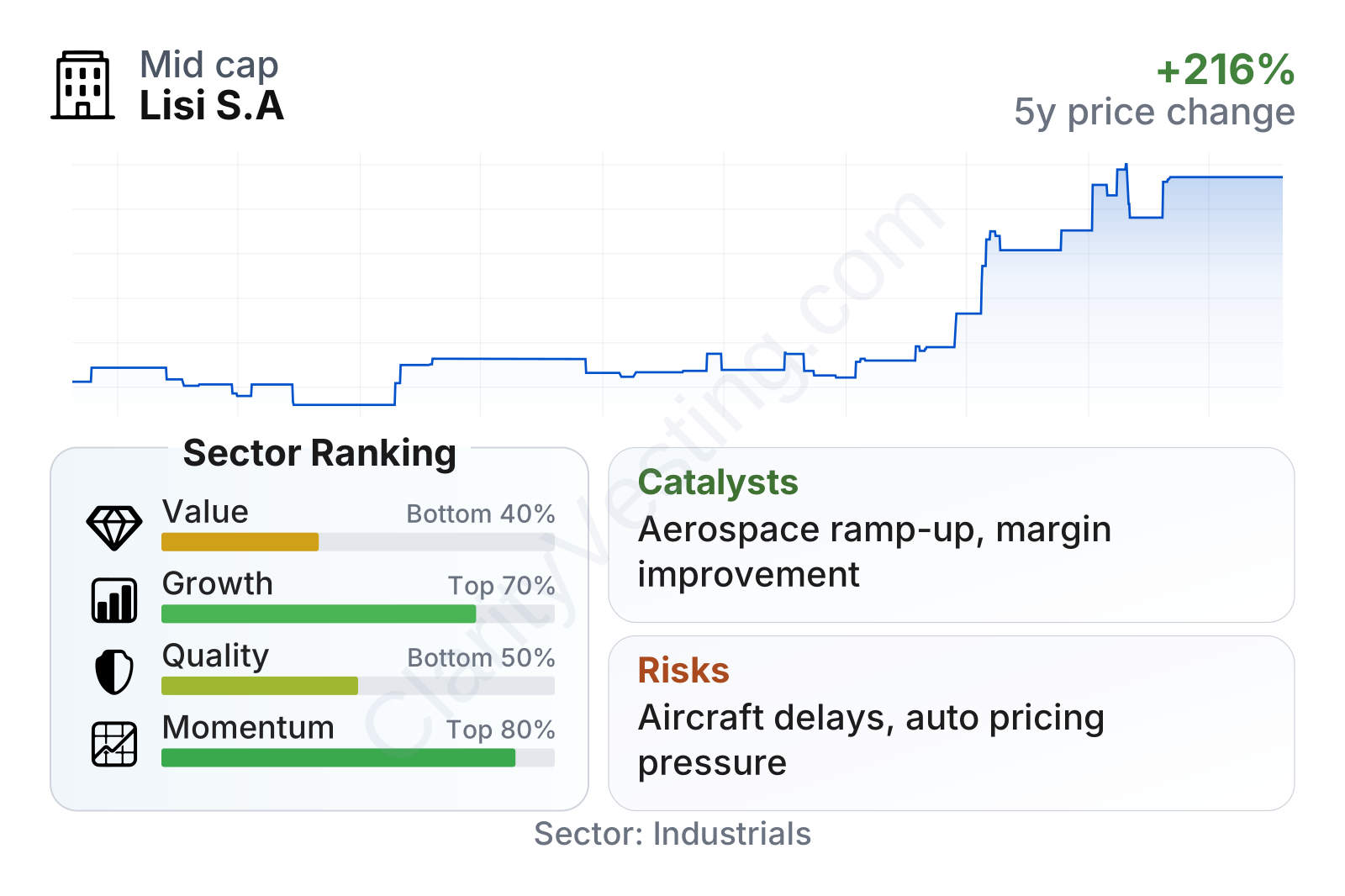
Lisi is a mid-sized industrial company with a market value a little above $3 billion and share-price volatility close to the broader market. The stock’s recent performance has been strong, with returns over one, three, and six months ahead of the sector median, showing that the market has been rewarding the recent improvement in business conditions.
The operating picture is mixed but improving. Profitability measures such as return on invested capital and return on assets are currently stronger than the sector median, while leverage looks fairly contained, with net debt relative to earnings below many peers. At the same time, operating margin remains slightly below the sector median, and interest coverage is not especially high, so the balance sheet is solid rather than exceptionally conservative.
Growth metrics also show two different realities. On a five-year basis, revenue per share growth has been strong and free cash flow growth has kept pace with the sector. However, recent year-over-year revenue growth is more moderate than the sector median, and five-year earnings-per-share growth remains distorted by past volatility. Overall, the figures point to a company that has improved meaningfully, but not one with perfectly smooth execution.
Growth
Lisi operates in a sector with credible long-term support, especially through aerospace. Global aircraft backlogs remain elevated, and production ramp-ups at major commercial aircraft manufacturers should continue to support demand for fasteners and structural components over several years. Defense spending in many Western markets also supports parts suppliers with certified capabilities. This backdrop is important because aerospace programs tend to last a long time, creating visibility once volumes start to rise.
The company’s strategy also makes industrial sense. Aerospace remains the most attractive business inside the group because customers value reliability, traceability, and certification as much as price. Those are areas where established suppliers can defend their position. In automotive, Lisi has exposure to fastening and safety-critical components that remain necessary even as vehicle architectures evolve. In medical, the company has a smaller but specialized platform that can add resilience and diversification.
A meaningful catalyst is the continuing normalization and ramp-up of commercial aerospace production. If aircraft output increases as expected across major platforms, suppliers such as Lisi can benefit not only from higher volumes but also from better factory utilization, which can lift margins. Another supportive element is that the company has already shown improving margin trends over five years, suggesting that scale and operational discipline can still contribute if end-market demand remains favorable.
Recent company communication has also pointed to sustained activity in aerospace and ongoing efforts to improve industrial performance across the group. For a long-term reader, the key point is not a single headline but the combination of structural aerospace demand, recurring content on aircraft platforms, and room for margin progression if operations continue to normalize.
Risks
This article is for informational purposes only and does not constitute financial advice. Some content is AI-generated. See Disclaimer


