Stock Analysis · Stride Inc (LRN)
Overview
Stride Inc is an education company focused on online and technology-enabled learning. It operates programs for students from kindergarten through 12th grade, career-focused learning aimed at helping students prepare for jobs, and services for schools and institutions that want digital curriculum, teaching support, or learning platforms. The company is best known for online public school programs, but over time it has broadened its reach into career education and adult-focused training.
Its revenue mix is led by General Education, with Career Learning now a meaningful second engine. Based on the latest annual filing for the fiscal year ended June 30, 2026, the business is organized mainly as follows:
- General Education: about 62% of revenue. This includes tuition and related funding from online public schools and school programs serving K-12 students, plus curriculum, instruction, and school support services.
- Career Learning: about 38% of revenue. This includes middle school and high school career-oriented programs, industry-aligned courses, career academies, and adult learning offerings tied to workforce skills and employability.
That mix matters because Career Learning has been the faster-growing part of the company in recent years, while the larger General Education segment still provides scale, relationships with school systems, and recurring enrollment-driven revenue.
The operating profile has improved noticeably over the last several years. Revenue has climbed from roughly $1.7 billion in fiscal 2022 to more than $2.5 billion in fiscal 2026, while operating income and net income have grown faster than sales. That suggests Stride has not only expanded but also converted a larger share of its revenue into profit.
The business flow shows a clear rise in revenue, gross profit, and operating income over the last five fiscal years. Costs have increased too, but profit has expanded faster than sales, which points to stronger operating efficiency and a more favorable mix.
Key Figures
| Metric | Value | Sector ⓘ |
|---|---|---|
| Date | Oct 03, 2026 | |
| Context | ||
| Sector | Consumer Defensive | |
| Industry | Education & Training Services | |
| Market Cap ⓘ | $3.14B | |
| Beta ⓘ | 0.11 | |
Value (Cheapness) | ||
| P/E Ratio ⓘ | 10.59 | 18.16 |
| P/B Ratio ⓘ | 2.19 | 1.27 |
| FCF Yield ⓘ | 11.30% | 12.39% |
| Dividend Yield ⓘ | N/A | 2.83% |
| EBIT / EV ⓘ | 15.88% | 6.45% |
| PEG ⓘ | 0.43 | |
Growth (Business expansion) | ||
| Revenue Growth ⓘ | -2.70% | 3.80% |
| RPS Growth (5Y CAGR) ⓘ | 7.56% | 6.20% |
| EPS Growth (5Y CAGR) ⓘ | 35.15% | -14.64% |
| BVPS Growth (5Y CAGR) ⓘ | 15.85% | 3.26% |
| Margin Growth (5Y Trend) ⓘ | 8.70% | -0.25% |
| FCF Growth (5Y CAGR) ⓘ | 26.35% | 4.65% |
| DPS Growth (5Y CAGR) ⓘ | 16.94% | 6.86% |
Quality (Business durability) | ||
| ROIC (Latest) ⓘ | 17.32% | 12.58% |
| ROA (Latest) ⓘ | 14.18% | 6.35% |
| ROIC (5Y Median) ⓘ | 14.24% | 10.36% |
| ROA (5Y Median) ⓘ | 11.09% | 5.44% |
| Net Debt / EBIT (Latest) ⓘ | -0.46 | 1.91 |
| Net Debt / EBIT (5Y Median) ⓘ | 0.10 | 2.32 |
| Net Debt / EBITDA (Latest) ⓘ | -0.36 | 1.36 |
| Net Debt / Assets ⓘ | -8.56% | 21.25% |
| EBITDA / Interest ⓘ | 49.20 | 9.61 |
| Operating Margin (Latest) ⓘ | 17.99% | 8.96% |
| Operating Margin (5Y Median) ⓘ | 13.55% | 9.53% |
| Debt to Equity (Latest) ⓘ | 33.45% | 71.66% |
| Profit Margin (Latest) ⓘ | 13.43% | 5.40% |
| Free Cash Flow (Latest) ⓘ | $354.97M | |
Momentum (Price trend) | ||
| 3Y Return ⓘ | +67.87% | +15.25% |
| 12M Return (excl. last month) ⓘ | -46.79% | +2.63% |
| 6M Return ⓘ | -10.19% | +2.43% |
| Price vs. 200-Day MA ⓘ | -10.42% | +0.43% |
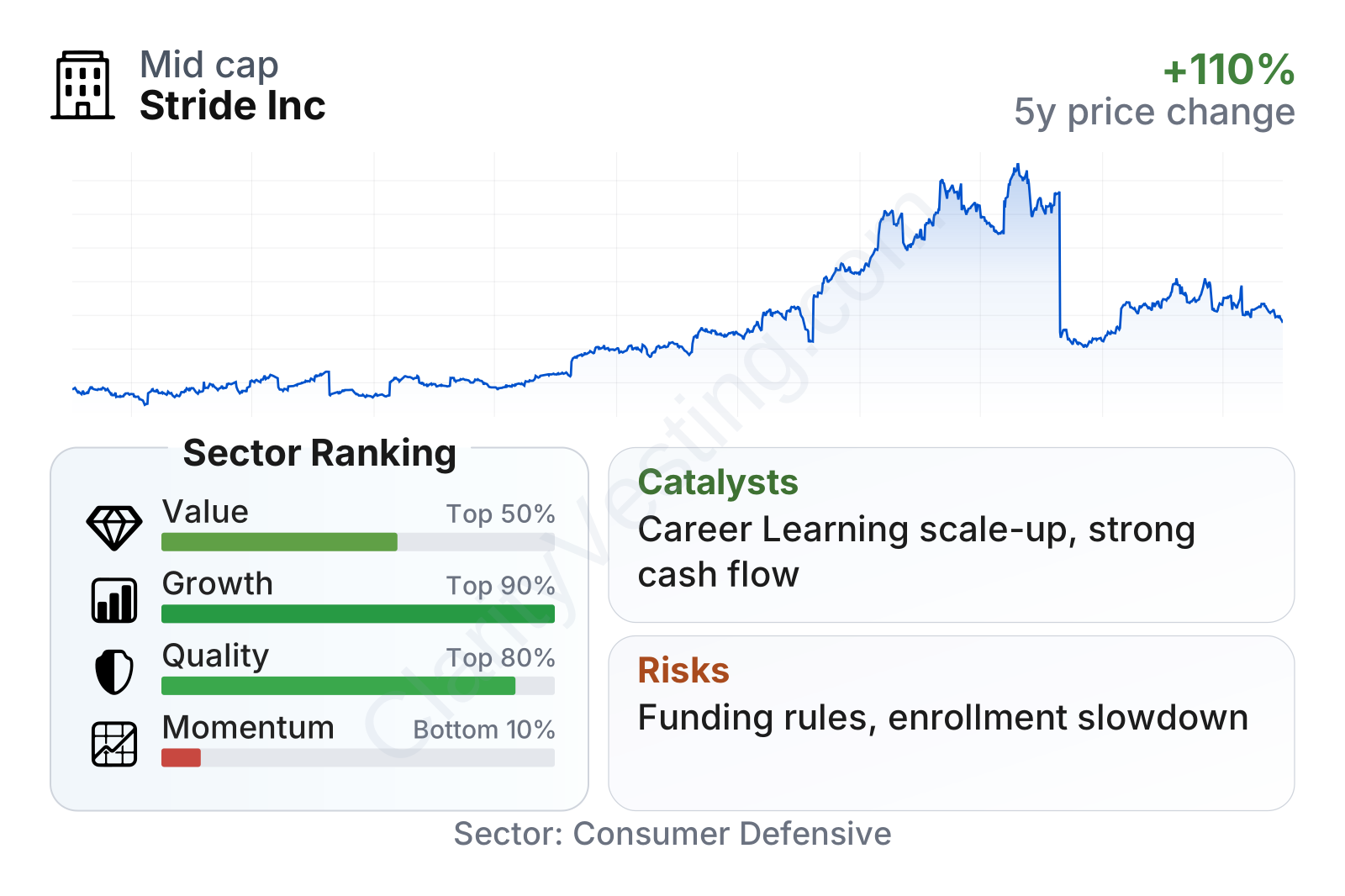
Stride is a mid-sized company with an unusually low beta, meaning its share price has historically moved less than the broader market. In the latest factor snapshot, the company ranks well on growth, quality, and valuation relative to much of its sector, but weakly on recent momentum. In simple terms, the underlying business looks stronger than the recent trading pattern. Profitability is comfortably above sector medians, leverage is modest, and earnings-based valuation remains below the sector median despite strong multi-year operating progress.
The stock chart also shows an important contrast between business performance and market behavior. Shares surged through 2024 and 2025, then reset sharply in early 2026 before partially recovering. That kind of move often means the market had previously priced in very high expectations and later became more cautious, even though the company remained profitable.
Growth
Stride operates in a part of education that still has room to expand. Online, hybrid, and career-oriented learning continue to benefit from several long-term trends: demand for flexible education formats, school districts needing digital tools, parents looking for alternatives to traditional classrooms, and employers pushing for job-ready skills. These trends do not guarantee steady year-to-year growth, but they support a broader market that remains relevant for the next decade.
The company’s strategy also makes practical sense. Instead of depending only on virtual K-12 enrollment, Stride has built a broader platform around career pathways, adult learning, and institutional services. That diversification can reduce reliance on a single student group and creates more ways to grow. Career-focused offerings are especially important because they connect education spending to workforce outcomes, which can be attractive to students, families, school partners, and policymakers.
Recent revenue growth has clearly cooled after a long period of strong expansion. Through most of 2022 to 2025, Stride posted mostly positive year-over-year growth, often in the high single digits or better, before slipping slightly negative in the most recent quarter. That slowdown does not erase the larger multi-year expansion, but it does suggest the company may be moving from a surge phase into a more normalized pace.
Cash generation has been a major positive. Free cash flow has increased substantially over the last few years and now stands in the hundreds of millions of dollars on a trailing basis. Strong cash production gives Stride flexibility to invest in curriculum, technology, acquisitions, and shareholder returns without leaning heavily on debt.
A notable catalyst is the continued scaling of Career Learning. Stride has repeatedly emphasized demand for programs tied to health care, information technology, business, manufacturing, and other practical fields. If this segment keeps growing faster than the legacy business, it could continue lifting margins and improving the company’s mix. Another potential tailwind is broader adoption of online and blended learning tools by school systems that want more flexible delivery models.
Recent company updates have also pointed to continued enrollment interest and operating discipline rather than a business under strain. The more significant opportunity is not a one-time event but the possibility that Stride is becoming a broader education platform rather than only a virtual school provider.
Risks
This article is for informational purposes only and does not constitute financial advice. Some content is AI-generated. See Disclaimer