Stock Analysis · L'Oréal S.A (LRLCF)
Overview
L'Oréal S.A. is one of the world’s largest beauty companies. It develops, manufactures, markets, and sells products across skincare, makeup, haircare, hair color, fragrances, and dermocosmetics. Its portfolio covers both mass-market and premium brands, which gives it exposure to a wide range of consumers, price points, and distribution channels. The group sells through mass retail, e-commerce, department stores, travel retail, pharmacies, salons, and its own direct-to-consumer platforms.
Its revenue base is diversified by product category and by division. Based on the latest annual disclosures, the largest sources of sales are approximately:
- Consumer Products: about 37% of sales. This includes broadly distributed brands sold in supermarkets, drugstores, and online.
- L'Oréal Luxe: about 36% of sales. This division includes prestige skincare, fragrances, and makeup sold in department stores, specialty beauty, travel retail, and e-commerce.
- Dermatological Beauty: about 16% of sales. This segment includes science-led skincare sold mainly through pharmacies, drugstores, and medical channels.
- Professional Products: about 11% of sales. This business serves hair salons with professional hair color and haircare products.
By geography, L'Oréal is also widely spread across Europe, North America, North Asia, SAPMENA-SSA, and Latin America, which helps reduce dependence on any single country. That said, China remains an important market, especially for premium beauty and travel retail.
The business model is attractive because beauty combines recurring demand with branding power. Consumers often repurchase familiar products, while the company supports pricing and loyalty through marketing, product innovation, and a very large brand portfolio.
Over the last several years, revenue has continued to rise, while gross profit and operating income have also expanded. A notable point is that selling and marketing costs remain very large, which is normal in beauty, but the company has still protected strong profitability. Research and development spending has also trended upward, showing continued investment behind future product launches.
Key Figures
| Metric | Value | Sector ⓘ |
|---|---|---|
| Date | Oct 03, 2026 | |
| Context | ||
| Sector | Consumer Defensive | |
| Industry | Household & Personal Products | |
| Market Cap ⓘ | $232.52B | |
| Beta ⓘ | 0.89 | |
Value (Cheapness) | ||
| P/E Ratio ⓘ | 32.62 | 18.16 |
| P/B Ratio ⓘ | 6.79 | 1.27 |
| FCF Yield ⓘ | 5.83% | 12.39% |
| Dividend Yield ⓘ | 1.60% | 2.83% |
| EBIT / EV ⓘ | N/A | 6.45% |
| PEG ⓘ | 2.32 | |
Growth (Business expansion) | ||
| Revenue Growth ⓘ | 5.80% | 3.80% |
| RPS Growth (5Y CAGR) ⓘ | 9.29% | 6.20% |
| EPS Growth (5Y CAGR) ⓘ | -30.89% | -14.64% |
| BVPS Growth (5Y CAGR) ⓘ | 11.53% | 3.26% |
| Margin Growth (5Y Trend) ⓘ | 1.08% | -0.25% |
| FCF Growth (5Y CAGR) ⓘ | 6.09% | 4.65% |
| DPS Growth (5Y CAGR) ⓘ | 14.87% | 6.86% |
Quality (Business durability) | ||
| ROIC (Latest) ⓘ | 30.98% | 12.58% |
| ROA (Latest) ⓘ | 20.26% | 6.35% |
| ROIC (5Y Median) ⓘ | 16.63% | 10.36% |
| ROA (5Y Median) ⓘ | 11.85% | 5.44% |
| Net Debt / EBIT (Latest) ⓘ | 0.70 | 1.91 |
| Net Debt / EBIT (5Y Median) ⓘ | 0.46 | 2.32 |
| Net Debt / EBITDA (Latest) ⓘ | 0.58 | 1.36 |
| Net Debt / Assets ⓘ | 19.09% | 21.25% |
| EBITDA / Interest ⓘ | 25.64 | 9.61 |
| Operating Margin (Latest) ⓘ | 20.36% | 8.96% |
| Operating Margin (5Y Median) ⓘ | 19.98% | 9.53% |
| Debt to Equity (Latest) ⓘ | 49.39% | 71.66% |
| Profit Margin (Latest) ⓘ | 13.90% | 5.40% |
| Free Cash Flow (Latest) ⓘ | $13.56B | |
Momentum (Price trend) | ||
| 3Y Return ⓘ | +10.26% | +15.25% |
| 12M Return (excl. last month) ⓘ | -4.87% | +2.63% |
| 6M Return ⓘ | +8.97% | +2.43% |
| Price vs. 200-Day MA ⓘ | -0.93% | +0.43% |
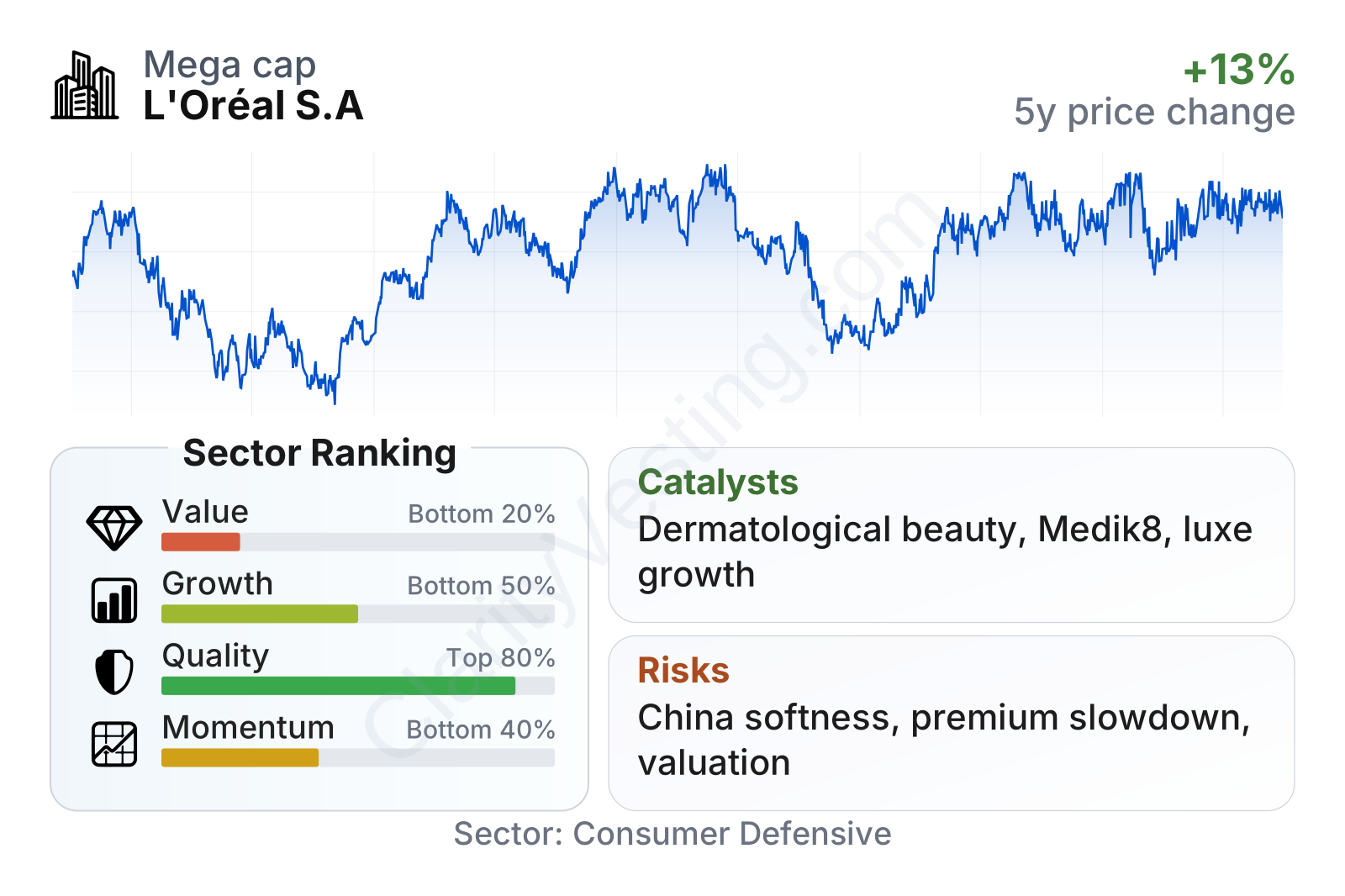
L'Oréal stands out more for business quality than for cheap valuation. Profitability is clearly above the sector median, with operating margin around 20% and profit margin in the low teens, both well ahead of many household and personal care peers. Returns on capital are also strong, which suggests the company converts brand strength into efficient earnings. Balance sheet pressure looks limited, with leverage below sector norms and interest coverage comfortably high. On the other hand, the valuation section of the table shows that the market continues to price this quality at a premium, while the recent share-price trend has been mixed rather than especially strong.
Growth
The beauty industry is a structurally growing market over the long run. Demand is supported by population growth, premiumization, rising beauty spending in emerging markets, and the expansion of skincare and dermatological categories. Digital channels also keep widening the market by improving product discovery, repeat purchases, and direct consumer relationships.
L'Oréal’s strategy is aligned with those trends. It has strong positions across both mass and prestige beauty, invests heavily in product development, and continues to scale e-commerce, data tools, and beauty technology. Its broad brand architecture matters here: the company can participate in fast-growing niches without relying on a single label or category.
One of the most important catalysts is dermatological beauty. Science-based skincare has been one of the most attractive areas in beauty, supported by consumer interest in efficacy, skin health, and products recommended by healthcare professionals. L'Oréal has already built meaningful scale in this segment and can continue expanding through innovation and international rollout.
Another useful growth driver is premium beauty. Luxury fragrances and prestige skincare have remained resilient globally, even when some discretionary categories softened. L'Oréal Luxe gives the company access to this higher-margin part of the market, while travel retail and online channels can add further reach when consumer traffic improves.
Recent growth metrics also suggest the company has continued to expand at a solid pace compared with much of its sector. Revenue growth has been ahead of the sector median, and the longer-term trend in revenue per share and free cash flow has also been favorable. Margin improvement over the past five years adds another positive point: the company has not just grown, it has done so while protecting operating efficiency.
A recent strategic development worth noting is the agreed acquisition of a majority stake in British skincare brand Medik8, announced in 2025. This fits L'Oréal’s pattern of adding promising brands in attractive beauty niches and may strengthen its presence in premium science-led skincare over time.
Risks
This article is for informational purposes only and does not constitute financial advice. Some content is AI-generated. See Disclaimer