Stock Analysis · Louisiana-Pacific Corporation (LPX)
Overview
Louisiana-Pacific Corporation is a building materials manufacturer focused mainly on wood-based products used in residential construction, repair, remodeling, and light commercial projects. The company is best known for oriented strand board, often called OSB, and for engineered wood siding products sold under the LP SmartSide brand. In simple terms, LPX makes structural panels and exterior building products that go into walls, roofs, and facades of homes and other low-rise buildings.
Its revenue base is concentrated in a small number of product groups, with siding becoming increasingly important as the company shifts toward higher-value, branded products rather than relying only on commodity panel pricing. Based on recent annual reporting, the business mix is approximately:
- Siding: about 43% of revenue. This includes engineered wood siding, trim, soffit, and related branded exterior products, primarily LP SmartSide.
- OSB: about 37% of revenue. These are structural panels used for sheathing, sub-flooring, and roofing, and this segment is the most exposed to swings in commodity prices.
- LP South America: about 13% of revenue. This includes OSB and siding products sold mainly in Brazil, Chile, Peru, and nearby markets.
- Other / Corporate and remaining activities: about 7% of revenue. This includes smaller product lines and intersegment items.
The broad trend in recent years is clear: siding has been taking a larger strategic role because it tends to offer more stable margins, more brand differentiation, and less direct exposure to raw commodity price swings than OSB. By contrast, OSB can produce very strong profits in favorable markets, but results can change quickly when housing demand or panel prices weaken.
The operating picture over the last several years shows how cyclical the business can be. Revenue and profit surged in 2021 and 2022, dropped sharply in 2023 as panel pricing normalized, recovered in 2024, and softened again in 2025. Selling and administrative costs have risen more steadily than revenue, which matters because lower pricing can compress earnings quickly in a commodity-heavy business.
Key Figures
| Metric | Value | Sector ⓘ |
|---|---|---|
| Date | Oct 24, 2026 | |
| Context | ||
| Sector | Industrials | |
| Industry | Building Products & Equipment | |
| Market Cap ⓘ | $5.06B | |
| Beta ⓘ | 1.62 | |
Value (Cheapness) | ||
| P/E Ratio ⓘ | 93.96 | 22.29 |
| P/B Ratio ⓘ | 2.91 | 1.98 |
| FCF Yield ⓘ | -0.38% | 6.26% |
| Dividend Yield ⓘ | 1.64% | 1.92% |
| EBIT / EV ⓘ | 1.62% | 4.83% |
| PEG ⓘ | 3.09 | |
Growth (Business expansion) | ||
| Revenue Growth ⓘ | -12.10% | 9.30% |
| RPS Growth (5Y CAGR) ⓘ | -0.80% | 7.76% |
| EPS Growth (5Y CAGR) ⓘ | -51.34% | -13.17% |
| BVPS Growth (5Y CAGR) ⓘ | 18.36% | 6.13% |
| Margin Growth (5Y Trend) ⓘ | -36.80% | 0.74% |
| FCF Growth (5Y CAGR) ⓘ | -47.85% | 10.79% |
| DPS Growth (5Y CAGR) ⓘ | 13.41% | 9.41% |
Quality (Business durability) | ||
| ROIC (Latest) ⓘ | 2.52% | 10.75% |
| ROA (Latest) ⓘ | 2.05% | 5.41% |
| ROIC (5Y Median) ⓘ | 20.42% | 9.37% |
| ROA (5Y Median) ⓘ | 16.78% | 4.95% |
| Net Debt / EBIT (Latest) ⓘ | 1.94 | 2.04 |
| Net Debt / EBIT (5Y Median) ⓘ | 0.07 | 2.27 |
| Net Debt / EBITDA (Latest) ⓘ | 0.65 | 1.39 |
| Net Debt / Assets ⓘ | 5.72% | 19.27% |
| EBITDA / Interest ⓘ | 13.41 | 9.58 |
| Operating Margin (Latest) ⓘ | 3.12% | 10.49% |
| Operating Margin (5Y Median) ⓘ | 18.16% | 10.30% |
| Debt to Equity (Latest) ⓘ | 21.62% | 64.82% |
| Profit Margin (Latest) ⓘ | 2.19% | 6.67% |
| Free Cash Flow (Latest) ⓘ | -$19.00M | |
Momentum (Price trend) | ||
| 3Y Return ⓘ | +41.22% | +67.77% |
| 12M Return (excl. last month) ⓘ | -25.17% | +12.05% |
| 6M Return ⓘ | +3.42% | 0.00% |
| Price vs. 200-Day MA ⓘ | -3.64% | +0.67% |
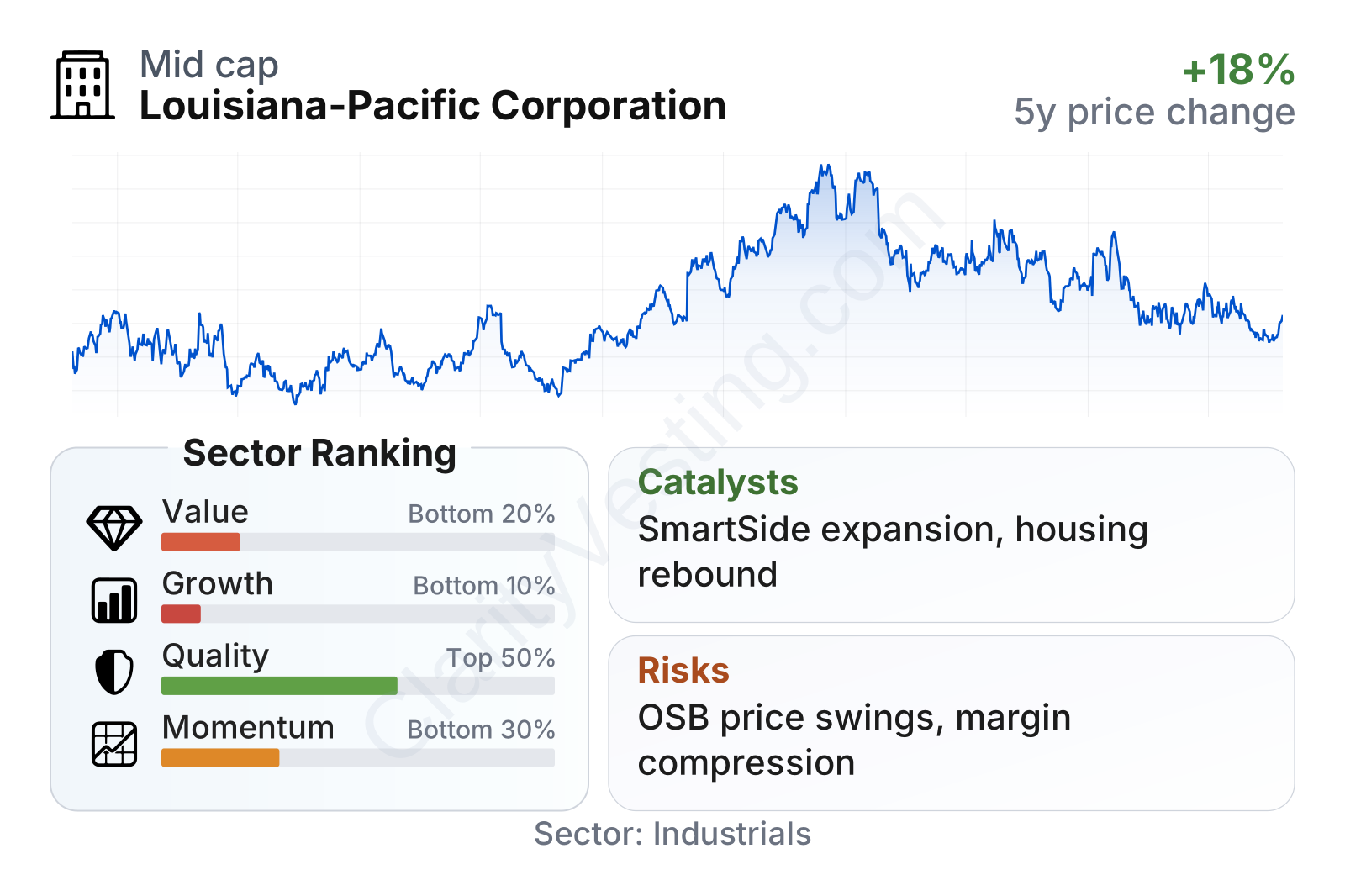
LPX sits in the mid-cap range and has a stock that has historically moved more than the broader market, which fits the company’s sensitivity to construction cycles and wood product prices. The latest factor picture is mixed. Balance-sheet metrics remain relatively solid, but recent growth, momentum, and headline valuation measures look weak versus much of the sector. That combination usually means the market is looking at depressed current earnings while waiting to see whether profits can recover.
The share price history also reflects that pattern. The stock had a powerful run into 2024 and early 2025, then gave back a meaningful portion of those gains. That does not automatically signal a broken business, but it does show how closely the market ties LPX to changes in housing activity, panel prices, and expectations for future margins.
Growth
LPX operates in a sector with long-term structural support, even though short-term demand can be volatile. New home construction, repair and remodeling activity, and replacement of older exterior materials all create ongoing need for structural panels and siding. In North America, housing supply remains tight over the long run, which supports the basic case for more construction activity over time. That backdrop is more favorable for a company selling core building components than for a business tied to a passing trend.
The most important part of LPX’s growth strategy is the continued buildout of its siding platform. This makes strategic sense because engineered wood siding is more branded, more specialized, and generally less commodity-like than OSB. It also gives the company more pricing power and a better chance to earn steadier margins through the cycle. Management has been investing in additional SmartSide capacity, and the conversion to the newer SmartSide ExpertFinish system can also raise average revenue per project by adding a factory-finished offering.
Recent revenue growth has been uneven and currently negative on a year-over-year basis, which shows that LPX is still dealing with a softer part of the cycle. The pattern over the last several years has been recovery followed by renewed pressure, rather than a straight upward climb. That is normal for a business with meaningful exposure to housing starts and panel pricing, but it also means investors need to separate temporary market weakness from the underlying direction of the company’s product mix.
Cash generation tells a similar story. LPX produced very strong free cash flow during stronger market conditions, but that measure has recently slipped close to break-even and slightly negative over the trailing twelve months. For a long-term view, the main question is whether recent weakness is a temporary trough caused by lower margins and investment spending, or a sign that returns on growth projects will take longer to appear. The company’s historically strong cash generation during better market environments suggests the first explanation is more plausible, but a full rebound depends on end-market demand improving.
A meaningful catalyst is the company’s multi-year shift toward siding capacity expansion in North America. If that higher-value category continues to represent a larger share of sales, LPX could become less dependent on OSB swings than it was in the past. Another notable opportunity is repair and remodeling demand, where siding replacement can remain active even when new home construction is under pressure. In addition, if interest rates ease and housing affordability improves, demand for the company’s products could benefit across both new construction and renovation channels.
Risks
This article is for informational purposes only and does not constitute financial advice. Some content is AI-generated. See Disclaimer


