Stock Analysis · Dorian LPG Ltd (LPG)
Overview
Dorian LPG Ltd is a shipping company focused on transporting liquefied petroleum gas, or LPG, by sea. In simple terms, it moves cargoes such as propane and butane from exporting regions to importing countries using very large gas carriers. This places the company in a narrow but important part of the energy value chain: it does not produce oil or gas, and it does not refine fuels; it earns money by providing marine transportation capacity.
The business is highly concentrated. Based on the company’s latest annual reporting for fiscal year 2026, nearly all revenue comes from vessel operations, mainly time charters, spot voyages, and contracts of affreightment tied to LPG transportation. Smaller contributions can come from freight derivatives, voyage-related reimbursements, and management or other ancillary items, but these are limited compared with core shipping income.
Main revenue sources can be summarized as follows:
- LPG shipping revenue: approximately 95% to 99% of total revenue. This includes earnings from chartering the fleet to customers and transporting propane, butane, and related LPG cargoes.
- Pool, commercial, and voyage-related income: approximately 1% to 4%. This can include reimbursements, commercial management arrangements, and voyage adjustments linked to operating the ships.
- Other income: typically below 1%. This may include minor non-core items.
Dorian’s appeal is its specialization. The company is not trying to be a broad shipping conglomerate. It is focused on the VLGC segment, which gives it direct exposure to global LPG trade flows, especially exports from the United States and the Middle East to Asia, Europe, and other import markets.
The recent financial flow also shows how sensitive results are to freight conditions. Revenue and operating profit surged into fiscal 2024, declined in fiscal 2025 as market conditions cooled, and then recovered strongly in fiscal 2026. Interest expense has moved lower more recently, which supports earnings when freight markets are favorable.
Key Figures
| Metric | Value | Sector ⓘ |
|---|---|---|
| Date | Oct 17, 2026 | |
| Context | ||
| Sector | Energy | |
| Industry | Oil & Gas Midstream | |
| Market Cap ⓘ | $2.48B | |
| Beta ⓘ | 0.73 | |
Value (Cheapness) | ||
| P/E Ratio ⓘ | 7.68 | 15.44 |
| P/B Ratio ⓘ | 1.91 | 1.73 |
| FCF Yield ⓘ | 9.00% | 8.20% |
| Dividend Yield ⓘ | 5.75% | 3.59% |
| EBIT / EV ⓘ | 13.77% | 7.46% |
| PEG ⓘ | -1.02 | |
Growth (Business expansion) | ||
| Revenue Growth ⓘ | 124.00% | 26.90% |
| RPS Growth (5Y CAGR) ⓘ | 13.57% | 6.90% |
| EPS Growth (5Y CAGR) ⓘ | -13.57% | -15.73% |
| BVPS Growth (5Y CAGR) ⓘ | 3.33% | 6.07% |
| Margin Growth (5Y Trend) ⓘ | 12.83% | 0.58% |
| FCF Growth (5Y CAGR) ⓘ | -7.82% | 1.86% |
| DPS Growth (5Y CAGR) ⓘ | 5.58% | 16.79% |
Quality (Business durability) | ||
| ROIC (Latest) ⓘ | 16.70% | 11.40% |
| ROA (Latest) ⓘ | 17.48% | 6.06% |
| ROIC (5Y Median) ⓘ | 10.54% | 10.30% |
| ROA (5Y Median) ⓘ | 10.61% | 5.42% |
| Net Debt / EBIT (Latest) ⓘ | 0.86 | 1.64 |
| Net Debt / EBIT (5Y Median) ⓘ | 2.14 | 1.83 |
| Net Debt / EBITDA (Latest) ⓘ | 0.71 | 1.08 |
| Net Debt / Assets ⓘ | 15.99% | 17.29% |
| EBITDA / Interest ⓘ | 14.10 | 9.64 |
| Operating Margin (Latest) ⓘ | 61.05% | 16.27% |
| Operating Margin (5Y Median) ⓘ | 46.29% | 20.39% |
| Debt to Equity (Latest) ⓘ | 52.26% | 54.76% |
| Profit Margin (Latest) ⓘ | 55.61% | 8.82% |
| Free Cash Flow (Latest) ⓘ | $223.31M | |
Momentum (Price trend) | ||
| 3Y Return ⓘ | +146.58% | +67.38% |
| 12M Return (excl. last month) ⓘ | +91.90% | +49.19% |
| 6M Return ⓘ | +67.28% | +7.07% |
| Price vs. 200-Day MA ⓘ | +40.13% | +9.56% |
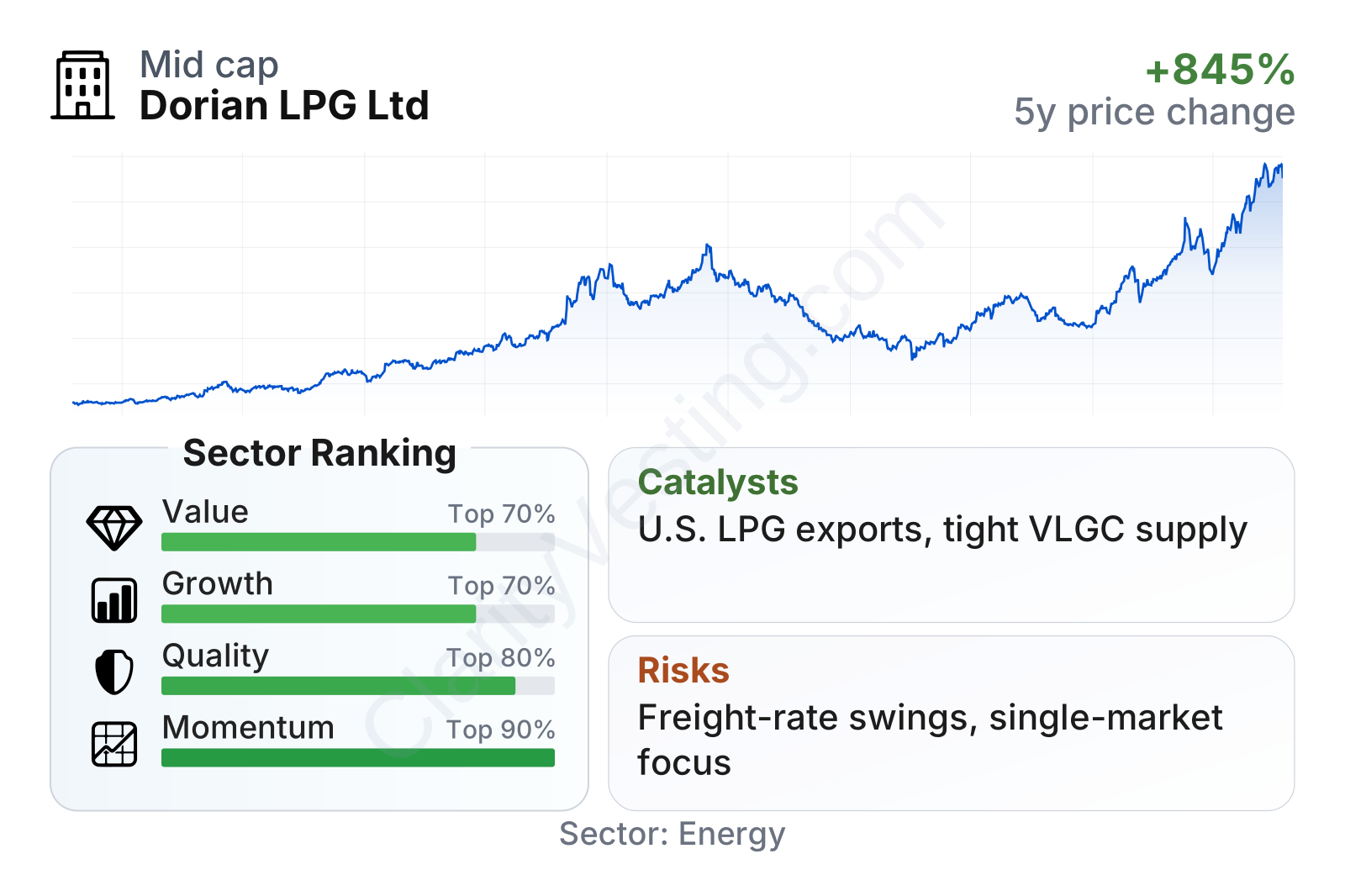
Dorian is a mid-sized public company with a market value in the low billions of dollars. The table points to a business that currently screens well on profitability, balance-sheet strength, and recent market performance. Profitability metrics stand well above sector medians, while leverage has improved to roughly in line with or slightly better than the broader energy peer group. On valuation measures, the shares trade at a lower earnings multiple than the sector median, although that needs to be read carefully because shipping profits can change quickly from one year to the next.
The stock’s multi-year price move has been very strong, but the path has not been smooth. This is normal for tanker and gas shipping names: market sentiment can swing sharply as charter rates rise or fall.
Growth
Dorian operates in a sector that has a credible long-term demand base, even if year-to-year results are cyclical. LPG consumption is supported by residential use, petrochemical demand, and fuel substitution in some regions. One of the most important structural drivers is the growth of U.S. LPG exports. As the United States produces more natural gas liquids, more cargo needs to be shipped overseas, and long-haul routes are especially valuable for vessel owners because they keep ships employed for longer periods.
The company’s strategy is straightforward and sensible for this market. It runs a modern VLGC fleet, focuses on operational efficiency, and keeps exposure to both spot and charter markets. That mix allows it to benefit when freight rates spike while still maintaining commercial flexibility. Fleet quality matters in shipping because younger and more efficient ships are generally more attractive to charterers and can perform better on costs and utilization.
Revenue growth has been volatile, which is normal for this industry, but the latest trend shows a sharp rebound after a weaker period. Recent year-over-year growth has moved back to very high levels, indicating that freight conditions and vessel earnings improved materially.
Cash generation has also remained meaningful through the cycle. Free cash flow surged during the strongest market period, fell as rates normalized, and then recovered again. That matters because shipping companies need real cash, not just accounting profit, to reduce debt, renew fleets, and return capital to shareholders.
A notable catalyst in recent years has been tightening vessel supply relative to trade demand. The VLGC order book and shipyard capacity are important industry variables. When too few new vessels arrive relative to cargo growth, charter rates can strengthen quickly. Another positive factor is the Panama Canal and other route constraints that can increase ton-mile demand by forcing longer voyages. Longer sailing distances often support higher earnings for shipowners even if the number of cargoes grows more modestly.
Recent company updates have also highlighted shareholder returns through dividends and share repurchases, supported by strong operating cash flow. That does not change the cyclical nature of the business, but it does show that the company has recently had room to convert favorable market conditions into cash distributions and balance-sheet improvement.
Risks
This article is for informational purposes only and does not constitute financial advice. Some content is AI-generated. See Disclaimer


