Stock Analysis · Lotus Bakeries NV (LOTBY)
Overview
Lotus Bakeries is a Belgian packaged-food company best known for Biscoff, the caramelized biscuit often served with coffee, and for a growing portfolio of snack brands. The group sells branded products in supermarkets, convenience channels, e-commerce, foodservice, and travel-related outlets. Its business has become increasingly international, with growth coming not only from Europe but also from North America and Asia.
The company’s revenue base is concentrated around a small number of brand platforms, with Biscoff clearly dominating the mix. Based on recent company reporting, the main sources of revenue can be summarized as follows:
- Biscoff: approximately 58% to 60% of revenue. This includes the original biscuits, sandwich cookies, spreads, and related extensions sold globally.
- Healthy Snacks: approximately 30% to 32% of revenue. This division includes brands such as nakd, TREK, BEAR, Kiddylicious, and other fruit- and bar-based snacks positioned around convenience and better-for-you consumption.
- Local Heroes: approximately 9% to 11% of revenue. This covers regional brands with stronger local positions, including products such as cakes, waffles, peperkoek, and specialty biscuits in selected markets.
This mix matters because it shows a business that is no longer just a European biscuit maker. Lotus Bakeries now combines a high-margin global brand with a second growth leg in snacking. Over the last several years, revenue, operating profit, and net income have all moved meaningfully higher, while profitability has remained strong. The visual breakdown of the business also highlights that a growing share of sales is flowing through branded products rather than lower-value activities, which supports the company’s pricing power and margin profile.
The long-term pattern is particularly notable: sales have risen from about €750 million in 2021 to about €1.23 billion in 2024, while operating income increased from roughly €120 million to more than €206 million. That suggests growth has not come only from volume expansion, but also from brand strength and disciplined execution.
Key Figures
| Metric | Value | Sector ⓘ |
|---|---|---|
| Date | Oct 17, 2026 | |
| Context | ||
| Sector | Consumer Defensive | |
| Industry | Packaged Foods | |
| Market Cap ⓘ | $11.63B | |
| Beta ⓘ | 0.61 | |
Value (Cheapness) | ||
| P/E Ratio ⓘ | 52.19 | 17.88 |
| P/B Ratio ⓘ | 12.97 | 1.29 |
| FCF Yield ⓘ | 1.71% | 12.39% |
| Dividend Yield ⓘ | 0.73% | 2.85% |
| EBIT / EV ⓘ | N/A | 6.43% |
| PEG ⓘ | N/A | |
Growth (Business expansion) | ||
| Revenue Growth ⓘ | 14.00% | 4.10% |
| RPS Growth (5Y CAGR) ⓘ | 14.79% | 6.18% |
| EPS Growth (5Y CAGR) ⓘ | -26.62% | -13.59% |
| BVPS Growth (5Y CAGR) ⓘ | 13.43% | 3.20% |
| Margin Growth (5Y Trend) ⓘ | 0.62% | -0.15% |
| FCF Growth (5Y CAGR) ⓘ | 6.73% | 4.10% |
| DPS Growth (5Y CAGR) ⓘ | 19.80% | 6.79% |
Quality (Business durability) | ||
| ROIC (Latest) ⓘ | 42.69% | 12.34% |
| ROA (Latest) ⓘ | 22.97% | 6.30% |
| ROIC (5Y Median) ⓘ | 15.96% | 10.49% |
| ROA (5Y Median) ⓘ | 11.05% | 5.44% |
| Net Debt / EBIT (Latest) ⓘ | 0.67 | 1.96 |
| Net Debt / EBIT (5Y Median) ⓘ | 0.88 | 2.35 |
| Net Debt / EBITDA (Latest) ⓘ | 0.57 | 1.38 |
| Net Debt / Assets ⓘ | 18.53% | 21.51% |
| EBITDA / Interest ⓘ | 84.71 | 9.46 |
| Operating Margin (Latest) ⓘ | 16.83% | 8.87% |
| Operating Margin (5Y Median) ⓘ | 16.17% | 9.53% |
| Debt to Equity (Latest) ⓘ | 45.61% | 72.35% |
| Profit Margin (Latest) ⓘ | 13.20% | 5.40% |
| Free Cash Flow (Latest) ⓘ | $198.80M | |
Momentum (Price trend) | ||
| 3Y Return ⓘ | +126.02% | +20.92% |
| 12M Return (excl. last month) ⓘ | +28.56% | +2.13% |
| 6M Return ⓘ | +25.84% | +1.26% |
| Price vs. 200-Day MA ⓘ | +19.74% | +1.39% |
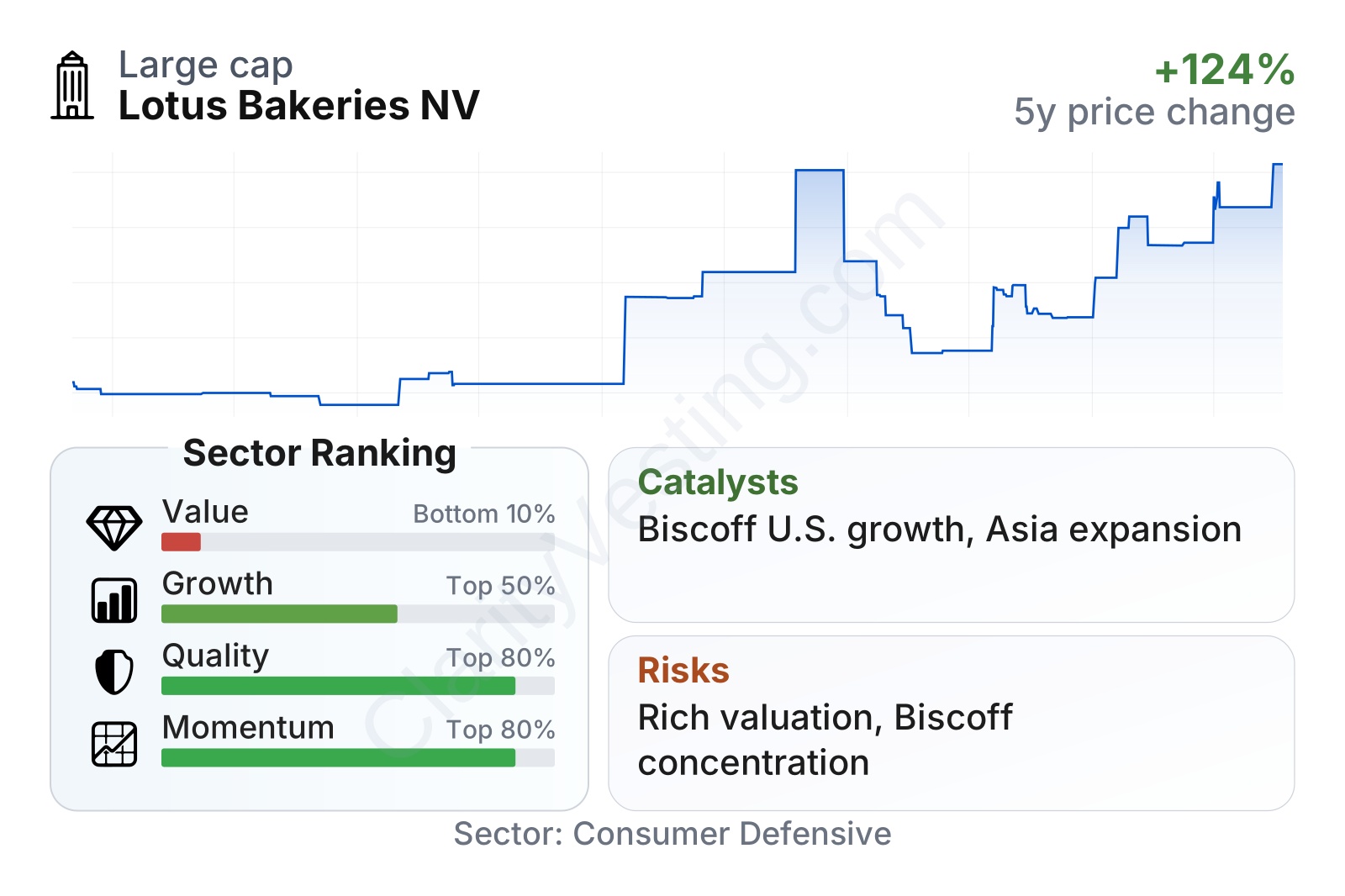
Lotus Bakeries stands out on quality, with profitability and capital efficiency well above the sector median. Operating margin is around the high teens versus a sector median in the high single digits, while return on invested capital and return on assets are also far stronger than most packaged-food peers. The balance sheet looks conservative as well, with low net debt relative to earnings and exceptionally strong interest coverage.
The growth profile is also solid. Recent revenue growth and five-year revenue-per-share growth are clearly ahead of the sector median, and free cash flow has compounded at a healthy pace. One weak point in the table is five-year EPS growth, which appears distorted by accounting and comparison effects rather than by a weak operating trend, because margins and net income have still improved over time.
Where the company looks stretched is valuation. The stock trades at a very high earnings multiple, a very high price-to-book ratio, and a low free-cash-flow yield relative to the sector. Momentum has been strong, but that often goes together with elevated expectations rather than a margin of safety.
Growth
Lotus Bakeries operates in attractive parts of consumer staples. Packaged snacks remain a large and resilient category, and premium branded biscuits and better-for-you snacks have continued to gain shelf space in many markets. These are not explosive industries in the way software or biotech can be, but they do offer long runways when a company has a recognizable brand, repeat purchases, and room for geographic expansion.
The company’s strategy appears coherent. Biscoff is the center of the model: it is a distinctive product with broad international appeal, simple positioning, and multiple consumption occasions. Lotus Bakeries has been extending that brand beyond the original biscuit into spread, sandwich cookies, and foodservice partnerships. At the same time, the Healthy Snacks portfolio gives the group exposure to consumer trends such as on-the-go snacking, lunchbox products, and reduced reliance on traditional indulgent categories.
A major catalyst is the continued internationalization of Biscoff, especially in the United States and Asia. The brand still has room to deepen distribution and awareness outside its historical European base. Capacity investments are therefore important: the company has been expanding production infrastructure to support future demand rather than waiting for constraints to emerge. In a branded food business, this can be a powerful signal that management sees sustained order growth ahead.
Another favorable point is that Lotus Bakeries has combined growth with strong economics. Revenue growth of around 14% year over year is well above the sector median, while operating margins remain robust. That combination is not common in consumer staples, where companies often have to choose between fast expansion and margin protection.
Recent company communication has also pointed to ongoing brand investment, wider international distribution, and continued scaling of strategic product categories. None of that guarantees the same pace every year, but it does indicate that the current expansion is supported by a deliberate multi-year plan rather than by a short-lived spike in demand.
Risks
This article is for informational purposes only and does not constitute financial advice. Some content is AI-generated. See Disclaimer


