Stock Analysis · Grand Canyon Education Inc (LOPE)
Overview
Grand Canyon Education, Inc. is an education services company that provides technology, academic support, counseling, marketing, and back-office services to universities and colleges. The company is best known for its long-term relationship with Grand Canyon University, but its model is not the same as a traditional school operator. Instead of relying mainly on tuition collected directly from students, Grand Canyon Education earns fees by supporting partner institutions in areas such as online program management, student services, curriculum support, and campus-related operations.
The business is still highly concentrated. Based on recent company filings, the largest share of revenue continues to come from services provided to Grand Canyon University, with a smaller but gradually expanding contribution from other university partners. The exact split can vary by period, but Grand Canyon University remains the dominant customer by a very wide margin.
In practical terms, Grand Canyon Education’s revenue sources can be understood as follows:
- University partner service revenue, primarily Grand Canyon University: approximately more than 85% of total revenue. This includes academic support, counseling, technology, marketing, enrollment-related services, and other operational support tied to student activity.
- Services provided to additional university partners: approximately less than 15% of total revenue. This includes similar support services for a growing roster of institutions using Grand Canyon Education’s platform and operational capabilities.
The business model has two notable characteristics for long-term analysis. First, it is asset-light compared with many education operators because it monetizes services and infrastructure rather than depending solely on owning degree-granting institutions. Second, the company benefits from recurring demand as long as partner schools keep attracting and retaining students.
Over the last several years, revenue has moved from roughly $900 million to more than $1.1 billion, while operating income and net income remained solid even through periods of enrollment pressure in the broader education market. That combination suggests a business with meaningful scale and unusually strong economics for its industry.
The broad financial flow shows a business that has expanded revenue steadily since 2021 while keeping costs under control well enough to preserve strong profitability. Margins are below their peak levels from 2021, but the company still converts a notably large share of revenue into operating profit and net income for an education services provider.
Key Figures
| Metric | Value | Sector ⓘ |
|---|---|---|
| Date | Oct 17, 2026 | |
| Context | ||
| Sector | Consumer Defensive | |
| Industry | Education & Training Services | |
| Market Cap ⓘ | $4.18B | |
| Beta ⓘ | 0.58 | |
Value (Cheapness) | ||
| P/E Ratio ⓘ | 19.45 | 17.88 |
| P/B Ratio ⓘ | 6.22 | 1.29 |
| FCF Yield ⓘ | 5.80% | 12.39% |
| Dividend Yield ⓘ | N/A | 2.85% |
| EBIT / EV ⓘ | 7.63% | 6.43% |
| PEG ⓘ | 0.89 | |
Growth (Business expansion) | ||
| Revenue Growth ⓘ | 6.70% | 4.10% |
| RPS Growth (5Y CAGR) ⓘ | 17.94% | 6.18% |
| EPS Growth (5Y CAGR) ⓘ | -6.26% | -13.59% |
| BVPS Growth (5Y CAGR) ⓘ | 2.90% | 3.20% |
| Margin Growth (5Y Trend) ⓘ | -12.05% | -0.15% |
| FCF Growth (5Y CAGR) ⓘ | -4.24% | 4.10% |
| DPS Growth (5Y CAGR) ⓘ | N/A | 6.79% |
Quality (Business durability) | ||
| ROIC (Latest) ⓘ | 30.64% | 12.34% |
| ROA (Latest) ⓘ | 22.97% | 6.30% |
| ROIC (5Y Median) ⓘ | 28.24% | 10.49% |
| ROA (5Y Median) ⓘ | 21.50% | 5.44% |
| Net Debt / EBIT (Latest) ⓘ | -0.23 | 1.96 |
| Net Debt / EBIT (5Y Median) ⓘ | -0.18 | 2.35 |
| Net Debt / EBITDA (Latest) ⓘ | -0.20 | 1.38 |
| Net Debt / Assets ⓘ | -7.27% | 21.51% |
| EBITDA / Interest ⓘ | N/A | 9.46 |
| Operating Margin (Latest) ⓘ | 25.13% | 8.87% |
| Operating Margin (5Y Median) ⓘ | 27.03% | 9.53% |
| Debt to Equity (Latest) ⓘ | 15.57% | 72.35% |
| Profit Margin (Latest) ⓘ | 19.63% | 5.40% |
| Free Cash Flow (Latest) ⓘ | $242.49M | |
Momentum (Price trend) | ||
| 3Y Return ⓘ | +36.71% | +20.92% |
| 12M Return (excl. last month) ⓘ | -27.88% | +2.13% |
| 6M Return ⓘ | -4.17% | +1.26% |
| Price vs. 200-Day MA ⓘ | +0.35% | +1.39% |
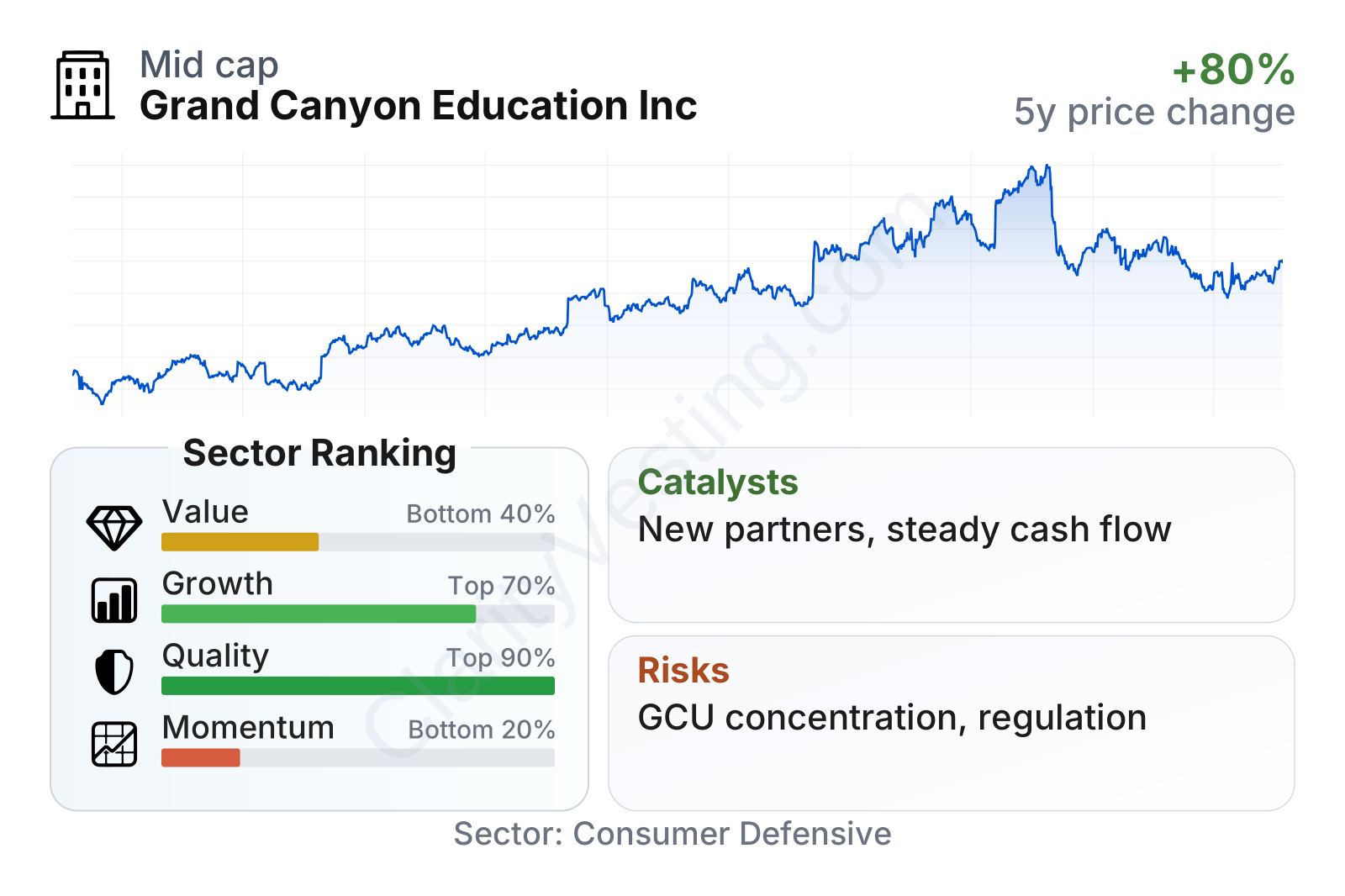
Grand Canyon Education sits in the mid-cap range and has shown relatively low share-price volatility, with a beta well below 1. In the factor breakdown, quality stands out the most: returns on capital and assets are far above typical sector levels, profitability is strong, and leverage remains low. Growth is respectable rather than spectacular, with revenue trends better than the sector median, although earnings and free cash flow growth over a longer period have been less smooth. Value looks close to average on earnings, but not especially cheap on balance-sheet multiples. Momentum is the weakest area after the stock’s pullback from its 2025 high.
Growth
The company operates in a part of the education market that still has room to expand over time. Demand for flexible degree programs, especially online and hybrid formats, remains important for working adults and nontraditional students. Colleges and universities also continue to look for outside partners that can help them with marketing, student support, and digital infrastructure without having to build every capability internally. That is the core trend Grand Canyon Education is trying to capture.
Its strategy appears coherent. Instead of depending only on one university relationship, management has been working to add more partners and broaden its service network. This matters because the company already has scale, operating systems, and student-support infrastructure in place. If additional institutions are added successfully, incremental revenue can potentially come with attractive economics.
Revenue growth has been consistently positive in recent quarters, generally running in the mid- to high-single-digit range. That is not explosive growth, but it is a healthy pattern for a mature education platform, especially in an industry where many operators have struggled with enrollment volatility.
Cash generation also supports the growth case. Free cash flow has recovered from earlier softness and has recently been moving back toward the upper end of its multiyear range. That gives the company room to invest in technology, support new partners, and continue share repurchases without leaning heavily on debt.
A useful catalyst is the company’s ability to expand beyond its flagship partner. In recent filings and investor communications, Grand Canyon Education has continued to emphasize new partner additions and broader program support capabilities. Another catalyst is the resilience of its service model: when institutions want to improve student outcomes, marketing efficiency, and online delivery, outsourcing to a scaled provider can become more attractive.
Recent operating trends also point to a meaningful opportunity. Revenue has continued to rise in 2026, suggesting that partner activity and student-related service demand remain healthy. If that pace is maintained while margins stabilize, the company could show that its platform can grow steadily even without a dramatic change in the higher education environment.
Risks
This article is for informational purposes only and does not constitute financial advice. Some content is AI-generated. See Disclaimer


