Stock Analysis · Lonking Holdings Limited (LONKF)
Overview
Lonking Holdings Limited is a Chinese manufacturer of construction and industrial machinery. The company is best known for equipment used in earthmoving, material handling, and road construction, with products sold both in China and overseas. Its lineup includes wheel loaders, excavators, forklifts, road rollers, and related components and parts. In simple terms, Lonking sells the heavy machines used on construction sites, mines, logistics yards, and infrastructure projects.
The business makes most of its money from equipment sales. Based on the company’s annual reporting structure in recent public reports, revenue is mainly generated from the following categories:
- Wheel loaders — historically the largest contributor, generally around 40% to 50% of revenue. These machines are used to move soil, sand, gravel, and other bulk materials.
- Forklifts — typically around 20% to 30% of revenue. This includes internal combustion and electric forklifts used in warehouses, factories, and ports.
- Excavators — usually around 10% to 20% of revenue. These are digging and earthmoving machines used in construction and mining.
- Road rollers and other construction machinery — generally a smaller share, often in the low-to-mid single-digit percentage range. These products support road building and site compaction.
- Parts, components, and others — a smaller but recurring portion of revenue, including spare parts and related items.
Lonking’s revenue mix matters because it shows the company is not dependent on only one niche, even though wheel loaders remain central. Forklifts also add an important second engine, especially as warehouse automation, factory expansion, and electric industrial vehicles continue to develop.
The business model is fairly straightforward: manufacture machines at scale, distribute them through dealer networks and direct channels, and support the installed base with parts and service-related demand. Over the last few years, revenue has been uneven, but profitability has improved meaningfully as costs have become more controlled and margins have recovered.
The operating picture has improved since the downturn in 2022 and 2023. Revenue has not yet returned to the 2021 peak, but gross profit and net income have recovered strongly, helped by lower financing costs and better cost discipline. Research and development spending has remained material, which suggests the company is still investing in product upgrades rather than simply harvesting mature lines.
Key Figures
| Metric | Value | Sector ⓘ |
|---|---|---|
| Date | Oct 17, 2026 | |
| Context | ||
| Sector | Industrials | |
| Industry | Farm & Heavy Construction Machinery | |
| Market Cap ⓘ | $1.67B | |
| Beta ⓘ | 1.14 | |
Value (Cheapness) | ||
| P/E Ratio ⓘ | 7.80 | 22.10 |
| P/B Ratio ⓘ | 0.15 | 1.97 |
| FCF Yield ⓘ | 136.09% | 6.38% |
| Dividend Yield ⓘ | 46.15% | 1.94% |
| EBIT / EV ⓘ | N/A | 4.79% |
| PEG ⓘ | N/A | |
Growth (Business expansion) | ||
| Revenue Growth ⓘ | 19.00% | 9.30% |
| RPS Growth (5Y CAGR) ⓘ | -5.48% | 7.81% |
| EPS Growth (5Y CAGR) ⓘ | -23.78% | -13.06% |
| BVPS Growth (5Y CAGR) ⓘ | 3.00% | 6.14% |
| Margin Growth (5Y Trend) ⓘ | 4.58% | 0.88% |
| FCF Growth (5Y CAGR) ⓘ | 138.80% | 11.01% |
| DPS Growth (5Y CAGR) ⓘ | -19.69% | 9.48% |
Quality (Business durability) | ||
| ROIC (Latest) ⓘ | N/A | 10.84% |
| ROA (Latest) ⓘ | 13.32% | 5.41% |
| ROIC (5Y Median) ⓘ | 7.24% | 9.38% |
| ROA (5Y Median) ⓘ | 6.55% | 4.95% |
| Net Debt / EBIT (Latest) ⓘ | -1.90 | 2.08 |
| Net Debt / EBIT (5Y Median) ⓘ | -2.04 | 2.27 |
| Net Debt / EBITDA (Latest) ⓘ | -1.59 | 1.39 |
| Net Debt / Assets ⓘ | -21.96% | 19.28% |
| EBITDA / Interest ⓘ | N/A | 9.58 |
| Operating Margin (Latest) ⓘ | 10.76% | 10.50% |
| Operating Margin (5Y Median) ⓘ | 7.77% | 10.29% |
| Debt to Equity (Latest) ⓘ | N/A | 65.48% |
| Profit Margin (Latest) ⓘ | 11.74% | 6.67% |
| Free Cash Flow (Latest) ⓘ | $2.27B | |
Momentum (Price trend) | ||
| 3Y Return ⓘ | +131.32% | +61.68% |
| 12M Return (excl. last month) ⓘ | +3.89% | +12.58% |
| 6M Return ⓘ | +8.33% | 0.00% |
| Price vs. 200-Day MA ⓘ | +10.60% | +0.02% |
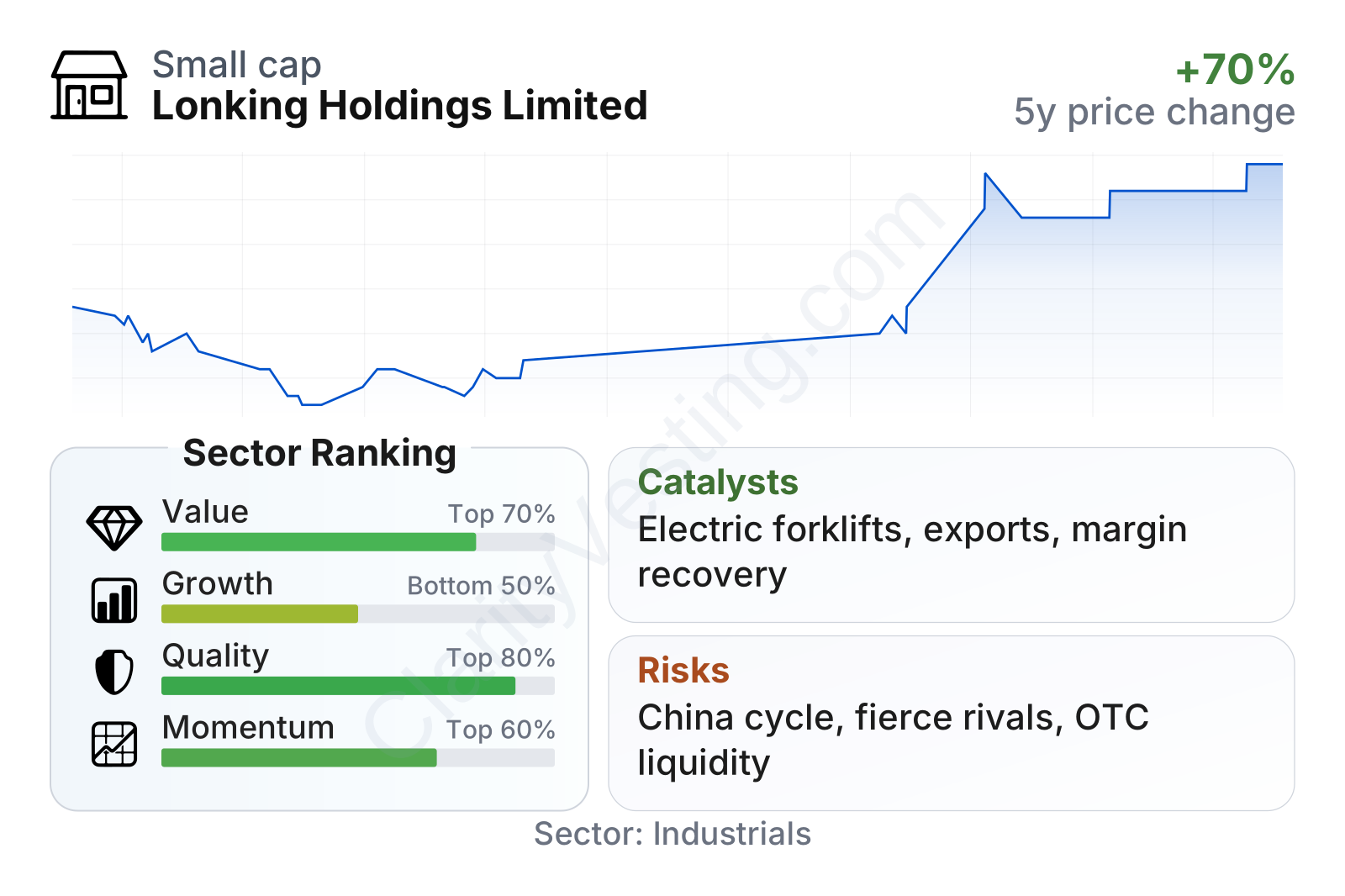
Lonking currently screens as inexpensive on traditional valuation measures, with earnings and book value multiples far below typical sector levels. Profitability and balance-sheet quality look better than many peers: return on assets is strong, profit margin is above the industry median, and the company carries net cash rather than heavy net debt. Growth is the weaker area. Recent year-over-year revenue growth has been solid, but the longer five-year record for sales and earnings per share remains soft, showing how cyclical the business has been. On share performance, the longer trend has been favorable, while the most recent twelve-month move has been more moderate.
Growth
Lonking operates in a sector tied to construction activity, infrastructure spending, manufacturing investment, mining demand, and logistics equipment replacement. That makes it cyclical, but it also means there are several growth paths rather than a single demand driver. In particular, forklifts can benefit from warehouse expansion and industrial modernization, while excavators and loaders are linked more directly to construction and public works activity.
The company’s strategy appears logical for this type of industry. It competes through broad product coverage, manufacturing scale, and cost efficiency, while continuing to spend on research and development. That matters because heavy machinery customers increasingly care about fuel efficiency, electrification, operating reliability, and lifetime maintenance cost. Lonking does not need to dominate the premium end of the market to remain relevant; being competitive on price and dependable on core performance can still support market share in many regions.
A notable catalyst is the ongoing shift toward electric industrial vehicles, especially in forklifts. This is one of the more practical electrification segments because the duty cycles and charging patterns are more manageable than in some larger heavy machines. If Lonking expands its electric lineup successfully, it could strengthen both domestic and export demand.
Another positive sign is the sharp rebound in earnings and cash generation after the weaker 2022-2023 period. Revenue in 2025 moved back above 2024 levels, while margins stayed healthier than before. That combination suggests the company is not relying only on volume recovery; it is also benefiting from better operating efficiency.
Recent company communications and public filings have continued to emphasize product development, overseas market expansion, and upgrades across machinery categories. For a manufacturer of this size, external growth does not need to come from a single major event. Steady export penetration, better product mix, and rising demand for newer equipment types can be enough to improve the earnings profile over time.
Risks
This article is for informational purposes only and does not constitute financial advice. Some content is AI-generated. See Disclaimer


