Stock Analysis · Loar Holdings Inc (LOAR)
Overview
Loar Holdings Inc is a specialized aerospace and defense supplier. The company sells mission-critical components that are used on commercial aircraft, business jets, military platforms, and related systems. Rather than building whole aircraft, Loar focuses on smaller but important parts that are difficult to replace once designed into an aircraft or defense program. This matters because aerospace customers usually prefer proven suppliers with certified products, long service histories, and dependable delivery.
Based on the company’s public filings and investor materials, Loar operates through a collection of niche engineering and manufacturing businesses. Its product portfolio includes components such as avionics and electronics-related products, actuation and motion-control systems, specialty sensors, restraint systems, and other highly engineered aerospace parts. A meaningful part of the business also benefits from aftermarket demand, where installed equipment creates recurring replacement, repair, or support revenue over time.
Revenue is not disclosed in the provided materials by a simple product-by-product percentage split that is current enough to present as a precise ranking for 2026. However, the business mix can still be understood through its end markets and operating model:
- Commercial aerospace: the largest demand driver, supported by aircraft production, fleet utilization, retrofits, and replacement parts.
- Defense aerospace: exposure to military aircraft and related systems, which can add stability when commercial cycles soften.
- Aftermarket and replacement demand: recurring revenue tied to the installed base of aircraft components already in service.
- Original equipment manufacturing: sales linked to new aircraft builds and platform content wins.
Financially, the business has been scaling quickly. Revenue rose from about $239 million in 2022 to about $496 million in 2025, while profitability improved even faster as interest burden eased and operating leverage expanded. The income flow also shows a useful shift: gross profit and operating income have been climbing steadily, and net income moved from losses in 2022 and 2023 to solid profitability in 2024 and 2025.
The financial profile shows a company that has become much more profitable as it has grown. Sales have roughly doubled in three years, operating income has expanded strongly, and interest expense has dropped sharply from 2023 to 2025, which helped turn operating progress into much stronger net income.
Key Figures
| Metric | Value | Sector ⓘ |
|---|---|---|
| Date | Oct 17, 2026 | |
| Context | ||
| Sector | Industrials | |
| Industry | Aerospace & Defense | |
| Market Cap ⓘ | $5.79B | |
| Beta ⓘ | 0.64 | |
Value (Cheapness) | ||
| P/E Ratio ⓘ | 87.11 | 22.10 |
| P/B Ratio ⓘ | 4.89 | 1.97 |
| FCF Yield ⓘ | 1.83% | 6.38% |
| Dividend Yield ⓘ | N/A | 1.94% |
| EBIT / EV ⓘ | 1.88% | 4.79% |
| PEG ⓘ | N/A | |
Growth (Business expansion) | ||
| Revenue Growth ⓘ | 39.40% | 9.30% |
| RPS Growth (5Y CAGR) ⓘ | 18.50% | 7.81% |
| EPS Growth (5Y CAGR) ⓘ | N/A | -13.06% |
| BVPS Growth (5Y CAGR) ⓘ | 30.75% | 6.14% |
| Margin Growth (5Y Trend) ⓘ | 4.93% | 0.88% |
| FCF Growth (5Y CAGR) ⓘ | 164.90% | 11.01% |
| DPS Growth (5Y CAGR) ⓘ | N/A | 9.48% |
Quality (Business durability) | ||
| ROIC (Latest) ⓘ | 5.76% | 10.84% |
| ROA (Latest) ⓘ | 3.52% | 5.41% |
| ROIC (5Y Median) ⓘ | N/A | 9.38% |
| ROA (5Y Median) ⓘ | 1.78% | 4.95% |
| Net Debt / EBIT (Latest) ⓘ | 6.57 | 2.08 |
| Net Debt / EBIT (5Y Median) ⓘ | 6.78 | 2.27 |
| Net Debt / EBITDA (Latest) ⓘ | 4.37 | 1.39 |
| Net Debt / Assets ⓘ | 36.22% | 19.28% |
| EBITDA / Interest ⓘ | 3.75 | 9.58 |
| Operating Margin (Latest) ⓘ | 21.86% | 10.50% |
| Operating Margin (5Y Median) ⓘ | 20.78% | 10.29% |
| Debt to Equity (Latest) ⓘ | 80.44% | 65.48% |
| Profit Margin (Latest) ⓘ | 11.60% | 6.67% |
| Free Cash Flow (Latest) ⓘ | $106.04M | |
Momentum (Price trend) | ||
| 3Y Return ⓘ | N/A | +61.68% |
| 12M Return (excl. last month) ⓘ | -15.61% | +12.58% |
| 6M Return ⓘ | -8.56% | 0.00% |
| Price vs. 200-Day MA ⓘ | -8.36% | +0.02% |
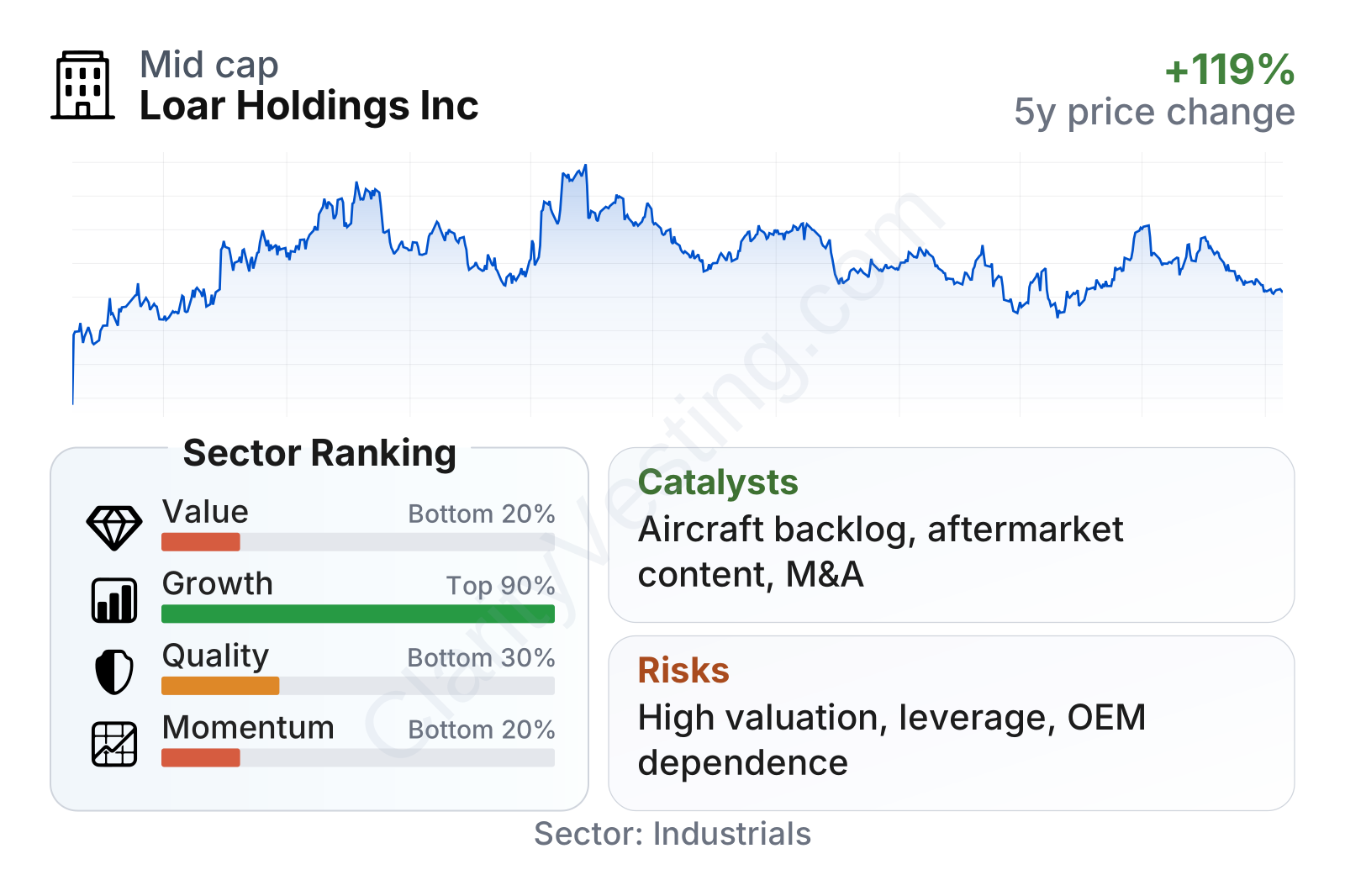
Loar currently sits in the stronger end of the sector for growth, but weaker on valuation and somewhat weaker on balance-sheet quality. Revenue growth is running far above the sector median, margins are better than average, and free cash flow has improved materially. At the same time, the stock trades at a much richer earnings multiple than most aerospace and defense peers, while leverage and interest coverage remain less comfortable than the sector norm.
Growth
Loar operates in an attractive long-term sector. Commercial aerospace continues to benefit from high passenger traffic, large aircraft backlogs, and the need to keep aging fleets flying efficiently. Defense demand also remains supportive in many Western markets. For a niche component supplier, these trends can create a long runway because growth does not depend on winning entire aircraft programs; it depends on preserving and expanding content on multiple platforms.
The company’s strategy appears logically aligned with that backdrop. Loar focuses on highly engineered components with certification barriers, smaller competitive fields, and applications where reliability matters more than price alone. That kind of positioning can support pricing power, sticky customer relationships, and long product lives. It also fits a consolidation model, where a parent company acquires smaller specialized businesses and improves their scale, customer reach, and margins.
Recent revenue momentum has been very strong. Year-over-year growth moved from an already solid range near 20% to 30% into the high 30% range in the most recent periods, clearly outpacing the broader sector. That acceleration suggests Loar is not only benefiting from favorable aerospace demand but is also executing well internally.
Cash generation has also been moving in the right direction. Free cash flow has climbed sharply from relatively modest levels in 2024 to much stronger levels by 2026. That is important because it shows growth is increasingly turning into actual cash, not just accounting earnings. For a company with acquisition ambitions and debt to manage, this trend matters a lot.
A meaningful catalyst is Loar’s exposure to aircraft content that can produce revenue for many years after the initial sale. Once a component is qualified and installed, switching suppliers is often inconvenient and costly for customers. Another catalyst is the company’s fragmented target market: niche aerospace suppliers can provide acquisition opportunities if integration remains disciplined. Stronger profitability since 2024 also gives Loar more room to reinvest in product development and bolt-on deals.
Recent company communications and filings have also pointed to continued business expansion, including ongoing demand across commercial and defense end markets. The broader industry setup remains favorable as major aircraft manufacturers work through backlogs and suppliers that can deliver reliably become more valuable within the chain.
Risks
This article is for informational purposes only and does not constitute financial advice. Some content is AI-generated. See Disclaimer


