Stock Analysis · Li Ning Co Ltd (LNNGY)
Overview
Li Ning Co Ltd is a Chinese sportswear company best known for athletic footwear, apparel, and sports equipment sold under the Li-Ning brand. The group designs products, manages branding and marketing, and sells through a mix of directly operated stores, distributors, e-commerce platforms, and online flagship stores. Its positioning sits between mass-market sportswear and premium domestic branding, with a strong focus on performance categories such as running, basketball, training, and badminton, while also developing lifestyle products tied to fashion trends.
The business is still mainly driven by mainland China, where domestic sports participation, health awareness, and interest in local brands have supported long-term demand. The company has also invested in digital retail, store upgrades, and category expansion to strengthen brand control and improve full-price sales.
Based on recent annual disclosures, revenue is primarily generated by product categories rather than geographic diversity, and footwear and apparel dominate the mix.
- Footwear: approximately 46% of revenue. This includes running shoes, basketball shoes, training shoes, and other athletic footwear.
- Apparel: approximately 48% of revenue. This covers sportswear, training clothing, lifestyle apparel, and team or event-related products.
- Equipment and accessories: approximately 6% of revenue. This includes items such as bags, hats, balls, rackets, and other sporting goods.
Another important lens is channel mix. Official filings indicate that wholesale remains the largest route to market, with direct retail and e-commerce also playing major roles. Exact percentages can vary year to year, but wholesale has historically been the biggest contributor, while direct sales and online channels are strategically important because they can improve pricing control, inventory visibility, and customer engagement.
Over the last several years, revenue kept rising, but profit conversion became less efficient. Sales increased from roughly RMB 22.6 billion in 2021 to about RMB 28.8 billion in 2025, while net income moved in the opposite direction after peaking earlier in the cycle. That pattern suggests the brand is still relevant and growing in absolute size, but growth has recently required heavier operating support.
The profit structure shows a business that continues to generate a large gross profit base, but operating income and net income have compressed since 2021. In simple terms, Li Ning is still selling more, yet a smaller share of each revenue dollar is flowing through to shareholders than before.
Key Figures
| Metric | Value | Sector ⓘ |
|---|---|---|
| Date | Oct 10, 2026 | |
| Context | ||
| Sector | Consumer Cyclical | |
| Industry | Leisure | |
| Market Cap ⓘ | $4.09B | |
| Beta ⓘ | 0.92 | |
Value (Cheapness) | ||
| P/E Ratio ⓘ | 9.51 | 16.86 |
| P/B Ratio ⓘ | 0.14 | 1.64 |
| FCF Yield ⓘ | 160.99% | 9.24% |
| Dividend Yield ⓘ | 5.44% | 2.71% |
| EBIT / EV ⓘ | N/A | 6.67% |
| PEG ⓘ | 1.51 | |
Growth (Business expansion) | ||
| Revenue Growth ⓘ | 2.80% | 5.65% |
| RPS Growth (5Y CAGR) ⓘ | 5.79% | 8.91% |
| EPS Growth (5Y CAGR) ⓘ | 59.40% | -17.54% |
| BVPS Growth (5Y CAGR) ⓘ | 6.50% | 5.62% |
| Margin Growth (5Y Trend) ⓘ | -9.85% | -0.23% |
| FCF Growth (5Y CAGR) ⓘ | -4.42% | 4.96% |
| DPS Growth (5Y CAGR) ⓘ | 26.92% | 10.03% |
Quality (Business durability) | ||
| ROIC (Latest) ⓘ | N/A | 12.38% |
| ROA (Latest) ⓘ | 15.62% | 5.49% |
| ROIC (5Y Median) ⓘ | 13.57% | 10.67% |
| ROA (5Y Median) ⓘ | 9.39% | 5.44% |
| Net Debt / EBIT (Latest) ⓘ | -1.33 | 2.17 |
| Net Debt / EBIT (5Y Median) ⓘ | -1.30 | 2.30 |
| Net Debt / EBITDA (Latest) ⓘ | -0.99 | 1.56 |
| Net Debt / Assets ⓘ | -28.68% | 21.76% |
| EBITDA / Interest ⓘ | 47.88 | 9.06 |
| Operating Margin (Latest) ⓘ | 14.09% | 9.08% |
| Operating Margin (5Y Median) ⓘ | 16.00% | 9.53% |
| Debt to Equity (Latest) ⓘ | 6.91% | 76.00% |
| Profit Margin (Latest) ⓘ | 10.04% | 5.31% |
| Free Cash Flow (Latest) ⓘ | $6.58B | |
Momentum (Price trend) | ||
| 3Y Return ⓘ | -55.44% | +14.94% |
| 12M Return (excl. last month) ⓘ | -25.10% | -0.67% |
| 6M Return ⓘ | -40.21% | 0.00% |
| Price vs. 200-Day MA ⓘ | -27.73% | -3.73% |
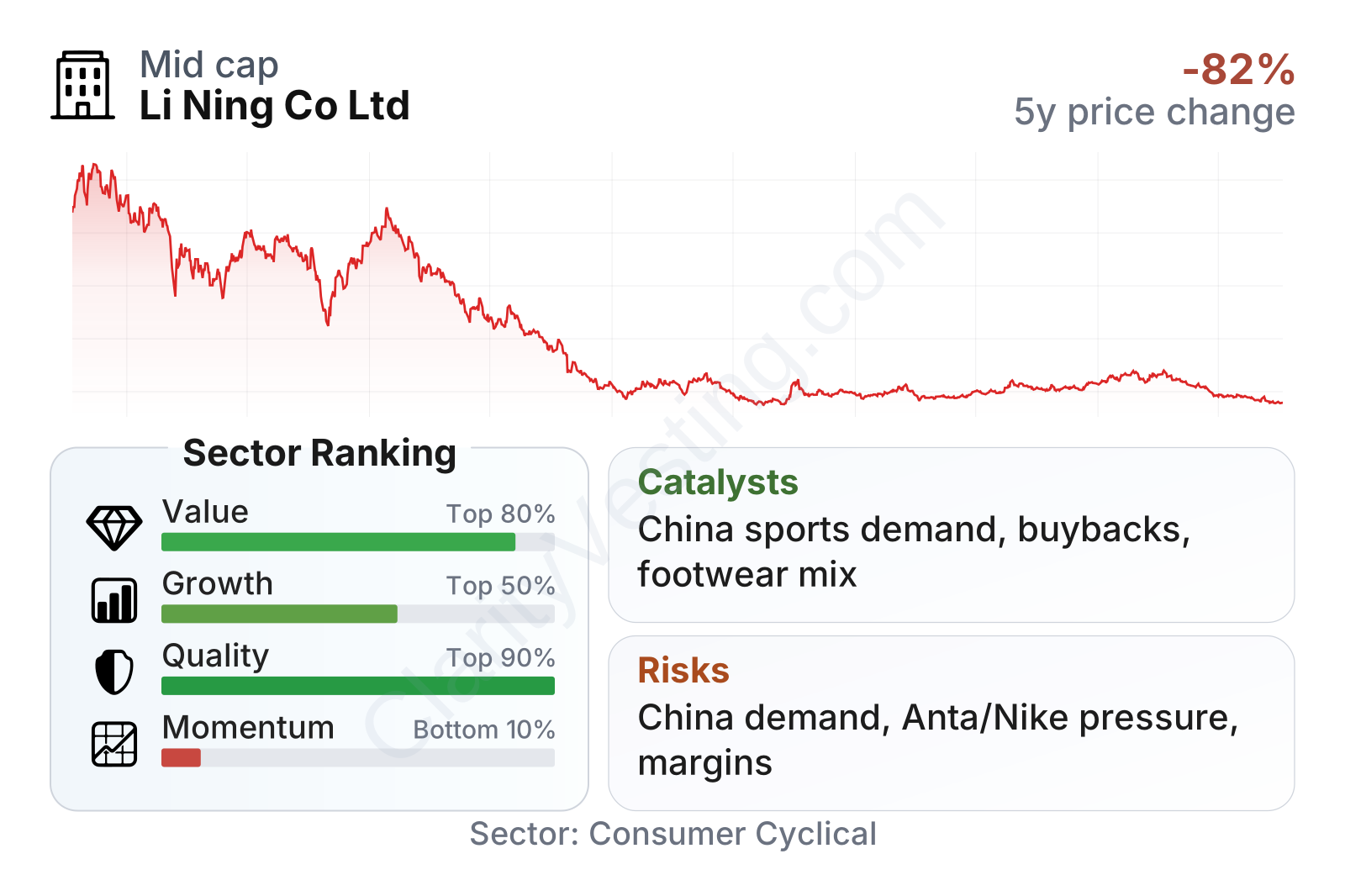
Li Ning stands out for balance-sheet strength and profitability, but not for stock market performance. Quality metrics are among the strongest in its sector: profitability on assets is well above the industry median, operating margins remain above peers even after recent pressure, and the company carries very little debt. Value metrics also look unusually low relative to the sector, with a single-digit earnings multiple and a dividend yield above the industry median. By contrast, growth is mixed rather than exceptional: recent revenue expansion has been modest, free cash flow has been uneven over five years, and margin trends have softened. Momentum is clearly weak, reflecting a share price that has fallen sharply from its 2021 peak and has continued to trail the broader consumer discretionary group.
Growth
Li Ning operates in a sector that still has structural growth drivers. Sports participation, fitness spending, sneaker culture, and the shift toward healthier lifestyles remain favorable themes in China. Domestic sportswear also benefits from a long-term trend toward local brand acceptance, especially among younger consumers who are more open to buying Chinese labels instead of relying only on global names.
The company’s strategy broadly makes sense for future expansion. It has been focusing on premium product design, higher-value categories such as professional running and basketball, stronger digital engagement, and a more disciplined retail network. These are sensible priorities because sportswear is not only about volume; long-term success usually depends on brand heat, product innovation, and avoiding excessive discounting.
There are also some practical catalysts. First, footwear remains a large category with room for innovation and mix improvement. Second, e-commerce and membership programs can deepen repeat purchases and support better customer data. Third, if consumer demand in China stabilizes, Li Ning could benefit from operating leverage because the business already has scale and a well-known brand.
Recent company updates have also emphasized shareholder returns through dividends and share repurchases, which can help support per-share results if earnings growth remains moderate. In addition, China’s continued support for sports participation, winter sports, and physical activity creates a favorable backdrop for recognized athletic brands with national reach.
That said, the company’s recent growth profile is no longer as powerful as it was during its strongest expansion phase. Revenue is still moving up, but at a slower pace than many investors once expected, and earnings growth has not kept pace. So the opportunity is less about an early-stage growth surge and more about whether Li Ning can restore stronger brand momentum and margins from a mature base.
Risks
This article is for informational purposes only and does not constitute financial advice. Some content is AI-generated. See Disclaimer