Stock Analysis · Lindsay Corporation (LNN)
Overview
Lindsay Corporation is an industrial company best known for irrigation equipment used in agriculture and for infrastructure products used on roads and transportation networks. In simple terms, one part of the business helps farmers deliver water more efficiently to crops, while the other part sells systems that improve road safety and traffic management.
The company reports two main business segments: Irrigation and Infrastructure. Irrigation is the core business and includes center pivot and lateral move irrigation systems, remote monitoring and control technology, parts, and related services. Infrastructure includes road safety products such as barriers, crash cushions, movable barriers, and transportation technology systems used for traffic management.
Based on the latest annual reporting structure, Lindsay’s revenue mix is approximately:
- Irrigation: about 80% to 85% of revenue. This is the company’s largest activity by far and includes equipment sold under the Zimmatic brand, replacement parts, and technology that helps manage water use.
- Infrastructure: about 15% to 20% of revenue. This includes road safety hardware and transportation systems for public agencies and contractors.
The business is geographically diversified, with the United States remaining important, but international agricultural markets also matter because irrigation adoption depends heavily on crop prices, water availability, government support, and local farm economics.
One notable financial pattern is that revenue has been somewhat cyclical, but the company has kept a meaningful share of profit through the cycle. Gross profit and net income have held up better than sales at several points, suggesting pricing discipline, product mix support, and a business model that is more resilient than a simple commodity equipment supplier.
Key Figures
| Metric | Value | Sector ⓘ |
|---|---|---|
| Date | Oct 17, 2026 | |
| Context | ||
| Sector | Industrials | |
| Industry | Farm & Heavy Construction Machinery | |
| Market Cap ⓘ | $1.17B | |
| Beta ⓘ | 0.68 | |
Value (Cheapness) | ||
| P/E Ratio ⓘ | 22.16 | 22.10 |
| P/B Ratio ⓘ | 2.36 | 1.97 |
| FCF Yield ⓘ | 3.82% | 6.38% |
| Dividend Yield ⓘ | 1.31% | 1.94% |
| EBIT / EV ⓘ | 6.01% | 4.79% |
| PEG ⓘ | 1.17 | |
Growth (Business expansion) | ||
| Revenue Growth ⓘ | -5.10% | 9.30% |
| RPS Growth (5Y CAGR) ⓘ | 4.64% | 7.81% |
| EPS Growth (5Y CAGR) ⓘ | -8.19% | -13.06% |
| BVPS Growth (5Y CAGR) ⓘ | 12.19% | 6.14% |
| Margin Growth (5Y Trend) ⓘ | 4.54% | 0.88% |
| FCF Growth (5Y CAGR) ⓘ | 50.86% | 11.01% |
| DPS Growth (5Y CAGR) ⓘ | 2.84% | 9.48% |
Quality (Business durability) | ||
| ROIC (Latest) ⓘ | 8.47% | 10.84% |
| ROA (Latest) ⓘ | 6.64% | 5.41% |
| ROIC (5Y Median) ⓘ | 12.14% | 9.38% |
| ROA (5Y Median) ⓘ | 9.25% | 4.95% |
| Net Debt / EBIT (Latest) ⓘ | -0.24 | 2.08 |
| Net Debt / EBIT (5Y Median) ⓘ | -0.24 | 2.27 |
| Net Debt / EBITDA (Latest) ⓘ | -0.19 | 1.39 |
| Net Debt / Assets ⓘ | -2.06% | 19.28% |
| EBITDA / Interest ⓘ | N/A | 9.58 |
| Operating Margin (Latest) ⓘ | 11.02% | 10.50% |
| Operating Margin (5Y Median) ⓘ | 13.55% | 10.29% |
| Debt to Equity (Latest) ⓘ | 27.62% | 65.48% |
| Profit Margin (Latest) ⓘ | 8.79% | 6.67% |
| Free Cash Flow (Latest) ⓘ | $44.90M | |
Momentum (Price trend) | ||
| 3Y Return ⓘ | +4.56% | +61.68% |
| 12M Return (excl. last month) ⓘ | -14.08% | +12.58% |
| 6M Return ⓘ | +0.34% | 0.00% |
| Price vs. 200-Day MA ⓘ | -4.37% | +0.02% |
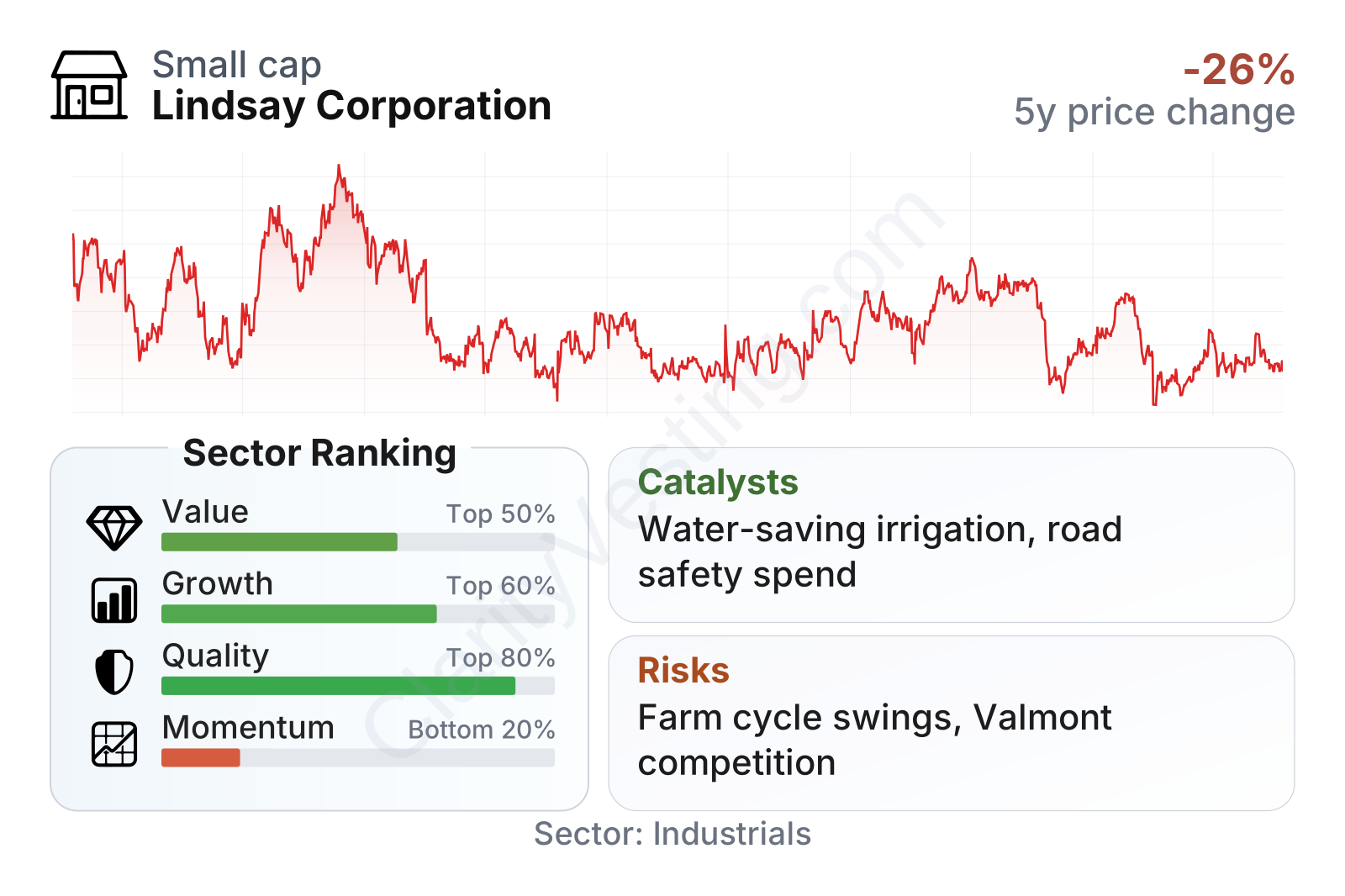
Lindsay is a relatively small public company by market value, with a share price that has moved unevenly over the past several years rather than following a strong upward trend. The balance sheet is a clear strength: leverage is low, and net debt metrics indicate the company is effectively operating with more cash flexibility than many industrial peers. Profitability also stands out, with margins above the sector median, while growth and recent market performance have been more mixed. Overall, the profile looks like a financially disciplined niche industrial business rather than a fast-growing machinery name.
Growth
Lindsay operates in two areas that both have long-term relevance, although they do not grow in a straight line. The irrigation business is tied to a structural theme: agriculture needs to produce more with tighter water constraints. Precision irrigation, automation, and digital farm management are increasingly important in regions facing water scarcity, labor pressure, and the need to improve crop yields. That gives the sector a credible long-term foundation, even if annual equipment demand still moves with farm income and weather.
The company’s strategy broadly fits that backdrop. Lindsay has been combining equipment sales with technology features such as remote monitoring, scheduling, and machine control. That matters because it can deepen customer relationships, support aftermarket revenue, and make the product more valuable than a basic irrigation machine alone. In infrastructure, the company is exposed to public spending on road safety and traffic systems, which adds a second growth path outside farming.
Recent revenue growth has been volatile. After a strong rebound earlier in the cycle, sales turned negative in several periods, and the latest year-over-year reading remains below the sector median. That does not automatically signal a broken business, but it does show that Lindsay is still exposed to timing swings in dealer orders, farm conditions, and project activity. The more encouraging point is that over a multi-year period, the company has improved margins and book value even without consistently strong top-line growth.
Cash generation is another favorable element. Free cash flow has improved sharply from the weaker level seen a few years ago and has remained solidly positive, even if it has eased from the peak. For a company in equipment manufacturing, that matters because internally generated cash can support product development, dividends, acquisitions, and resilience during softer demand periods.
A meaningful catalyst is the broader push for water efficiency. Farmers and policymakers in many regions are under pressure to manage limited water resources more carefully, which supports adoption of more advanced irrigation systems over time. A second catalyst is transportation infrastructure modernization, where demand for road safety hardware and traffic technologies can benefit from public investment programs. Recent company communications have also highlighted ongoing international irrigation opportunities and continued focus on technology-enabled products, both of which could help Lindsay expand beyond pure replacement demand.
Risks
This article is for informational purposes only and does not constitute financial advice. Some content is AI-generated. See Disclaimer


