Stock Analysis · Lee & Man Paper Manufacturing Ltd (LMPMY)
Overview
Lee & Man Paper Manufacturing Ltd is a large Chinese paper producer focused on containerboard and other industrial paper grades used in packaging. In simple terms, the company turns recovered paper and pulp into packaging paper, tissue products, and related pulp materials. Its business is tied closely to manufacturing activity, e-commerce shipping demand, and everyday consumer paper use.
The company’s revenue is mainly generated by paper manufacturing, with packaging paper clearly the core business. Based on the company’s recent annual reporting structure, revenue sources can be summarized approximately as follows:
- Containerboard and corrugating medium: about 70% to 80% of revenue. This includes linerboard, corrugating medium, and other board products used to make cardboard boxes and transport packaging.
- Tissue paper: about 10% to 20% of revenue. This covers household and sanitary tissue products.
- Pulp and related raw-material products: about 5% to 15% of revenue. This includes pulp used internally and, when applicable, sold externally.
- Other products and services: a small remainder. This generally includes ancillary paper grades and related operating items.
This revenue mix matters because it shows Lee & Man is primarily a packaging-paper company rather than a broad consumer brand. That makes earnings more sensitive to industrial demand, box demand, waste paper costs, pulp prices, and the balance between supply and demand in China’s paper market.
Recent operating trends look better than the difficult period seen in 2022 and 2023. Revenue recovered in 2024 and 2025, while operating income and net income improved more sharply than sales, suggesting pricing and cost conditions became more favorable. Gross profit has also rebounded meaningfully from its low point, which is important in a commodity-like industry where margins can move quickly.
The flow of revenue to profit shows a business that went through a margin squeeze and then recovered. Sales have not returned to the 2021 peak, but profitability improved much more clearly in 2024 and 2025, helped by lower financing costs than 2024 and better conversion of sales into operating income.
Key Figures
| Metric | Value | Sector ⓘ |
|---|---|---|
| Date | Oct 17, 2026 | |
| Context | ||
| Sector | Basic Materials | |
| Industry | Paper & Paper Products | |
| Market Cap ⓘ | $1.83B | |
| Beta ⓘ | 0.99 | |
Value (Cheapness) | ||
| P/E Ratio ⓘ | 5.67 | 16.90 |
| P/B Ratio ⓘ | 0.05 | 1.65 |
| FCF Yield ⓘ | -23.78% | 5.76% |
| Dividend Yield ⓘ | 6.16% | 2.13% |
| EBIT / EV ⓘ | N/A | 6.30% |
| PEG ⓘ | N/A | |
Growth (Business expansion) | ||
| Revenue Growth ⓘ | 21.30% | 11.10% |
| RPS Growth (5Y CAGR) ⓘ | -4.62% | 4.49% |
| EPS Growth (5Y CAGR) ⓘ | 7.06% | -13.47% |
| BVPS Growth (5Y CAGR) ⓘ | -2.02% | 5.51% |
| Margin Growth (5Y Trend) ⓘ | -1.74% | -1.54% |
| FCF Growth (5Y CAGR) ⓘ | N/A | 0.37% |
| DPS Growth (5Y CAGR) ⓘ | -23.88% | 6.08% |
Quality (Business durability) | ||
| ROIC (Latest) ⓘ | 6.92% | 9.26% |
| ROA (Latest) ⓘ | 5.95% | 4.91% |
| ROIC (5Y Median) ⓘ | 3.53% | 7.70% |
| ROA (5Y Median) ⓘ | 2.56% | 3.86% |
| Net Debt / EBIT (Latest) ⓘ | 4.73 | 1.40 |
| Net Debt / EBIT (5Y Median) ⓘ | 9.18 | 1.70 |
| Net Debt / EBITDA (Latest) ⓘ | 4.19 | 0.95 |
| Net Debt / Assets ⓘ | 32.84% | 13.69% |
| EBITDA / Interest ⓘ | 5.66 | 12.34 |
| Operating Margin (Latest) ⓘ | 8.67% | 13.20% |
| Operating Margin (5Y Median) ⓘ | 7.46% | 11.80% |
| Debt to Equity (Latest) ⓘ | 66.14% | 40.56% |
| Profit Margin (Latest) ⓘ | 8.56% | 6.43% |
| Free Cash Flow (Latest) ⓘ | -$434.11M | |
Momentum (Price trend) | ||
| 3Y Return ⓘ | +64.37% | +68.89% |
| 12M Return (excl. last month) ⓘ | +27.56% | +30.21% |
| 6M Return ⓘ | -2.68% | -4.16% |
| Price vs. 200-Day MA ⓘ | +21.56% | -1.27% |
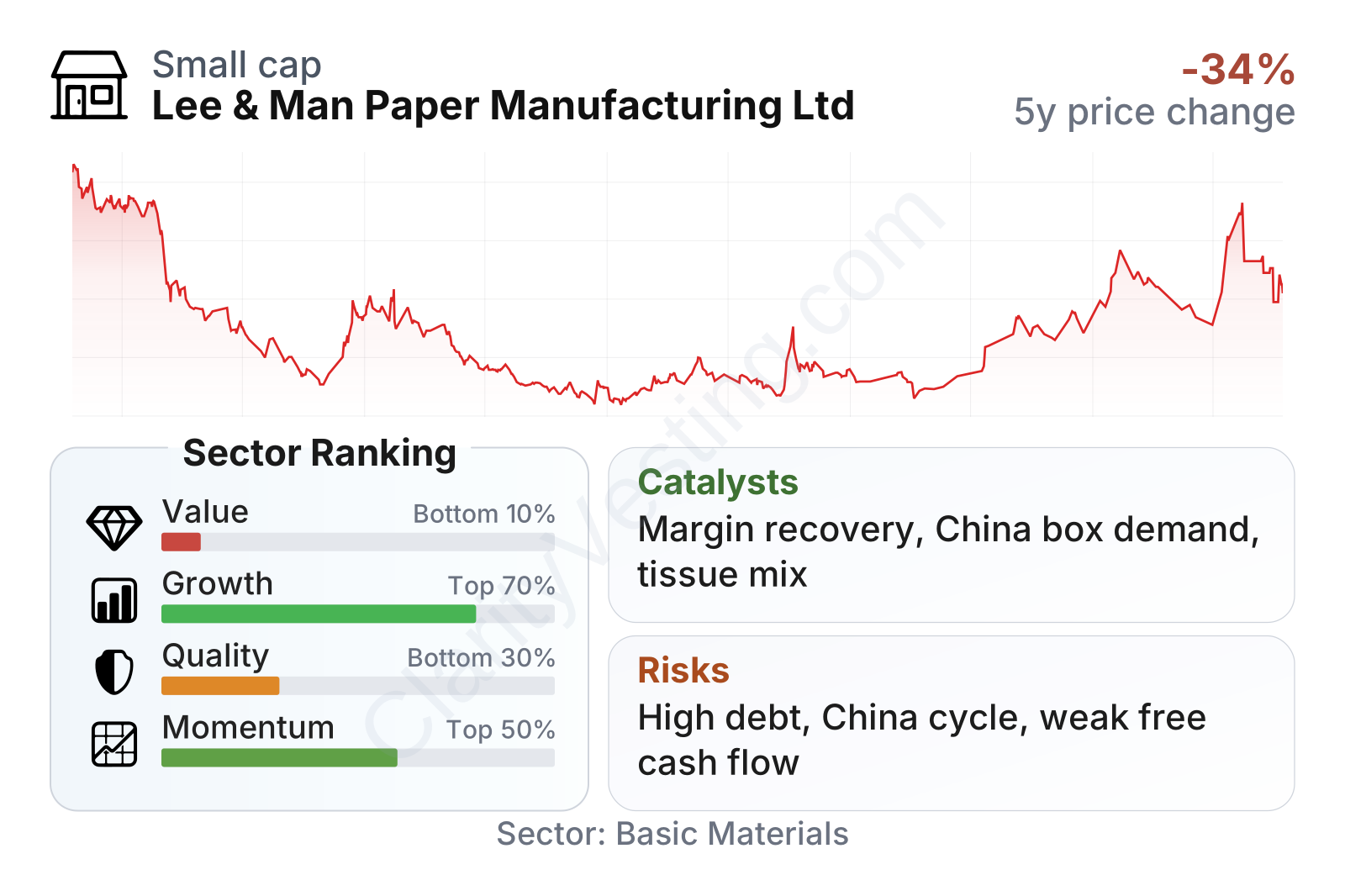
Lee & Man is a mid-sized materials company with share-price volatility close to the broader market. The stock has rebounded strongly from its lows, and its recent momentum stands above much of the sector over longer periods. On valuation, the shares screen as very inexpensive: earnings and book-based multiples are far below typical sector levels, while the dividend yield is notably above the sector median.
That cheapness comes with trade-offs. Growth looks mixed rather than consistently strong: recent year-over-year revenue growth has been solid, but five-year revenue per share and book value per share trends remain weak. Profitability is also uneven. Current profit margin is decent for the sector, yet operating margin and returns on invested capital remain below many peers. The biggest weak spot in the table is balance-sheet and cash-flow quality, with leverage higher than sector norms and free cash flow still negative on a trailing basis.
The stock-price history also reflects that pattern. The shares fell heavily from 2021 into late 2023, then staged a meaningful recovery into 2026. That usually signals that the market is recognizing better conditions, but it also reminds readers that this is a cyclical company, not a stable compounder.
Growth
Lee & Man operates in a sector with steady long-term demand but cyclical short-term swings. Packaging paper benefits from structural support such as e-commerce shipments, logistics activity, and the ongoing need for transport packaging across manufacturing and consumer goods. Tissue demand is also relatively durable because it comes from everyday consumption. That means the sector is not a high-growth industry in the technology sense, but it does have recurring demand and room for volume growth when the economy expands.
The company’s strategy is logical for this type of industry. It has built scale in packaging paper, added tissue and pulp capacity, and uses vertical integration to reduce dependence on outside suppliers. In paper manufacturing, size matters because larger producers can spread fixed costs, negotiate better on sourcing, and run broader mill networks. Lee & Man’s ability to recover earnings in 2024 and 2025 suggests this scale still has value.
A meaningful catalyst is margin normalization. When recovered paper, pulp, energy, and freight costs ease while selling prices stabilize, paper producers can see profits recover faster than revenue. That seems to be part of what happened recently. Another catalyst is any improvement in Chinese industrial output and domestic consumption, since stronger goods production and shipping volumes support containerboard demand.
The company has also discussed capacity development and product mix upgrades in its public reporting, which can support future growth if demand remains healthy. Higher-value tissue and pulp integration can help smooth earnings versus relying only on containerboard. Even so, the real growth case depends more on disciplined capacity management and margin improvement than on explosive end-market expansion.
Risks
This article is for informational purposes only and does not constitute financial advice. Some content is AI-generated. See Disclaimer


