Stock Analysis · Lemonade Inc (LMND)
Overview
Lemonade is a digital insurance company focused on property and casualty coverage, with additional products that extend into adjacent personal insurance categories. Its brand is built around a mobile-first experience, fast policy issuance, and claims handling supported by automation and artificial intelligence. Instead of operating like a traditional insurer that relies heavily on agents and legacy systems, Lemonade aims to lower operating friction, price risk more dynamically, and cross-sell multiple policies to the same customer over time.
The company writes insurance through a mix of direct underwriting and reinsurance arrangements. In practical terms, Lemonade sells policies, collects premiums, keeps part of the risk on its own balance sheet, and passes part of the exposure to reinsurers. That structure matters because reported revenue does not simply equal total premiums sold; it reflects the portion recognized after accounting rules, risk transfer, and investment income.
Based on company disclosures, Lemonade’s business mix is organized mainly by product line rather than by geography. Its largest sources of customer demand are renters and homeowners insurance, followed by auto, pet, and life. Precise revenue by product is not fully broken out in recent public filings, but gross earned premium and in-force premium indicate the following approximate order of importance in the business mix:
- Car: one of the largest and fastest-scaling businesses, covering auto insurance policies and related premium growth from the Metromile combination and subsequent expansion.
- Homeowners: a major revenue contributor, including owner-occupied home coverage and higher-premium policies than renters.
- Renters: historically Lemonade’s foundation product, typically lower premium per customer but useful for customer acquisition and cross-selling.
- Pet: a meaningful and growing line, covering veterinary and related pet health costs.
- Life: still smaller than the core property and pet lines, focused on digital term life offerings.
- Investment income and other insurance-related income: a smaller but relevant contributor as the company invests its float and premium-related assets.
Lemonade’s recent financial progression shows a business that is expanding rapidly in revenue while still operating at a loss. Revenue grew from about $128 million in 2021 to nearly $738 million in 2025, while net losses narrowed from roughly $241 million to about $166 million over the same span. Gross profit also improved sharply, suggesting better unit economics than in earlier years, even though the company has not yet reached sustained profitability.
The long-term pattern is encouraging on the revenue side: sales have risen several-fold, gross profit has expanded materially, and net losses have been narrowing. At the same time, operating expenses remain heavy, so the central question is not demand, but whether Lemonade can convert that demand into durable profits.
Key Figures
| Metric | Value | Sector ⓘ |
|---|---|---|
| Date | Oct 24, 2026 | |
| Context | ||
| Sector | Financial Services | |
| Industry | Insurance - Property & Casualty | |
| Market Cap ⓘ | $3.50B | |
| Beta ⓘ | 1.87 | |
Value (Cheapness) | ||
| P/E Ratio ⓘ | N/A | 12.46 |
| P/B Ratio ⓘ | 7.00 | 1.25 |
| FCF Yield ⓘ | 0.23% | 9.82% |
| Dividend Yield ⓘ | N/A | 2.94% |
| EBIT / EV ⓘ | -4.05% | 8.11% |
| PEG ⓘ | N/A | |
Growth (Business expansion) | ||
| Revenue Growth ⓘ | 79.40% | 9.10% |
| RPS Growth (5Y CAGR) ⓘ | 48.78% | 12.31% |
| EPS Growth (5Y CAGR) ⓘ | -32.10% | -6.97% |
| BVPS Growth (5Y CAGR) ⓘ | -17.63% | 5.02% |
| Margin Growth (5Y Trend) ⓘ | N/A | -4.00% |
| FCF Growth (5Y CAGR) ⓘ | -35.96% | 4.71% |
| DPS Growth (5Y CAGR) ⓘ | N/A | 8.92% |
Quality (Business durability) | ||
| ROIC (Latest) ⓘ | -15.12% | 9.18% |
| ROE (Latest) ⓘ | -27.25% | 13.93% |
| ROA (Latest) ⓘ | -7.04% | 1.57% |
| ROIC (5Y Median) ⓘ | -22.71% | 7.80% |
| ROE (5Y Median) ⓘ | -31.05% | 12.15% |
| ROA (5Y Median) ⓘ | -15.85% | 1.28% |
| Net Debt / EBIT (Latest) ⓘ | N/A | 1.02 |
| Net Debt / EBIT (5Y Median) ⓘ | N/A | 0.72 |
| Net Debt / EBITDA (Latest) ⓘ | N/A | 0.88 |
| Operating Margin (Latest) ⓘ | -14.32% | 22.30% |
| Operating Margin (5Y Median) ⓘ | -53.47% | 24.50% |
| Debt to Equity (Latest) ⓘ | 41.32% | 59.34% |
| Profit Margin (Latest) ⓘ | -14.20% | 26.42% |
| Free Cash Flow (Latest) ⓘ | $8.10M | |
Momentum (Price trend) | ||
| 3Y Return ⓘ | +292.14% | +95.73% |
| 12M Return (excl. last month) ⓘ | -20.09% | +17.30% |
| 6M Return ⓘ | -31.71% | +6.07% |
| Price vs. 200-Day MA ⓘ | -23.70% | +5.36% |
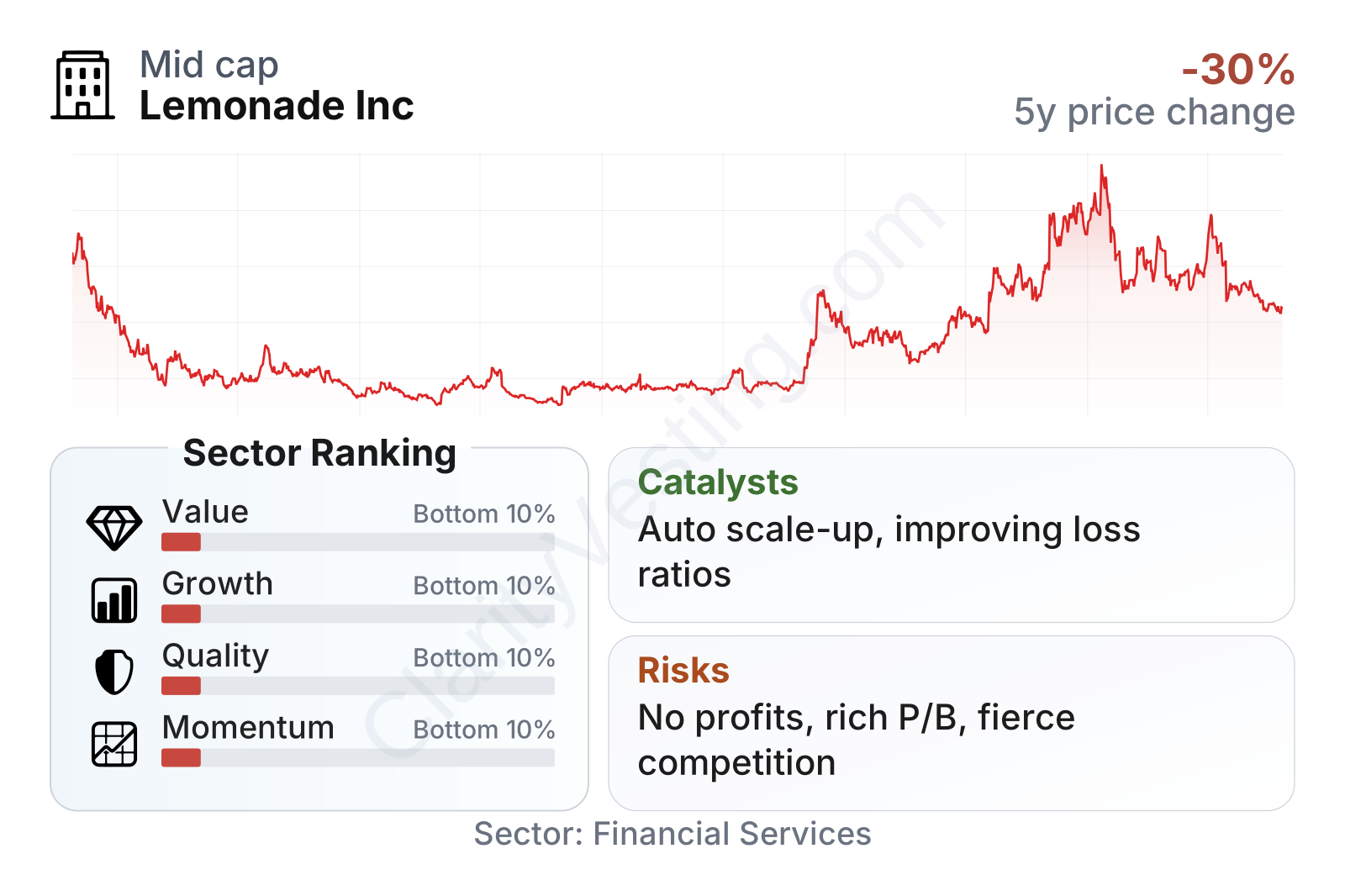
Lemonade is now a mid-sized listed insurer by market value, but its financial profile still looks very different from a mature insurance company. The business ranks weakly versus the sector on value, quality, growth, and momentum factors taken together. That unusual combination comes from very fast top-line expansion paired with negative profitability, modest free cash flow, and a valuation multiple far above the sector norm. The share price history also shows how sentiment has shifted sharply: after a steep decline from earlier highs, the stock later rebounded strongly, but recent trading has remained volatile.
Growth
Lemonade operates in a large and structurally important market. Insurance is not a niche category; it is a recurring, necessity-driven product with room for digital disruption, especially in personal lines where customers increasingly expect mobile onboarding, faster service, and simpler pricing. That creates a real opening for a company that can combine technology, brand, and underwriting discipline. The long-term opportunity is not just taking share in one product, but building a multi-product relationship across renters, home, car, pet, and life.
The core strategic logic is straightforward. Lemonade often starts with lower-complexity products such as renters or pet insurance, then tries to raise customer value through cross-selling into higher-premium categories like homeowners and auto. If that works, customer acquisition spending can become more efficient over time because one customer generates more premium across several policies. The company has repeatedly highlighted in-force premium growth, improved customer mix, and larger premium per customer as evidence that this model is maturing.
Another important growth driver is auto insurance. Car insurance is one of the biggest personal insurance markets in the United States, and it offers much larger premium potential than renters coverage. Lemonade’s expansion in auto therefore matters disproportionately: even moderate success there can have a major effect on overall premium scale. Pet insurance is another attractive lane because it remains underpenetrated relative to other insurance categories and fits well with Lemonade’s digital distribution model.
The earnings trend still shows losses, but the direction has improved. Annual earnings per share have moved from much deeper losses a few years ago to less negative levels more recently. That does not mean the business has solved profitability, but it does show that scale and pricing actions have started to reduce the drag from earlier expansion.
Book value per share has moved downward over time, reflecting accumulated losses. For an insurer, that is an important counterweight to the growth narrative because book value represents part of the financial cushion supporting underwriting risk. A long-term improvement case therefore depends not only on premium growth, but also on eventually stabilizing and rebuilding book value through better margins.
Recent company updates have reinforced the main opportunity: management has continued to emphasize expanding premium, improving gross loss ratios, and increasing use of automation in claims and servicing. If those trends persist, Lemonade could start to look less like a pure growth experiment and more like a scalable insurance platform. That is the main catalyst the market appears to be watching.
Risks
This article is for informational purposes only and does not constitute financial advice. Some content is AI-generated. See Disclaimer


