Stock Analysis · Lumine Group Inc (LMGIF)
Overview
Lumine Group Inc is a software company that acquires, operates, and builds vertical market software businesses. In simple terms, it owns many niche software providers that sell mission-critical products to specific industries. Rather than trying to create one blockbuster software platform, Lumine’s model is to buy specialized businesses with sticky customer relationships and keep them operating for the long run. The company is part of the Constellation Software ecosystem, which matters because that background has shaped its acquisition discipline and decentralized operating approach.
Its businesses generally serve customers that rely on software for daily operations, which tends to support recurring revenue, maintenance fees, and long product lifecycles. That can make results more resilient than those of software companies that depend heavily on short-term advertising, hardware cycles, or one-time project work.
Public disclosures indicate that Lumine reports through operating groups rather than through a very detailed end-market revenue split in the way some larger software vendors do. The broad revenue mix is therefore better understood by business model than by narrow product line.
- Recurring software and maintenance revenue: the largest source of revenue. This typically includes subscription fees, maintenance contracts, customer support, and other ongoing charges tied to installed software.
- Professional services: implementation, customization, consulting, and training attached to software deployments.
- License and other revenue: smaller and more variable revenue streams, including perpetual or term licenses where applicable and other ancillary items.
The financial flow over recent years shows a business that has expanded rapidly through acquisitions, with revenue rising from about $228 million in 2021 to about $766 million in 2025. Gross profit also increased strongly over that period. Reported net income was distorted in 2023 and 2024 by large non-cash charges, while 2025 showed a return to positive earnings. That pattern is important because headline profit alone does not fully describe the operating trajectory.
Key Figures
| Metric | Value | Sector ⓘ |
|---|---|---|
| Date | Oct 03, 2026 | |
| Context | ||
| Sector | Technology | |
| Industry | Software - Application | |
| Market Cap ⓘ | $3.74B | |
| Beta ⓘ | 0.70 | |
Value (Cheapness) | ||
| P/E Ratio ⓘ | 35.54 | 29.95 |
| FCF Yield ⓘ | 6.23% | 4.22% |
| Dividend Yield ⓘ | N/A | 1.30% |
| EBIT / EV ⓘ | 3.99% | 2.83% |
| PEG ⓘ | N/A | |
Growth (Business expansion) | ||
| Revenue Growth ⓘ | 27.80% | 15.80% |
| RPS Growth (5Y CAGR) ⓘ | 6.56% | 8.55% |
| EPS Growth (5Y CAGR) ⓘ | N/A | -11.72% |
| Margin Growth (5Y Trend) ⓘ | 3.20% | 0.39% |
| FCF Growth (5Y CAGR) ⓘ | 28.45% | 9.72% |
| DPS Growth (5Y CAGR) ⓘ | N/A | 7.73% |
Quality (Business durability) | ||
| ROIC (Latest) ⓘ | 10.75% | 9.36% |
| ROIC (5Y Median) ⓘ | N/A | 8.32% |
| Net Debt / EBIT (Latest) ⓘ | 0.38 | 0.50 |
| Net Debt / EBIT (5Y Median) ⓘ | N/A | 0.46 |
| Net Debt / EBITDA (Latest) ⓘ | 0.21 | 0.28 |
| Net Debt / Assets ⓘ | 3.45% | 3.44% |
| EBITDA / Interest ⓘ | 14.90 | 12.67 |
| Operating Margin (Latest) ⓘ | 18.56% | 9.81% |
| Operating Margin (5Y Median) ⓘ | 13.03% | 8.50% |
| Debt to Equity (Latest) ⓘ | N/A | 33.33% |
| Profit Margin (Latest) ⓘ | 12.86% | 7.15% |
| Free Cash Flow (Latest) ⓘ | $232.98M | |
Momentum (Price trend) | ||
| 3Y Return ⓘ | -1.15% | +49.46% |
| 12M Return (excl. last month) ⓘ | -49.12% | +16.51% |
| 6M Return ⓘ | -8.72% | +24.29% |
| Price vs. 200-Day MA ⓘ | -11.68% | +4.74% |
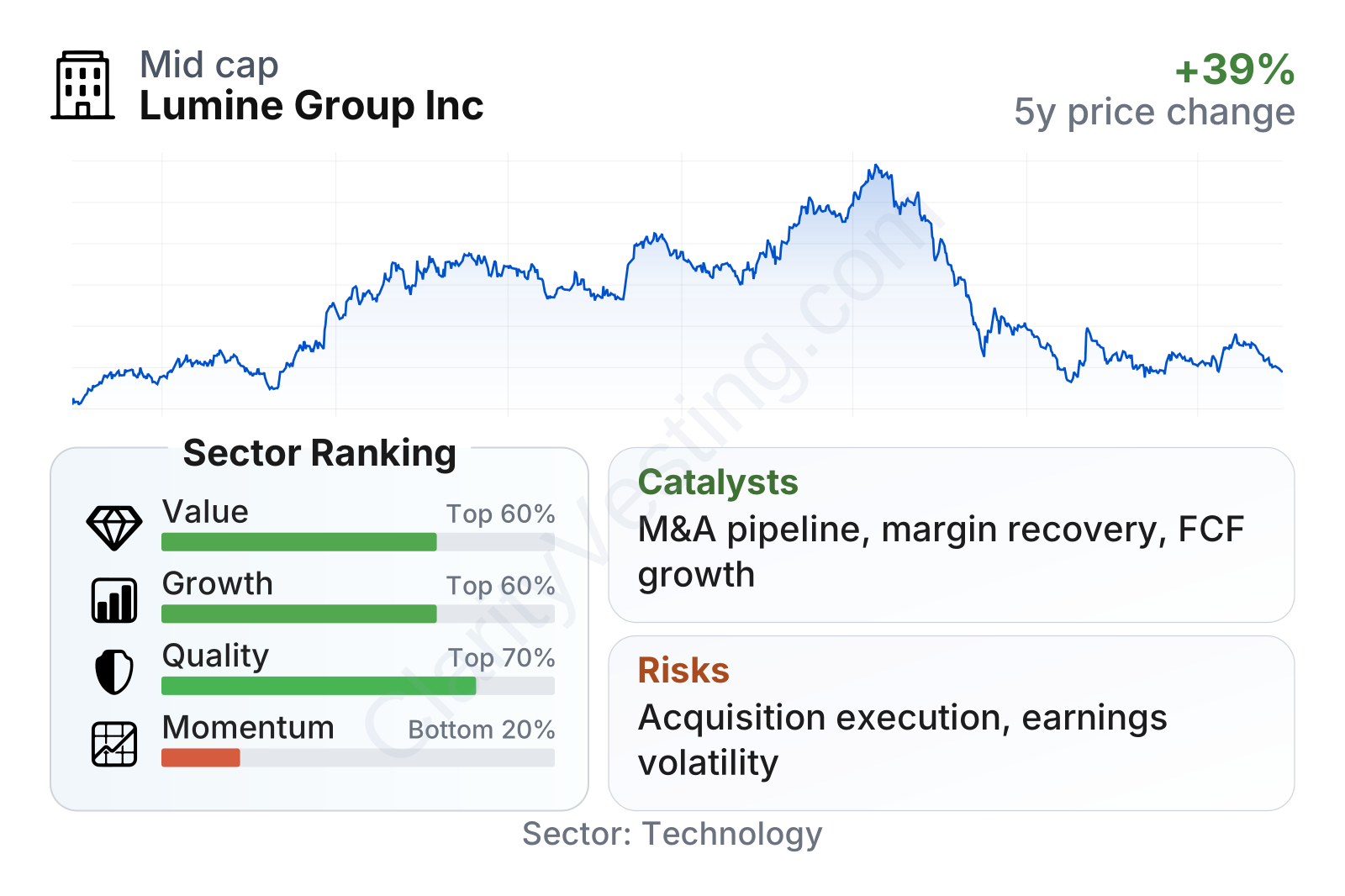
Lumine is a mid-sized software company with a market value around the lower end of the multi-billion-dollar range and a beta of about 0.7, which suggests the stock has historically moved less than the broader market. On valuation measures, the picture is mixed: the earnings multiple is above the software sector median, but free cash flow yield is also stronger than the sector median. Growth metrics are generally solid, especially on recent revenue growth and five-year free cash flow expansion, while share-price momentum has been weak compared with most software peers. Profitability now looks much healthier than the sector median on net margin, but that follows a period of unusually noisy reported earnings.
Growth
Lumine operates in enterprise software, and more specifically in vertical market software, a segment that has attractive long-term characteristics. Customers in these niches often use software that is deeply embedded in their workflows, making switching difficult and increasing retention. This does not always produce explosive organic growth, but it can create durable cash generation and a steady base for acquisitions.
The company’s strategy is built around repeatable acquisitions. This approach has already produced a clear step-up in scale. Annual revenue increased sharply from 2023 through 2025, and recent year-over-year revenue growth has remained positive, generally in the mid-teens to high-twenties range. That is above the sector median in the latest comparison and suggests Lumine is still integrating new assets while expanding its revenue base.
Cash generation is another supportive part of the growth profile. Free cash flow has remained positive and has expanded strongly over the last five years, well ahead of the sector median on a compounded basis. That matters because an acquisition-led software company needs dependable internal cash generation to fund deals, reduce financial strain, and support long-term compounding.
A major catalyst is the company’s ongoing ability to acquire niche software businesses and improve them under a long-term ownership model. The association with Constellation Software’s operating philosophy is relevant here because it gives Lumine credibility in sourcing, evaluating, and integrating targets. Another catalyst is the normalization of earnings after the unusually large losses reported in 2023 and 2024. As non-cash charges recede, the underlying economics become easier for the market to assess.
Recent operating trends also point to a meaningful opportunity: profitability has swung back into positive territory, and the latest net margin is comfortably above the software sector median. If revenue continues to grow while margins remain stable, the company may be entering a period where scale benefits become more visible in reported earnings.
Risks
This article is for informational purposes only and does not constitute financial advice. Some content is AI-generated. See Disclaimer