Stock Analysis · LeMaitre Vascular Inc (LMAT)
Overview
LeMaitre Vascular is a small medical device company focused on products used in vascular surgery. In simple terms, it sells tools and implants that help surgeons treat diseased or blocked blood vessels. Its products are typically used in procedures involving peripheral vascular disease, carotid disease, dialysis access, and aortic surgery. The company operates in a specialized part of healthcare where surgeons often value reliability, familiarity, and clinical outcomes over constant product switching.
Its revenue comes mainly from the sale of vascular surgery devices and implants, with sales spread across hospitals and surgical centers in the United States, Europe, and other international markets. LeMaitre has expanded over time by developing products internally and by acquiring niche device lines that fit its vascular focus. That strategy has helped it build a broad catalog rather than relying on only one flagship product.
Based on the company’s recent annual reporting, revenue is diversified across several product families rather than concentrated in a single device category. The largest sources are generally grafts, biologic patches, valvulotomes, shunts, embolectomy catheters, and other vascular surgery tools. Product mix moves over time, but the business can be summarized this way:
- Vascular grafts and conduits: roughly 20% to 25% of revenue. These include synthetic grafts used to bypass or repair diseased vessels.
- Biologic patches: roughly 15% to 20%. These are used to close or reinforce blood vessel repairs after surgery.
- Valvulotomes and related devices: roughly 10% to 15%. These help surgeons prepare veins for bypass procedures.
- Shunts: roughly 10% to 15%. These maintain blood flow during certain vascular operations.
- Embolectomy catheters: roughly 10% to 15%. These are used to remove clots from blood vessels.
- Other vascular devices and accessories: roughly 20% to 30%. This includes smaller product lines across carotid, peripheral, and dialysis-related procedures.
The operating profile has become stronger in recent years. Revenue has climbed steadily, while gross profit and operating income have grown faster than sales, showing better scale and pricing discipline. Cost of revenue has increased much more slowly than total sales, which helps explain the company’s expanding profitability.
Key Figures
| Metric | Value | Sector ⓘ |
|---|---|---|
| Date | Oct 17, 2026 | |
| Context | ||
| Sector | Healthcare | |
| Industry | Medical Instruments & Supplies | |
| Market Cap ⓘ | $1.89B | |
| Beta ⓘ | 0.47 | |
Value (Cheapness) | ||
| P/E Ratio ⓘ | 28.59 | 24.79 |
| P/B Ratio ⓘ | 4.85 | 3.08 |
| FCF Yield ⓘ | 3.91% | 3.15% |
| Dividend Yield ⓘ | 1.10% | 1.94% |
| EBIT / EV ⓘ | 5.06% | 0.57% |
| PEG ⓘ | 2.13 | |
Growth (Business expansion) | ||
| Revenue Growth ⓘ | 9.60% | 7.45% |
| RPS Growth (5Y CAGR) ⓘ | 10.92% | 8.61% |
| EPS Growth (5Y CAGR) ⓘ | 8.11% | -17.81% |
| BVPS Growth (5Y CAGR) ⓘ | 9.74% | 3.72% |
| Margin Growth (5Y Trend) ⓘ | 8.56% | -0.62% |
| FCF Growth (5Y CAGR) ⓘ | 25.29% | 1.04% |
| DPS Growth (5Y CAGR) ⓘ | 16.10% | 6.77% |
Quality (Business durability) | ||
| ROIC (Latest) ⓘ | 11.42% | 3.24% |
| ROA (Latest) ⓘ | 10.60% | 3.01% |
| ROIC (5Y Median) ⓘ | 11.01% | 4.60% |
| ROA (5Y Median) ⓘ | 9.80% | 1.89% |
| Net Debt / EBIT (Latest) ⓘ | 1.95 | 1.34 |
| Net Debt / EBIT (5Y Median) ⓘ | 0.06 | 1.84 |
| Net Debt / EBITDA (Latest) ⓘ | 1.74 | 1.00 |
| Net Debt / Assets ⓘ | 25.55% | 5.45% |
| EBITDA / Interest ⓘ | 18.14 | 9.64 |
| Operating Margin (Latest) ⓘ | 31.91% | 9.27% |
| Operating Margin (5Y Median) ⓘ | 23.64% | 7.38% |
| Debt to Equity (Latest) ⓘ | 45.26% | 28.58% |
| Profit Margin (Latest) ⓘ | 25.02% | 3.59% |
| Free Cash Flow (Latest) ⓘ | $73.83M | |
Momentum (Price trend) | ||
| 3Y Return ⓘ | +78.37% | +42.80% |
| 12M Return (excl. last month) ⓘ | -12.25% | +18.50% |
| 6M Return ⓘ | -27.17% | +7.57% |
| Price vs. 200-Day MA ⓘ | -11.59% | +5.12% |
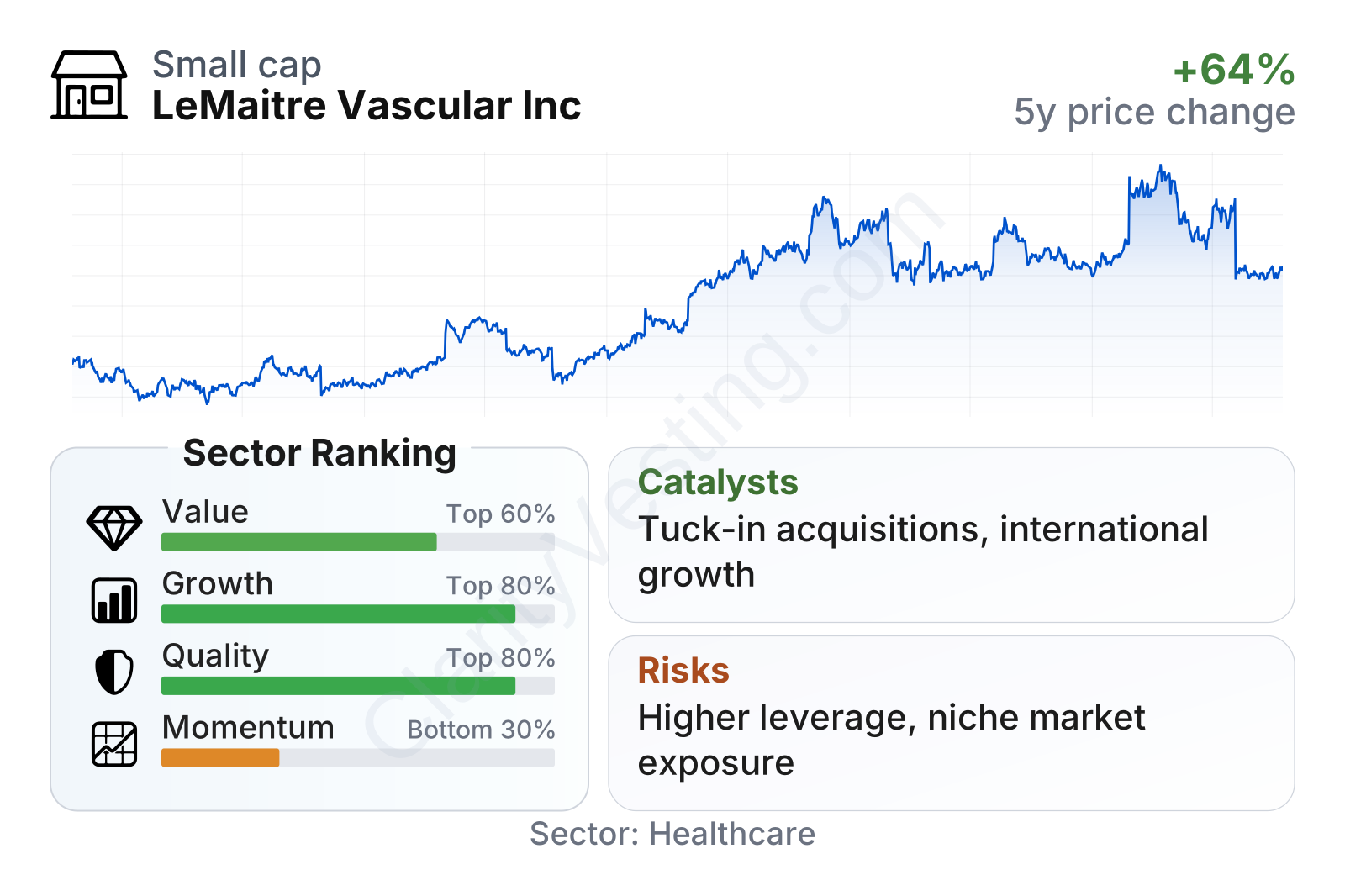
LeMaitre is still a relatively small healthcare company by market value, but its financial quality stands out. Growth and quality metrics rank in the upper part of its healthcare peer group, supported by double-digit returns on capital and unusually strong margins for a medical device business of this size. The weaker area is market momentum: the stock has lagged the sector over the last six to twelve months even though the longer-term share price trend remains positive.
Another notable point is the combination of profitability and cash generation. Free cash flow yield is slightly better than the sector median, while operating and profit margins are far above typical healthcare peers. The valuation metrics, however, indicate that the market still assigns a premium to that quality.
Growth
LeMaitre operates in a part of healthcare that benefits from durable long-term demand. Vascular disease is closely tied to aging populations, diabetes, smoking history, kidney disease, and other chronic conditions that remain widespread. That does not usually create explosive industry growth, but it does create a stable need for procedures and specialized surgical tools. For a focused manufacturer, that can support consistent expansion over many years.
The company’s strategy is sensible for this kind of market. Rather than competing head-to-head across every category in large cardiovascular devices, it concentrates on narrower product niches where surgeon relationships, product breadth, and steady execution matter. This approach also fits its acquisition model: LeMaitre has often purchased overlooked or non-core product lines from larger companies and then integrated them into its vascular sales channel. For a specialized sales force, even modest additions can become meaningful growth drivers.
Recent revenue trends still point to a growing business, although the pace has moderated from the exceptionally strong growth seen in 2023 through 2025. The latest year-over-year increase is around 10%, which remains ahead of the sector median. That is a healthy level for a surgical device company, especially because it is being paired with margin expansion rather than bought through heavy spending.
Cash generation has improved sharply. Free cash flow has moved from a much lower level a few years ago to roughly the high tens of millions of dollars on a trailing basis. That matters because it gives LeMaitre more flexibility to fund acquisitions, expand manufacturing, support product launches, and continue dividends without stretching the balance sheet too aggressively.
A meaningful catalyst is the company’s ability to keep consolidating niche vascular assets. In a fragmented device market, larger companies do not always prioritize slower-growing specialty products, but those same products can perform well inside a company built entirely around vascular surgery. Another catalyst is continued international expansion, particularly in Europe, where direct sales infrastructure can gradually lift market penetration. New product launches and line extensions also matter because they increase wallet share with the same surgeon base rather than requiring an entirely new customer set.
Recent company communications have continued to emphasize product expansion, physician education, and disciplined tuck-in acquisitions. For a business of this size, even one successful product addition or acquired line can move growth more noticeably than it would for a giant medtech company.
Risks
This article is for informational purposes only and does not constitute financial advice. Some content is AI-generated. See Disclaimer


