Stock Analysis · Eli Lilly and Company (LLY)
Overview
Eli Lilly and Company is a large global pharmaceutical company focused on discovering, developing, manufacturing, and selling prescription medicines. Its biggest businesses today are diabetes and obesity treatments, but the company also has important products in immunology, oncology, and neuroscience. Lilly’s recent transformation has been driven by powerful demand for incretin-based medicines, especially Mounjaro for type 2 diabetes and Zepbound for obesity.
Revenue is mainly generated by branded medicines protected by patents, which allows Lilly to charge premium prices while products remain differentiated and clinically relevant. Based on recent annual reporting and product disclosures, the revenue mix is concentrated in a handful of major medicines, with obesity and diabetes now dominating the group.
- Mounjaro (tirzepatide): approximately 28% of 2025 revenue. Used for type 2 diabetes and one of Lilly’s most important growth engines.
- Zepbound (tirzepatide): approximately 19% of 2025 revenue. Obesity treatment and a major driver of the company’s expansion in the fast-growing weight-loss market.
- Verzenio: approximately 9%. Cancer medicine, mainly in breast cancer.
- Jardiance: approximately 8%. Diabetes treatment; Lilly records revenue through its alliance economics.
- Trulicity: approximately 7%. Diabetes drug that was previously a core growth product but is now being overtaken by newer therapies.
- Kisunla: still a small share of revenue, but strategically important in Alzheimer’s disease.
- Immunology, neuroscience, and other established medicines: the remaining 29% combined, including products such as Taltz, Humalog, Basaglar, Omvoh, and other therapies across Lilly’s portfolio.
The business mix is becoming more concentrated around a few very large products, which creates exceptional growth potential but also raises dependence on execution, manufacturing capacity, and sustained clinical leadership. Another notable trend is that revenue has scaled much faster than operating costs in the last two years, which helps explain the sharp rise in profitability.
Over the past several years, Lilly’s sales have expanded dramatically while research, manufacturing, and commercial spending also increased. Even with that heavier investment, profit growth has accelerated, showing the benefit of high-margin blockbuster drugs.
Key Figures
| Metric | Value | Sector ⓘ |
|---|---|---|
| Date | Oct 04, 2026 | |
| Context | ||
| Sector | Healthcare | |
| Industry | Drug Manufacturers - General | |
| Market Cap ⓘ | $1.02T | |
| Beta ⓘ | 0.50 | |
Value (Cheapness) | ||
| P/E Ratio ⓘ | 38.31 | 24.06 |
| P/B Ratio ⓘ | 30.15 | 3.08 |
| FCF Yield ⓘ | 1.97% | 3.08% |
| Dividend Yield ⓘ | 0.56% | 2.05% |
| EBIT / EV ⓘ | 3.84% | 0.63% |
| PEG ⓘ | 1.14 | |
Growth (Business expansion) | ||
| Revenue Growth ⓘ | 47.70% | 7.50% |
| RPS Growth (5Y CAGR) ⓘ | 25.04% | 8.70% |
| EPS Growth (5Y CAGR) ⓘ | 22.39% | -18.20% |
| BVPS Growth (5Y CAGR) ⓘ | 33.76% | 3.95% |
| Margin Growth (5Y Trend) ⓘ | 22.62% | -0.58% |
| FCF Growth (5Y CAGR) ⓘ | 13.60% | 0.88% |
| DPS Growth (5Y CAGR) ⓘ | 16.66% | 6.80% |
Quality (Business durability) | ||
| ROIC (Latest) ⓘ | 43.83% | 3.29% |
| ROA (Latest) ⓘ | 20.77% | 3.02% |
| ROIC (5Y Median) ⓘ | 24.83% | 4.75% |
| ROA (5Y Median) ⓘ | 12.71% | 1.93% |
| Net Debt / EBIT (Latest) ⓘ | 1.12 | 1.33 |
| Net Debt / EBIT (5Y Median) ⓘ | 1.99 | 1.83 |
| Net Debt / EBITDA (Latest) ⓘ | 1.06 | 0.99 |
| Net Debt / Assets ⓘ | 32.34% | 5.33% |
| EBITDA / Interest ⓘ | 44.21 | 9.63 |
| Operating Margin (Latest) ⓘ | 51.72% | 9.25% |
| Operating Margin (5Y Median) ⓘ | 25.01% | 7.80% |
| Debt to Equity (Latest) ⓘ | 162.07% | 28.99% |
| Profit Margin (Latest) ⓘ | 33.53% | 3.60% |
| Free Cash Flow (Latest) ⓘ | $20.05B | |
Momentum (Price trend) | ||
| 3Y Return ⓘ | +122.14% | +36.74% |
| 12M Return (excl. last month) ⓘ | +58.79% | +20.89% |
| 6M Return ⓘ | +22.54% | +9.73% |
| Price vs. 200-Day MA ⓘ | +6.67% | +4.69% |
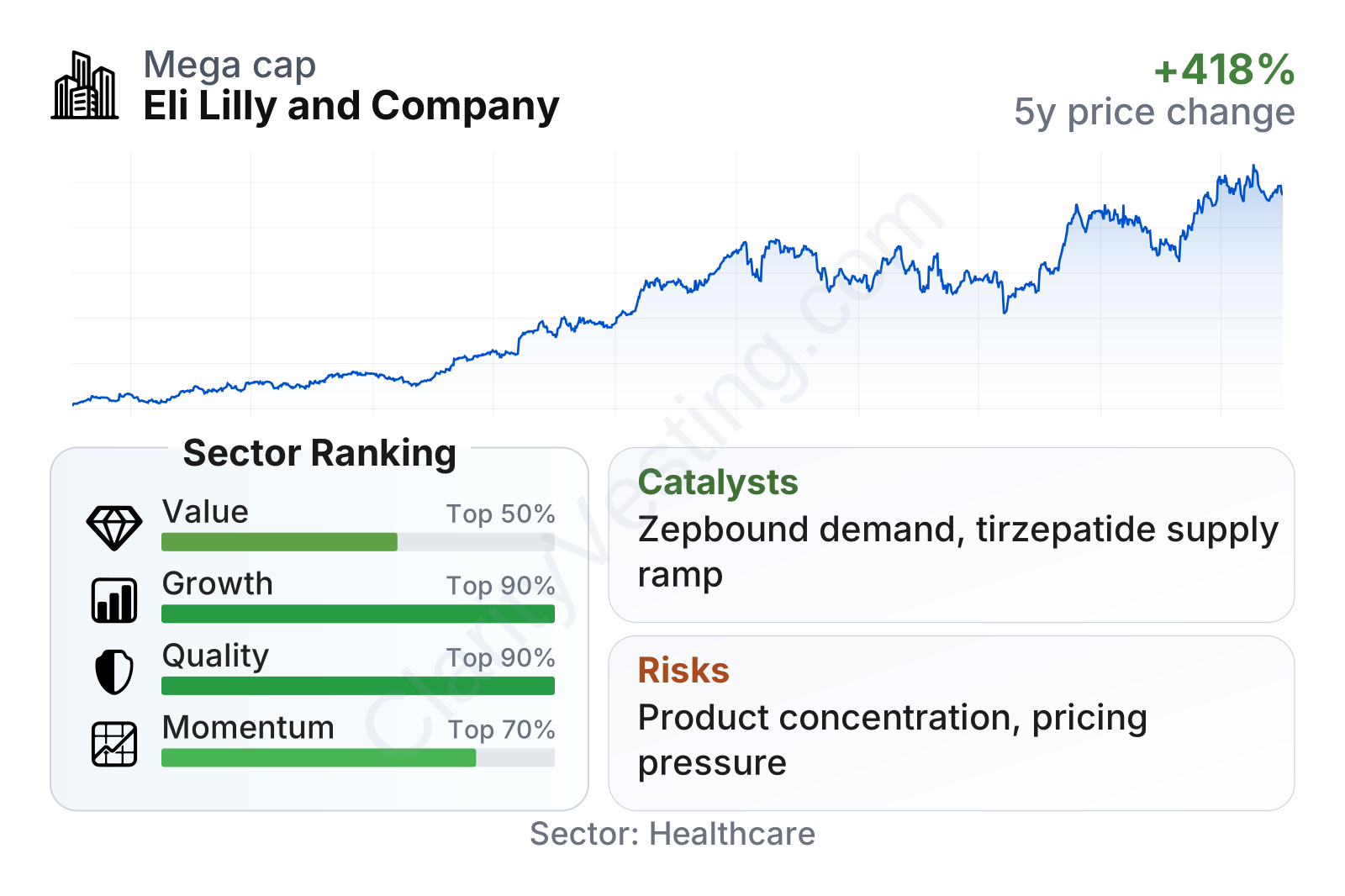
Lilly stands out as one of the largest companies in healthcare and its market behavior has been relatively less volatile than the broader market, with a beta near 0.5. On operating quality and growth, it ranks near the top of its sector: revenue growth, margins, returns on capital, and earnings expansion are all far above typical drug manufacturers. The weaker area is valuation, where the shares trade at clear premiums on earnings, book value, and cash flow measures. The stock’s long upward move also shows that much of the business improvement has already been recognized by the market.
Growth
Lilly operates in some of the most attractive areas of modern medicine. Obesity is one of the largest underpenetrated treatment markets in healthcare, and demand for effective weight-loss drugs has expanded far beyond earlier expectations. Type 2 diabetes remains a large and durable market globally, while oncology, immunology, and Alzheimer’s disease provide additional long-term expansion opportunities. That places Lilly in a sector with both structural demand and strong pricing power for innovative therapies.
The company’s strategy is coherent. Lilly is building around therapeutic areas where clinical outcomes can support large-scale adoption, then backing those products with manufacturing expansion and a broad pipeline. Tirzepatide is the clearest example: it has become a franchise spanning diabetes and obesity, and Lilly is investing heavily to increase supply. The company has also been broadening its reach with oral obesity candidates, additional metabolic indications, and neuroscience assets that could reduce reliance on a single treatment category over time.
Recent revenue growth has been extraordinary by large-cap pharmaceutical standards, with year-over-year expansion running far above the sector median for several quarters. That pace reflects both strong underlying demand and improved product availability, especially in incretin therapies.
Cash generation has been uneven because Lilly has been spending aggressively on capacity and growth infrastructure, but the more recent rebound shows the earnings surge is increasingly turning into cash. With trailing free cash flow now back in strongly positive territory, the business is showing that heavy investment has not prevented operating strength from coming through.
Recent company updates have reinforced the idea that the opportunity is still developing rather than maturing. Lilly has continued to expand manufacturing for obesity and diabetes products, and it is also advancing next-generation therapies such as oral GLP-1 candidates. In Alzheimer’s disease, Kisunla adds another potential leg of growth if adoption improves, even though that market remains more complex and slower to build than obesity. Overall, the strongest catalyst remains the combination of expanding supply and expanding demand in obesity and related metabolic diseases.
Risks
This article is for informational purposes only and does not constitute financial advice. Some content is AI-generated. See Disclaimer