Stock Analysis · Link Real Estate Investment Trust (LKREF)
Overview
Link Real Estate Investment Trust is a large Asia-focused real estate investment trust best known for owning and managing retail properties, parking facilities, and offices. The portfolio started in Hong Kong and has expanded into mainland China, Australia, Singapore, and the United Kingdom. Its business model is straightforward: it owns income-producing properties, leases space to tenants, collects rent and related fees, and tries to improve asset value through renovations, tenant mix upgrades, selective acquisitions, and occasional asset sales.
The company’s revenue base is still centered on recurring rental income, with Hong Kong remaining the core market. Based on recent annual reporting, the main sources of revenue can be summarized as follows:
- Retail properties: about 55% to 60% of revenue. This includes shopping centers and community retail assets, mainly in Hong Kong but also in mainland China and other markets.
- Car parks and related operations: about 15% to 20%. This includes parking rental income and related management revenue, historically an important contributor in Hong Kong.
- Office properties: about 10% to 15%. This covers office leasing income from assets in Hong Kong and overseas.
- Logistics, business, and other properties: about 5% to 10%. This reflects a broader push into non-retail real estate categories.
- Property management and other income: under 10%. This includes management fees and miscellaneous property-related income.
What stands out is the balance between stability and transition. Community retail and parking assets tend to be resilient because they serve everyday needs, while the growing international portfolio gives Link more diversification than a traditional single-city retail landlord. At the same time, that broader footprint adds complexity, currency exposure, and execution risk.
The revenue and cost flow shows that top-line income has generally moved upward over the last several years, but reported profit has become much more volatile. The key reason is that property owners like Link are heavily affected by valuation changes on their assets, which can swing accounting earnings sharply even when rent collection remains relatively steady.
Key Figures
| Metric | Value | Sector ⓘ |
|---|---|---|
| Date | Oct 17, 2026 | |
| Context | ||
| Sector | Real Estate | |
| Industry | REIT - Retail | |
| Market Cap ⓘ | $12.04B | |
| Beta ⓘ | 0.86 | |
Value (Cheapness) | ||
| P/E Ratio ⓘ | N/A | 17.38 |
| P/B Ratio ⓘ | 0.08 | 0.85 |
| FCF Yield ⓘ | 122.84% | 7.38% |
| Dividend Yield ⓘ | 54.54% | 4.85% |
| EBIT / EV ⓘ | N/A | 3.78% |
| PEG ⓘ | 13.83 | |
Growth (Business expansion) | ||
| Revenue Growth ⓘ | -0.30% | 5.30% |
| RPS Growth (5Y CAGR) ⓘ | 67.90% | 6.02% |
| EPS Growth (5Y CAGR) ⓘ | -26.77% | -11.37% |
| BVPS Growth (5Y CAGR) ⓘ | 57.38% | 0.45% |
| Margin Growth (5Y Trend) ⓘ | -112.44% | -0.22% |
| FCF Growth (5Y CAGR) ⓘ | 0.39% | 5.40% |
| DPS Growth (5Y CAGR) ⓘ | 74.94% | 5.02% |
Quality (Business durability) | ||
| ROIC (Latest) ⓘ | 3.69% | 5.69% |
| ROE (Latest) ⓘ | -10.08% | 7.56% |
| ROA (Latest) ⓘ | -7.05% | 2.85% |
| ROIC (5Y Median) ⓘ | 0.41% | 4.22% |
| ROE (5Y Median) ⓘ | -1.08% | 6.03% |
| ROA (5Y Median) ⓘ | -0.76% | 2.44% |
| Net Debt / EBIT (Latest) ⓘ | 5.19 | 7.59 |
| Net Debt / EBIT (5Y Median) ⓘ | 5.61 | 8.40 |
| Net Debt / EBITDA (Latest) ⓘ | 5.11 | 5.27 |
| Net Debt / Assets ⓘ | 24.10% | 37.76% |
| EBITDA / Interest ⓘ | 3.43 | 4.10 |
| Operating Margin (Latest) ⓘ | 35.88% | 35.29% |
| Operating Margin (5Y Median) ⓘ | 9.63% | 37.31% |
| Debt to Equity (Latest) ⓘ | 37.51% | 88.87% |
| Profit Margin (Latest) ⓘ | -52.37% | 19.61% |
| Free Cash Flow (Latest) ⓘ | $14.79B | |
Momentum (Price trend) | ||
| 3Y Return ⓘ | +23.22% | +30.75% |
| 12M Return (excl. last month) ⓘ | -1.68% | +4.36% |
| 6M Return ⓘ | -2.71% | -2.52% |
| Price vs. 200-Day MA ⓘ | -2.95% | -2.34% |
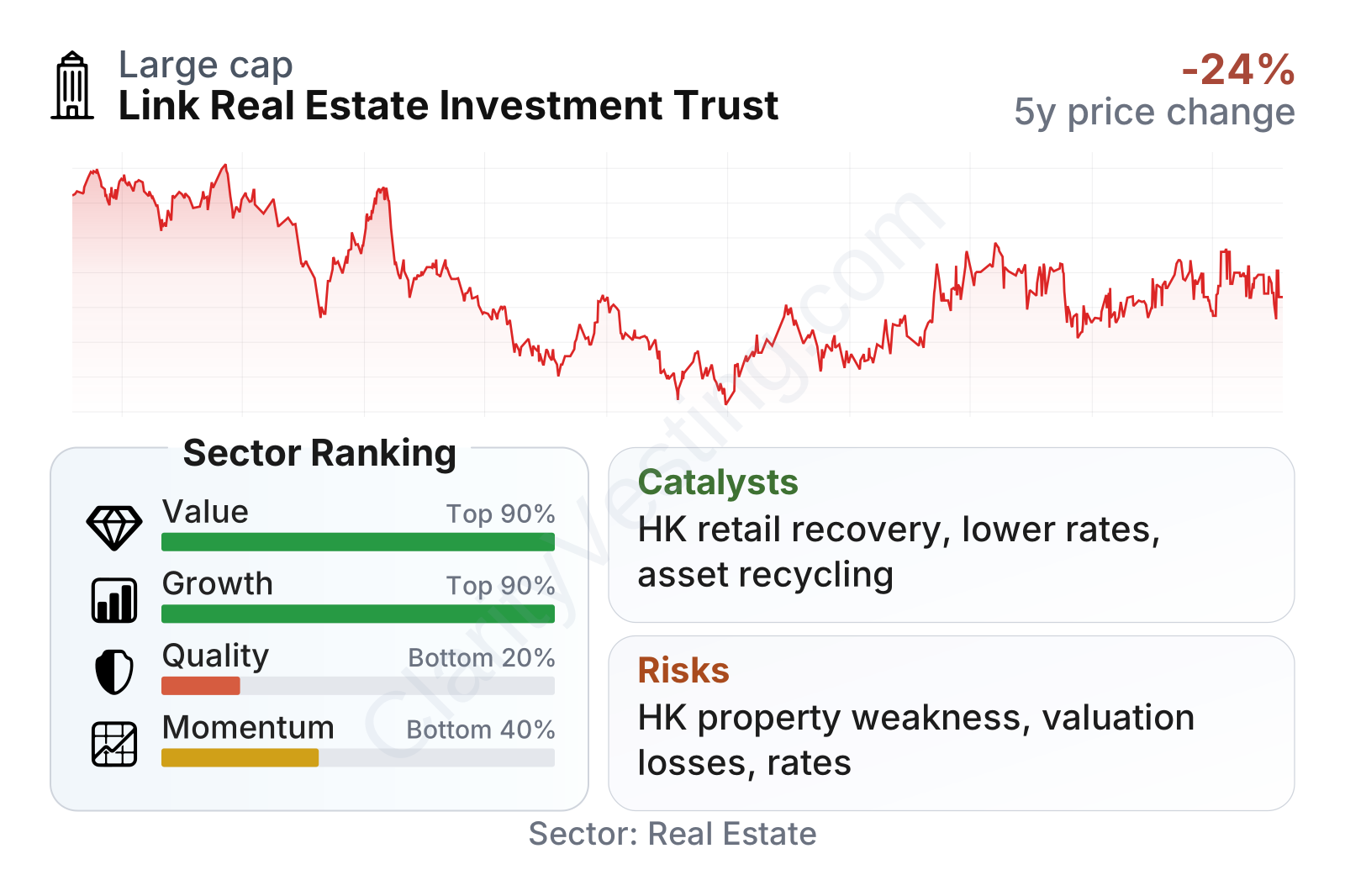
Link is a large real estate company by market value, and its share price has been volatile over the past few years, falling sharply through 2023 and early 2024 before partially recovering. In the latest factor breakdown, valuation metrics look unusually cheap versus the broader real estate peer group, helped by a very low price-to-book ratio and a very high trailing dividend yield. Growth metrics also screen strongly on a multi-year basis, but those readings need caution because accounting effects and asset value changes can distort per-share trends for property trusts.
The weaker area is quality. Returns on assets and equity are below sector norms, and profitability has been hurt by large non-cash valuation losses. Balance-sheet leverage is not extreme for a property owner, with debt-to-equity around 38% and net debt to assets around 24%, but interest coverage is only moderate, so financing costs still matter.
Growth
Link operates in a mature sector rather than a fast-expanding one, so the growth case depends less on explosive industry demand and more on property management skill, redevelopment, active leasing, and capital recycling. That is important for long-term analysis: this is not a business likely to transform through technology, but it can still compound value if it upgrades assets, protects occupancy, and shifts capital into stronger property categories and locations.
Its strategy broadly makes sense. Link has spent years reducing reliance on a single market and a single property type. Hong Kong neighborhood retail remains the anchor, but expansion into mainland China, Australia, Singapore, and the United Kingdom gives the trust more ways to redeploy capital. It has also been selective about selling mature assets and reinvesting in properties where rental growth or repositioning potential appears stronger.
Revenue per share has been fairly stable for most of the period and then shows a sharp jump in the latest reading. For a property trust, a move of that size usually deserves careful verification against reporting changes, portfolio events, or accounting treatment rather than being read as a normal operating acceleration. Even so, the broader picture is that top-line income has held up better than headline earnings.
Distributions have also looked broadly resilient over time, with some fluctuations rather than a steady straight line. That matters because income stability is a central part of the investment case for many real estate trusts. A very high trailing yield can reflect either strong cash distribution capacity or a depressed share price, and in Link’s case the second factor is clearly part of the explanation.
Recent company updates have pointed to ongoing portfolio optimization, leasing efforts, and asset enhancement initiatives rather than a single transformative catalyst. The most important opportunity is a combination of rental normalization, better occupancy and tenant sales in key retail assets, and a possible recovery in property values if interest-rate pressure eases. For a landlord with significant high-quality urban assets, lower funding pressure and firmer property sentiment could meaningfully improve reported results.
Risks
This article is for informational purposes only and does not constitute financial advice. Some content is AI-generated. See Disclaimer


