Stock Analysis · Lakeland Financial Corporation (LKFN)
Overview
Lakeland Financial Corporation is the parent company of Lake City Bank, a regional bank based in Indiana. It provides traditional banking services to businesses, commercial real estate clients, and individuals. In simple terms, the company gathers deposits from customers, lends part of that money out, and earns a spread between what it receives on loans and securities and what it pays on deposits and other funding. It also earns fees from treasury management, wealth-related services, debit and card activity, and other banking services.
The business model is centered on relationship banking in local markets rather than national scale. That usually means a strong focus on small and mid-sized businesses, commercial borrowers, and long-standing customer ties in the communities it serves. For a bank like Lakeland Financial, the quality of deposits, lending discipline, and expense control matter more than rapid expansion alone.
Based on recent annual results, revenue is primarily driven by net interest income, with noninterest income playing a smaller but still useful role.
- Net interest income: approximately 80% to 85% of total revenue. This is the income earned from loans, leases, securities, and other interest-earning assets after subtracting interest paid on deposits and borrowings.
- Noninterest income: approximately 15% to 20% of total revenue. This typically includes service charges on deposit accounts, wealth advisory and trust fees, debit card and interchange fees, loan-related fees, and other customer service income.
Over the past few years, total revenue has generally moved higher, but the path has not been perfectly smooth because interest expense rose sharply as rates increased across the banking system. Even so, the company remained solidly profitable, which is an important sign for a regional bank operating through a tougher funding environment.
The longer-term picture shows a bank that has expanded revenue meaningfully since 2021, while preserving healthy profitability. The main pressure point has been funding costs, not a collapse in core banking activity.
Key Figures
| Metric | Value | Sector ⓘ |
|---|---|---|
| Date | Oct 24, 2026 | |
| Context | ||
| Sector | Financial Services | |
| Industry | Banks - Regional | |
| Market Cap ⓘ | $1.44B | |
| Beta ⓘ | 0.76 | |
Value (Cheapness) | ||
| P/E Ratio ⓘ | 13.31 | 12.46 |
| P/B Ratio ⓘ | 1.94 | 1.25 |
| FCF Yield ⓘ | 7.74% | 9.82% |
| Dividend Yield ⓘ | 3.52% | 2.94% |
| EBIT / EV ⓘ | 10.24% | 8.11% |
| PEG ⓘ | 1.44 | |
Growth (Business expansion) | ||
| Revenue Growth ⓘ | 9.20% | 9.10% |
| RPS Growth (5Y CAGR) ⓘ | 15.21% | 12.31% |
| EPS Growth (5Y CAGR) ⓘ | -15.28% | -6.97% |
| BVPS Growth (5Y CAGR) ⓘ | 1.83% | 5.02% |
| Margin Growth (5Y Trend) ⓘ | -19.58% | -4.00% |
| FCF Growth (5Y CAGR) ⓘ | -0.90% | 4.71% |
| DPS Growth (5Y CAGR) ⓘ | 10.21% | 8.92% |
Quality (Business durability) | ||
| ROIC (Latest) ⓘ | 13.06% | 9.18% |
| ROE (Latest) ⓘ | 14.63% | 13.93% |
| ROA (Latest) ⓘ | 1.57% | 1.57% |
| ROIC (5Y Median) ⓘ | 12.15% | 7.80% |
| ROE (5Y Median) ⓘ | 14.30% | 12.15% |
| ROA (5Y Median) ⓘ | 1.51% | 1.28% |
| Net Debt / EBIT (Latest) ⓘ | 0.04 | 1.02 |
| Net Debt / EBIT (5Y Median) ⓘ | -0.92 | 0.72 |
| Net Debt / EBITDA (Latest) ⓘ | 0.04 | 0.88 |
| Operating Margin (Latest) ⓘ | 31.81% | 22.30% |
| Operating Margin (5Y Median) ⓘ | 32.14% | 24.50% |
| Debt to Equity (Latest) ⓘ | 9.05% | 59.34% |
| Profit Margin (Latest) ⓘ | 40.64% | 26.42% |
| Free Cash Flow (Latest) ⓘ | $111.66M | |
Momentum (Price trend) | ||
| 3Y Return ⓘ | +34.28% | +95.73% |
| 12M Return (excl. last month) ⓘ | -5.64% | +17.30% |
| 6M Return ⓘ | +1.36% | +6.07% |
| Price vs. 200-Day MA ⓘ | +0.18% | +5.36% |
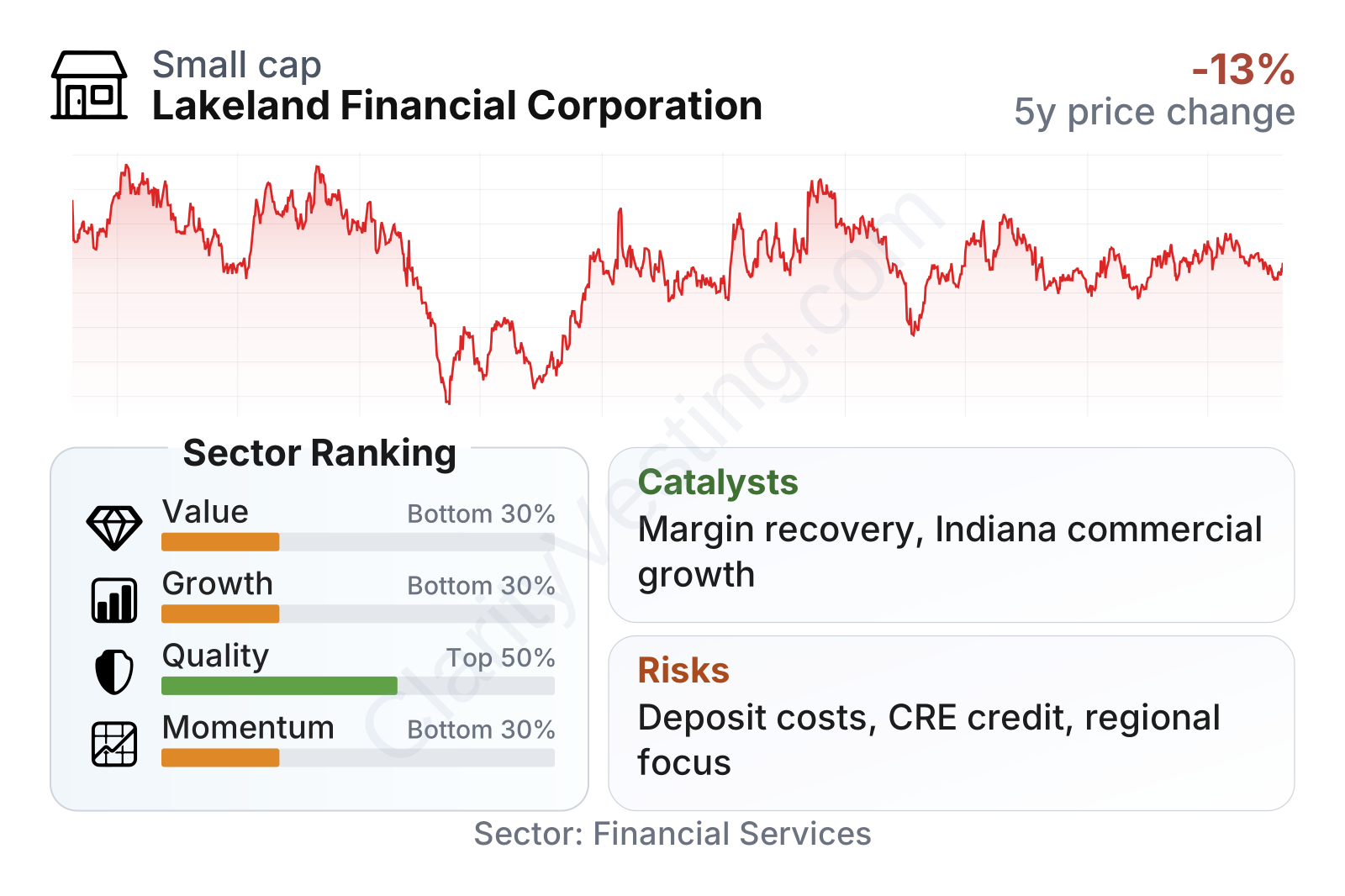
Lakeland Financial sits in the smaller end of the listed banking universe, with relatively low share-price volatility. On quality measures, it ranks better than many regional peers, helped by strong profitability, solid margins, and conservative balance-sheet leverage. Growth measures are less impressive, with book value compounding and earnings growth trailing parts of the sector over the last five years. Value metrics suggest the market is assigning the company a premium to many regional banks, especially on price-to-book, while recent stock momentum has been weaker than the broader regional bank group.
The stock-price history also reflects the regional banking turbulence seen since 2023. Shares fell sharply during that period, then recovered a meaningful portion of the decline, but they have not matched the stronger rebounds seen in some peers. That combination of resilience and slower re-rating fits a bank that is viewed as high quality, yet not cheap.
Growth
Regional banking is not a high-growth industry in the same way as software or semiconductors, but it remains a necessary part of the economy. Banks that can gather stable local deposits, keep credit quality under control, and win business customers in attractive markets can still grow steadily over long periods. Lakeland Financial operates in Indiana, where growth is tied to local business formation, commercial real estate activity, household banking demand, and gradual expansion within its footprint.
The company’s strategy appears straightforward and sensible for this kind of sector: focus on relationship-based commercial banking, maintain underwriting discipline, and build deposits that can support lending without taking excessive funding risk. That is not an aggressive formula, but it can be effective over time, especially when weaker competitors pull back.
Earnings per share have been uneven rather than consistently upward. After improving in 2022, earnings softened in 2023 and 2024 before recovering in 2025. That pattern suggests the core franchise is still capable of generating profit, but the company is not insulated from rate cycles and funding-cost pressure.
Book value per share has recovered and advanced since the 2022 drop, which matters for a bank because book value is a rough measure of the equity base supporting future lending and earnings. The pace of growth has been positive, though not especially fast compared with stronger-growing banks.
A meaningful catalyst for future growth is the interest-rate environment. If deposit costs stabilize or ease while loan yields remain healthy, net interest margin can improve. Another potential support is continued commercial and small-business activity in its Indiana markets, where local relationships can help the bank win business from customers who prefer a community-focused lender over a national institution. Incremental branch expansion, treasury management services, and wealth-related fee income can also deepen customer relationships without requiring dramatic balance-sheet risk.
Recent company filings and investor communications indicate continued profitability, capital strength, and ongoing dividend support rather than a major strategic reset. The opportunity here is less about a single dramatic event and more about steady compounding if loan growth, deposits, and margins remain constructive.
Risks
This article is for informational purposes only and does not constitute financial advice. Some content is AI-generated. See Disclaimer


