Stock Analysis · Luk Fook Holdings Limited (LKFLF)
Overview
Luk Fook Holdings Limited is a Hong Kong-based jewelry retailer and brand operator focused on gold, platinum, gemstone, and branded luxury jewelry. The group sells through a mix of self-operated shops, licensed stores, and e-commerce channels, with its strongest presence in Hong Kong, Macau, and Mainland China. Its brand is best known in Chinese-speaking markets for wedding jewelry, gold products, and gift-oriented purchases tied to festivals and tourism.
The business makes money from both product sales and wholesale-related activities linked to its store network. Based on the company’s annual reporting structure and recent filings, revenue is mainly split as follows:
- Retail sales of gold and platinum products: approximately 55% to 65% of revenue. This usually includes plain gold jewelry and fixed-price gold items sold in self-operated stores.
- Retail sales of gem-set jewelry: approximately 15% to 25% of revenue. This covers diamond, jadeite, gemstone, and other higher-margin branded pieces.
- Wholesale and licensing-related sales: approximately 15% to 25% of revenue. This comes from supplying licensed shops and franchise-like network partners, mainly in Mainland China.
- Other business lines: typically a low-single-share portion when disclosed separately, including service-related and ancillary income.
That mix matters because gold jewelry tends to drive volume, while gem-set jewelry and brand-related sales often contribute more to margin. The company’s network model also allows it to expand with lower capital needs than a purely self-operated chain.
Over the last five reported fiscal years, revenue and profit have been volatile, reflecting swings in consumer demand, tourism, and gold-price-driven buying patterns. Even so, the latest year shows a strong rebound in sales and earnings, with gross profit expanding faster than revenue. The business remains clearly profitable and cash generative.
The recent progression points to a notable recovery: revenue moved from roughly HK$13 billion in fiscal 2025 to about HK$17 billion in fiscal 2026, while net income climbed from about HK$1.1 billion to just above HK$2.0 billion. Gross profit improved strongly as well, suggesting a better sales mix and stronger operating leverage after a softer year.
Key Figures
| Metric | Value | Sector ⓘ |
|---|---|---|
| Date | Oct 03, 2026 | |
| Context | ||
| Sector | Consumer Cyclical | |
| Industry | Luxury Goods | |
| Market Cap ⓘ | $1.76B | |
| Beta ⓘ | 0.78 | |
Value (Cheapness) | ||
| P/E Ratio ⓘ | 6.82 | 17.04 |
| P/B Ratio ⓘ | 0.12 | 1.61 |
| FCF Yield ⓘ | 38.29% | 9.02% |
| Dividend Yield ⓘ | 52.33% | 2.75% |
| EBIT / EV ⓘ | N/A | 6.69% |
| PEG ⓘ | N/A | |
Growth (Business expansion) | ||
| Revenue Growth ⓘ | 31.30% | 5.60% |
| RPS Growth (5Y CAGR) ⓘ | 10.02% | 9.04% |
| EPS Growth (5Y CAGR) ⓘ | -36.49% | -17.44% |
| BVPS Growth (5Y CAGR) ⓘ | 5.73% | 5.73% |
| Margin Growth (5Y Trend) ⓘ | 0.96% | -0.26% |
| FCF Growth (5Y CAGR) ⓘ | -23.81% | 4.91% |
| DPS Growth (5Y CAGR) ⓘ | -8.23% | 10.48% |
Quality (Business durability) | ||
| ROIC (Latest) ⓘ | 16.01% | 12.38% |
| ROA (Latest) ⓘ | 16.05% | 5.54% |
| ROIC (5Y Median) ⓘ | 10.67% | 10.63% |
| ROA (5Y Median) ⓘ | 9.06% | 5.44% |
| Net Debt / EBIT (Latest) ⓘ | 0.65 | 2.16 |
| Net Debt / EBIT (5Y Median) ⓘ | 0.02 | 2.31 |
| Net Debt / EBITDA (Latest) ⓘ | 0.44 | 1.52 |
| Net Debt / Assets ⓘ | 10.81% | 21.74% |
| EBITDA / Interest ⓘ | 51.88 | 9.06 |
| Operating Margin (Latest) ⓘ | 10.71% | 9.12% |
| Operating Margin (5Y Median) ⓘ | 13.99% | 9.56% |
| Debt to Equity (Latest) ⓘ | 31.64% | 76.18% |
| Profit Margin (Latest) ⓘ | 11.89% | 5.30% |
| Free Cash Flow (Latest) ⓘ | $674.48M | |
Momentum (Price trend) | ||
| 3Y Return ⓘ | +41.65% | +11.77% |
| 12M Return (excl. last month) ⓘ | -4.11% | +0.61% |
| 6M Return ⓘ | +1.69% | +1.32% |
| Price vs. 200-Day MA ⓘ | +23.93% | -3.47% |
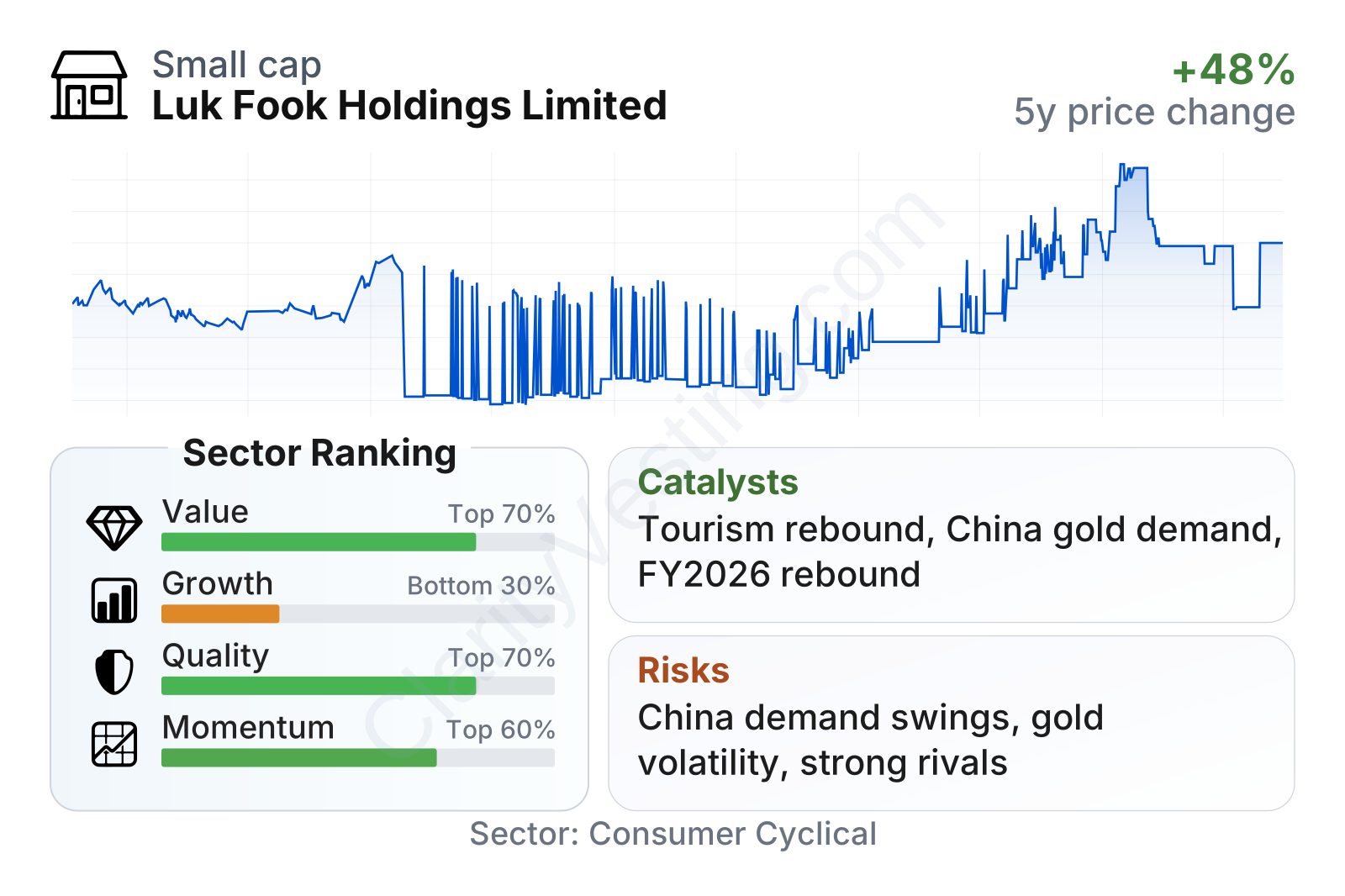
The overall picture is unusual: valuation metrics look very cheap relative to the broader consumer discretionary universe, while profitability and balance-sheet quality look healthier than the sector median. Return on assets and return on invested capital are solid, leverage is modest, and interest coverage is very strong. Growth metrics are more mixed because the latest rebound follows weaker years, so longer-term earnings and free cash flow trends still look uneven despite the recent recovery.
The share price history also shows a stock that can move sharply. After a deep slump in 2023, it recovered strongly through 2025 and into 2026. That pattern fits a business tied to luxury demand, tourism flows, and sentiment around China consumption rather than a steady, low-volatility retailer.
Growth
Luk Fook operates in a sector that has attractive long-term drivers, but it is not a straight-line growth market. Jewelry demand in Greater China benefits from rising household wealth over time, cultural demand for wedding and festival purchases, and the role of gold jewelry as both adornment and a store of value. Premiumization also matters: branded jewelry chains can take share from smaller independent stores when consumers place more value on authenticity, design, and trusted sourcing.
The company’s strategy is sensible for that environment. It combines a recognizable brand with a wide retail footprint and a licensing model that helps extend reach without requiring every store to be funded directly by the group. This is especially relevant in Mainland China, where scale, local presence, and supplier relationships matter. Management has also continued to develop e-commerce and product mix, which can support higher-margin categories over time.
One of the clearest catalysts is the normalization of cross-border traffic between Mainland China, Hong Kong, and Macau. Luk Fook has meaningful exposure to tourist spending, and stronger visitor flows can lift same-store sales in high-traffic locations. Another catalyst is sustained consumer interest in gold products during periods of macro uncertainty or elevated gold prices, since that can stimulate demand for pure gold and fixed-price gold jewelry.
Recent company reporting also points to a significant earnings recovery in fiscal 2026, helped by stronger revenue and a rebound in profitability. If that improvement proves durable rather than temporary, it strengthens the case that the business still has meaningful earnings power even after a difficult stretch.
Risks
This article is for informational purposes only and does not constitute financial advice. Some content is AI-generated. See Disclaimer