Stock Analysis · LivaNova PLC (LIVN)
Overview
LivaNova PLC is a medical device company focused on therapies for serious heart and brain-related conditions. Its products are used mainly in hospitals and specialized care settings. The business is centered on areas where devices are difficult to replace once doctors are trained on them and where clinical evidence matters a great deal, which gives the company a more specialized profile than broad healthcare equipment groups.
Based on the company’s recent annual reporting structure, revenue mainly comes from two operating segments: Cardiopulmonary and Neuromodulation. Cardiopulmonary includes heart-lung machines, oxygenation products, cannulae, autotransfusion systems, and related disposables used in cardiac surgery. Neuromodulation is primarily the company’s vagus nerve stimulation business, used mainly for drug-resistant epilepsy and difficult-to-treat depression in certain markets.
The revenue mix is approximately:
- Cardiopulmonary: about 58% to 62% of revenue. This includes systems and recurring consumables used during cardiac surgery, making it the company’s largest source of sales.
- Neuromodulation: about 38% to 42% of revenue. This is largely implantable vagus nerve stimulation therapy and related accessories and services.
This mix matters because Cardiopulmonary brings a meaningful recurring component through disposables, while Neuromodulation offers exposure to a therapy area with room for broader adoption if clinical use expands. Over the last several years, the company has also been reshaped by divestitures and legal overhangs, which makes today’s LivaNova more focused than it used to be.
The financial profile has improved materially from the loss-making period seen earlier in the decade: revenue has climbed from a little above $1.0 billion in 2022 to nearly $1.4 billion in 2025, while gross profit has also moved higher. That said, reported earnings have been uneven because one-time items and litigation-related charges have had a major impact on bottom-line results.
The business has become larger and more profitable at the gross level over time, but the path has not been smooth. Sales and gross profit expanded steadily from 2023 through 2025, while operating and net income were much more volatile, showing how legal and other non-operating items can dominate headline profit in some years.
Key Figures
| Metric | Value | Sector ⓘ |
|---|---|---|
| Date | Oct 03, 2026 | |
| Context | ||
| Sector | Healthcare | |
| Industry | Medical Devices | |
| Market Cap ⓘ | $4.20B | |
| Beta ⓘ | 0.87 | |
Value (Cheapness) | ||
| P/E Ratio ⓘ | 22.57 | 24.06 |
| P/B Ratio ⓘ | 3.17 | 3.08 |
| FCF Yield ⓘ | 3.53% | 3.07% |
| Dividend Yield ⓘ | N/A | 2.05% |
| EBIT / EV ⓘ | 2.98% | 0.63% |
| PEG ⓘ | 0.93 | |
Growth (Business expansion) | ||
| Revenue Growth ⓘ | 10.80% | 7.50% |
| RPS Growth (5Y CAGR) ⓘ | 5.64% | 8.70% |
| EPS Growth (5Y CAGR) ⓘ | -4.75% | -18.20% |
| BVPS Growth (5Y CAGR) ⓘ | -3.67% | 3.95% |
| Margin Growth (5Y Trend) ⓘ | N/A | -0.58% |
| FCF Growth (5Y CAGR) ⓘ | 22.44% | 0.88% |
| DPS Growth (5Y CAGR) ⓘ | -23.72% | 6.80% |
Quality (Business durability) | ||
| ROIC (Latest) ⓘ | 5.45% | 3.29% |
| ROA (Latest) ⓘ | 7.26% | 3.02% |
| ROIC (5Y Median) ⓘ | -2.11% | 4.75% |
| ROA (5Y Median) ⓘ | -3.84% | 1.93% |
| Net Debt / EBIT (Latest) ⓘ | -1.35 | 1.33 |
| Net Debt / EBIT (5Y Median) ⓘ | N/A | 1.83 |
| Net Debt / EBITDA (Latest) ⓘ | -0.91 | 0.99 |
| Net Debt / Assets ⓘ | -6.24% | 5.33% |
| EBITDA / Interest ⓘ | 3.92 | 9.63 |
| Operating Margin (Latest) ⓘ | 8.27% | 9.25% |
| Operating Margin (5Y Median) ⓘ | -2.63% | 7.80% |
| Debt to Equity (Latest) ⓘ | 26.56% | 28.99% |
| Profit Margin (Latest) ⓘ | 12.81% | 3.60% |
| Free Cash Flow (Latest) ⓘ | $148.34M | |
Momentum (Price trend) | ||
| 3Y Return ⓘ | +41.85% | +37.48% |
| 12M Return (excl. last month) ⓘ | +42.20% | +20.85% |
| 6M Return ⓘ | +15.58% | +9.73% |
| Price vs. 200-Day MA ⓘ | +4.78% | +4.69% |
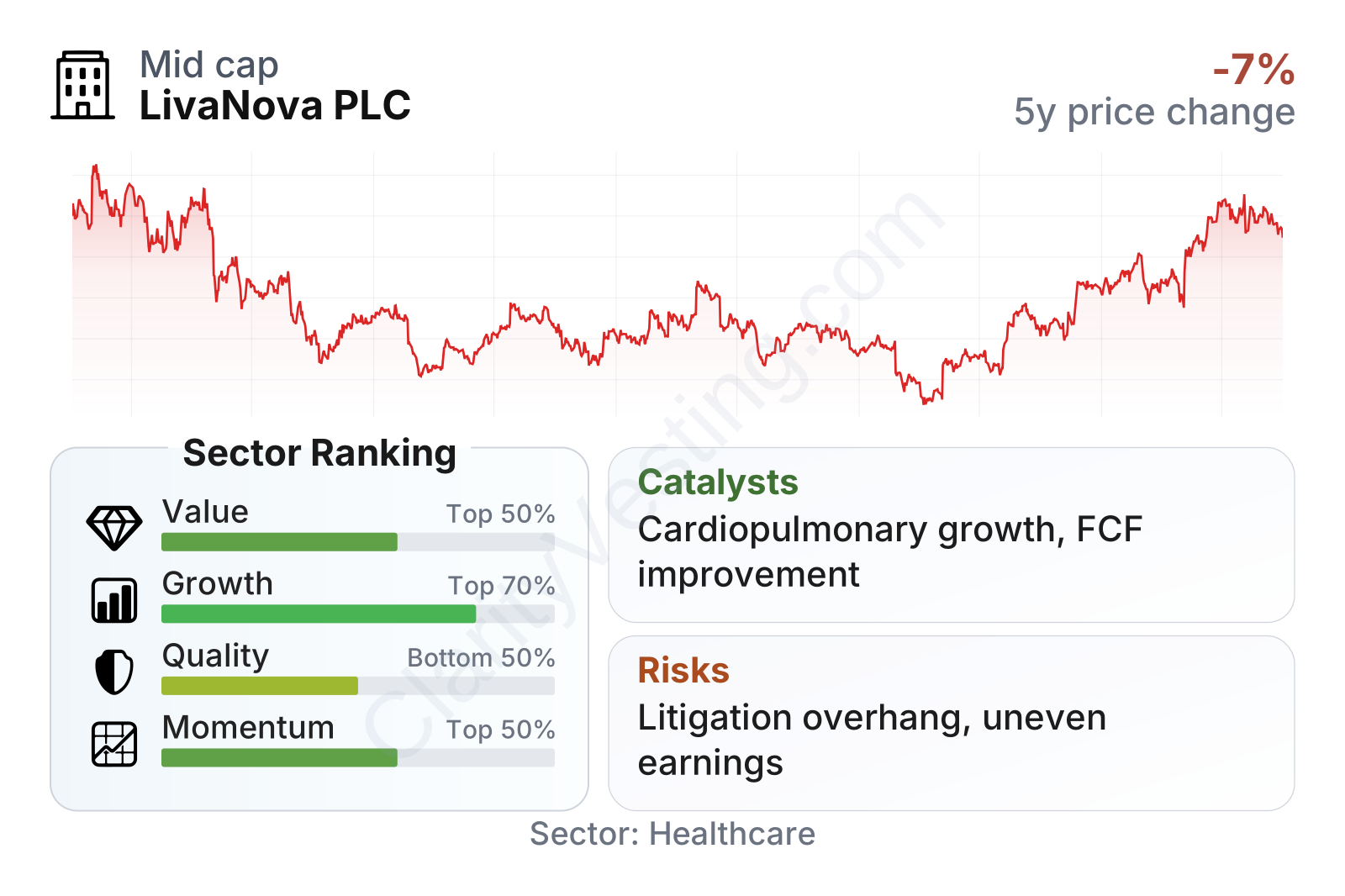
LivaNova sits in the mid-cap range, with a share price record that has been volatile but notably stronger over the past year than much of the healthcare equipment group. The factor snapshot is mixed in a constructive way: valuation is around the better half of the sector, growth is above average but not elite, momentum is solid, and quality is held back by weak longer-term profitability history despite much better recent returns and margins.
The current profile shows a company in transition rather than a fully mature compounder. Revenue growth of roughly 11% is ahead of the sector median, free cash flow generation has improved, and the balance sheet looks much cleaner than in prior periods. At the same time, historical profitability still reflects the effects of restructuring, uneven earnings, and litigation-related disruptions.
Growth
LivaNova operates in segments of healthcare that benefit from durable long-term demand. Cardiac surgery volumes are supported by aging populations and broader access to complex procedures, while neuromodulation is tied to ongoing demand for treatment options in patients whose neurological conditions are not adequately managed by drugs alone. These are not fast-changing consumer markets; they are clinical markets where adoption tends to build over time through physician training, product reliability, and evidence.
The company’s strategy appears coherent for future growth because it is concentrated on categories where it already has established products, specialist sales channels, and relationships with surgeons and hospitals. In Cardiopulmonary, the recurring sale of disposables can support steadier expansion as procedure volumes rise. In Neuromodulation, growth can come from wider penetration of existing indications, geographic expansion, and product upgrades that improve ease of use for physicians and patients.
Recent sales momentum has been encouraging. After a flat to declining period in 2022, year-over-year growth turned clearly positive in 2023 and has mostly remained in a high-single-digit to low-teens range since then. That pattern suggests the company is no longer relying only on cost actions or accounting recovery; it is also benefiting from stronger underlying demand.
Cash generation has improved sharply as well. Free cash flow was relatively modest earlier in the period, then moved materially higher over the last year, which is important because medical device businesses with rising cash generation generally have more flexibility to fund research, manage legal costs, support manufacturing, and strengthen the balance sheet without needing outside capital.
A major catalyst is the continuing normalization of profitability after years marked by exceptional items. Another is the company’s focused portfolio after exiting non-core activities in prior years. If management can keep translating revenue growth into cleaner operating income and cash flow, the business may start to be judged more on its underlying medical device economics and less on old disruptions. In public company communications during 2026, management has also continued to emphasize execution in its core franchises, which supports the view that recent growth is tied to the existing platform rather than a one-off event.
Risks
This article is for informational purposes only and does not constitute financial advice. Some content is AI-generated. See Disclaimer