Stock Analysis · Lionsgate Studios Holding Corp (LION)
Overview
Lionsgate Studios Holding Corp is a film and television content company built around producing, acquiring, distributing, and licensing entertainment. In practical terms, it makes money from movies, scripted and unscripted TV series, and a large library of older titles that can be licensed again and again to theaters, streaming platforms, broadcasters, and home entertainment channels. The listed company is relatively new in its current form after the separation of Lionsgate’s studio assets, so the market history under the current ticker does not fully reflect the longer operating history of the underlying business.
Its revenue base is diversified across content creation and content monetization rather than a single consumer subscription product. Based on recent company reporting, the business is mainly organized around these sources:
- Motion Picture — approximately 40% to 45% of revenue in recent years. This includes theatrical releases, premium video on demand, home entertainment, and licensing of films to streaming and television outlets.
- Television Production — approximately 35% to 40% of revenue. This covers the production and sale of TV series to networks and streaming platforms, including delivery of episodes and related distribution revenue.
- Media Networks and other studio-related revenue — approximately 15% to 20% on a historical Lionsgate basis, though this mix has been changing with corporate restructuring. This area has included premium and international channel exposure as well as ancillary revenue streams tied to content exploitation.
- Library licensing and catalog monetization — not always broken out as a stand-alone segment, but strategically important because it supports recurring cash generation from older titles across streaming, international, and television windows.
That mix matters because a studio is not only judged by opening-weekend performance. A large part of the economics comes from how often the same intellectual property can be reused across sequels, spin-offs, streaming deals, foreign markets, and back-catalog licensing.
The multi-year financial flow also shows an uneven pattern: revenue moved between roughly $2.6 billion and $3.2 billion over the last five annual periods, while operating profit stayed positive but modest, and interest expense rose materially. That combination explains why gross profit has remained meaningful, yet net income has often stayed negative.
The business still converts a sizable amount of revenue into gross profit, but financing costs have become a heavier burden over time. Revenue does not show a clean upward line, so the central issue is less about demand for filmed entertainment in general and more about whether Lionsgate can turn its content library and production pipeline into steadier earnings.
Key Figures
| Metric | Value | Sector ⓘ |
|---|---|---|
| Date | Oct 17, 2026 | |
| Context | ||
| Sector | Financial Services | |
| Industry | Shell Companies | |
| Market Cap ⓘ | $3.25B | |
| Beta ⓘ | N/A | |
Value (Cheapness) | ||
| P/E Ratio ⓘ | N/A | 12.26 |
| P/B Ratio ⓘ | N/A | 1.23 |
| FCF Yield ⓘ | 2.99% | 10.40% |
| Dividend Yield ⓘ | N/A | 3.02% |
| EBIT / EV ⓘ | 1.75% | 8.14% |
| PEG ⓘ | N/A | |
Growth (Business expansion) | ||
| Revenue Growth ⓘ | N/A | 9.35% |
| RPS Growth (5Y CAGR) ⓘ | -51.90% | 12.19% |
| EPS Growth (5Y CAGR) ⓘ | N/A | -9.53% |
| BVPS Growth (5Y CAGR) ⓘ | -25.97% | 4.99% |
| Margin Growth (5Y Trend) ⓘ | -0.13% | -3.86% |
| FCF Growth (5Y CAGR) ⓘ | N/A | 4.81% |
| DPS Growth (5Y CAGR) ⓘ | 12.35% | 8.79% |
Quality (Business durability) | ||
| ROIC (Latest) ⓘ | 4.45% | 9.49% |
| ROE (Latest) ⓘ | N/A | 13.90% |
| ROA (Latest) ⓘ | -2.25% | 1.55% |
| ROIC (5Y Median) ⓘ | 2.86% | 7.86% |
| ROE (5Y Median) ⓘ | N/A | 12.17% |
| ROA (5Y Median) ⓘ | -1.97% | 1.30% |
| Net Debt / EBIT (Latest) ⓘ | 29.47 | 0.96 |
| Net Debt / EBIT (5Y Median) ⓘ | 23.41 | 0.73 |
| Net Debt / EBITDA (Latest) ⓘ | 2.93 | 0.92 |
| Operating Margin (Latest) ⓘ | 4.14% | 22.30% |
| Operating Margin (5Y Median) ⓘ | 3.94% | 24.63% |
| Debt to Equity (Latest) ⓘ | -328.17% | 58.56% |
| Profit Margin (Latest) ⓘ | N/A | 26.57% |
| Free Cash Flow (Latest) ⓘ | $97.10M | |
Momentum (Price trend) | ||
| 3Y Return ⓘ | +5.25% | +88.33% |
| 12M Return (excl. last month) ⓘ | +54.13% | +19.38% |
| 6M Return ⓘ | +3.38% | +4.75% |
| Price vs. 200-Day MA ⓘ | -3.87% | +3.50% |
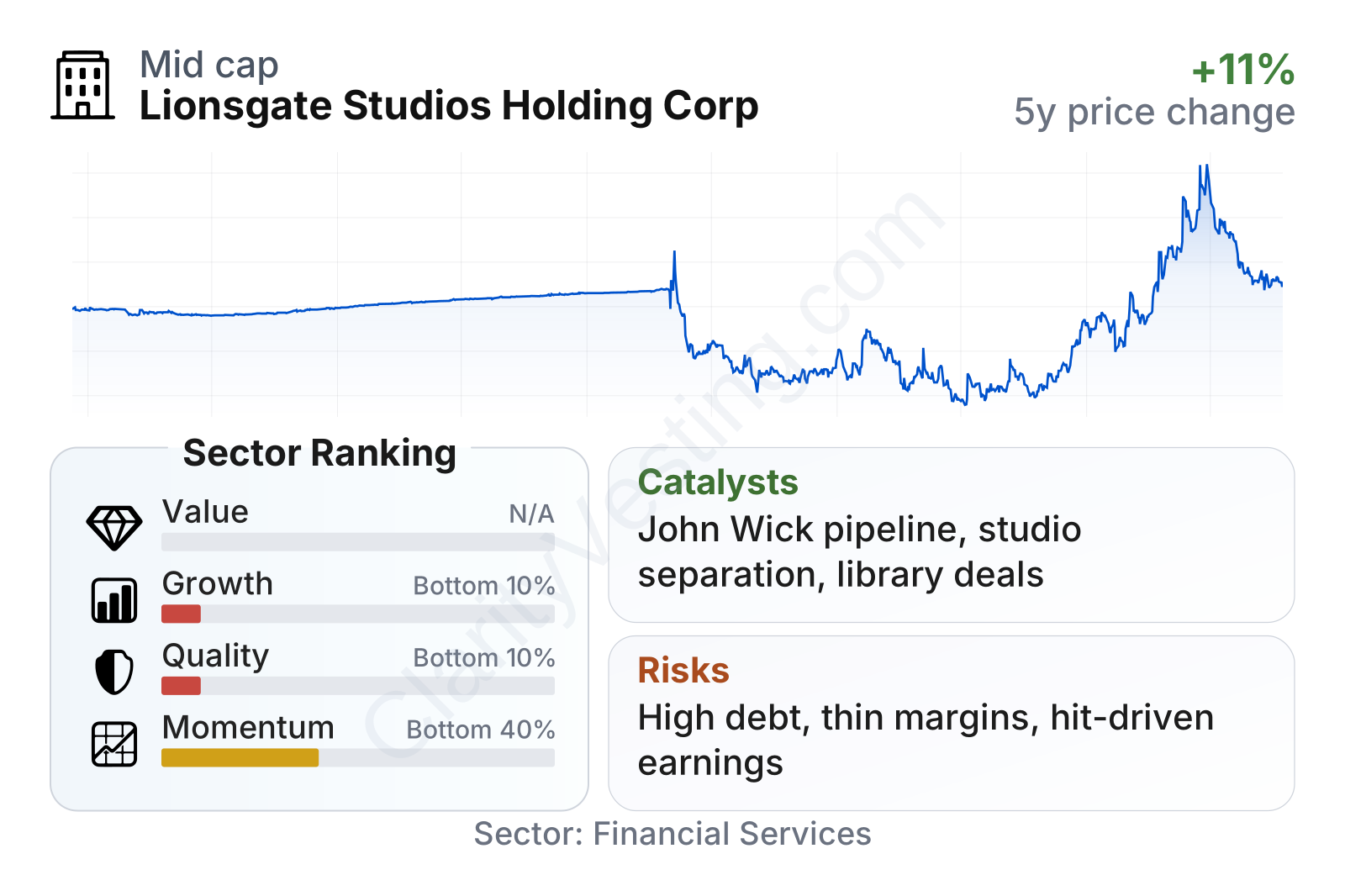
The stock has been volatile, with a long flat period followed by a drop and then a sharp rebound in 2026. That kind of move usually signals that the market is reassessing the company after restructuring and strategic changes rather than rewarding a long record of stable operating performance.
The latest factor profile is mixed. Momentum has improved over the past year, but growth and quality rank near the bottom of the broader sector comparison. Free cash flow is positive, which is helpful for a content company, yet cash generation remains modest relative to the company’s size. Profitability ratios and leverage metrics remain the weakest parts of the profile.
Growth
Lionsgate operates in a sector with durable long-term demand. Global appetite for filmed entertainment continues to expand across theaters, streaming platforms, ad-supported video services, and international licensing markets. The opportunity is especially attractive for companies that own recognizable intellectual property because the same title can be monetized repeatedly in different formats and territories.
That said, the sector’s growth does not automatically translate into smooth corporate growth. Studios face hit-driven economics, release timing swings, and changing buyer behavior from streamers. For Lionsgate, the strategic logic is clear: keep feeding franchises, monetize the film and TV library more aggressively, and use the stand-alone structure to surface the value of its content assets more directly.
One of the strongest growth pillars is franchise depth. Lionsgate controls well-known properties such as John Wick, The Hunger Games, and other branded content that can support sequels, prequels, series adaptations, and licensing extensions. In media, repeatable franchises usually carry better economics than one-off productions because marketing efficiency improves and buyer demand is easier to predict.
Another important catalyst is industry demand for independent content suppliers. Major streaming and media platforms increasingly need outside studios to fill their release calendars without carrying the full fixed cost of producing everything internally. Lionsgate’s position as an established independent studio gives it a useful place in that supply chain.
Earnings per share have been inconsistent, with profits and losses alternating over the period shown. The recent return to positive EPS is constructive, but the broader pattern still points to a business that has not yet established dependable earnings power. For long-term analysis, that makes the direction more important than any single quarter.
Book value per share has stayed negative, which is not unusual for some media businesses after large accounting adjustments, goodwill write-downs, and debt-heavy capital structures, but it does limit how useful traditional balance-sheet valuation measures are. Future growth therefore depends more on the earning power of the content library and franchise pipeline than on accounting book value.
Recent corporate actions also matter. The studio separation was designed to make the business easier to evaluate on its own terms. If management can show cleaner segment reporting, a more visible content slate, and better monetization of the library, that could improve how the market values the company relative to its assets.
Risks
This article is for informational purposes only and does not constitute financial advice. Some content is AI-generated. See Disclaimer


