Stock Analysis · Lineage Inc (LINE)
Overview
Lineage Inc is a temperature-controlled warehouse owner and operator focused on the food supply chain. In simple terms, it stores frozen and refrigerated food, helps move it through distribution networks, and provides related logistics services for food producers, retailers, and distributors. The company operates as an industrial REIT, which means real estate is central to the business, but its value is tied not just to buildings themselves, but to specialized cold-storage infrastructure that is difficult and expensive to replicate.
Its business is built around large refrigerated facilities located near ports, production regions, and end markets. These sites are used to store products such as meat, seafood, poultry, dairy, fruits, vegetables, and prepared foods. Because many food categories need reliable temperature control from origin to consumer, cold storage tends to be a mission-critical service rather than a discretionary one.
Based on company disclosures, revenue mainly comes from warehouse and service activities tied to handling food inventory, while rent-like income from real estate ownership is only part of the economic picture. The mix can vary by period, but the business can be broadly understood through these main sources:
- Storage services: fees charged for keeping customer products in temperature-controlled warehouses. This is typically the largest recurring revenue stream.
- Warehouse handling services: fees for moving pallets in and out, order picking, blast freezing, case picking, and other value-added warehouse activities. This is usually another major source and can be highly tied to throughput.
- Transportation and integrated logistics: services related to moving products across the cold chain, including freight coordination and network solutions.
- Other real-estate-related or ancillary income: smaller contributions from property-related arrangements and other support services.
At a high level, the company’s economics are driven by a combination of occupied warehouse capacity, customer activity levels, pricing, and operating efficiency. Revenue has expanded strongly over the last several years, but profit conversion has been less stable because of high operating costs, depreciation, and financing expenses.
The business has clearly scaled up since 2021, with revenue rising from about $3.7 billion to about $5.4 billion by 2025. However, the path from revenue to profit has been uneven. Gross profit was much stronger in 2022 through 2024 than in 2021, but operating income and net income remained pressured by overhead, asset-heavy operations, and sizable interest expense. That helps explain why a large network and essential service do not automatically translate into strong accounting returns.
Key Figures
| Metric | Value | Sector ⓘ |
|---|---|---|
| Date | Oct 17, 2026 | |
| Context | ||
| Sector | Real Estate | |
| Industry | REIT - Industrial | |
| Market Cap ⓘ | $8.40B | |
| Beta ⓘ | 0.93 | |
Value (Cheapness) | ||
| P/E Ratio ⓘ | N/A | 17.38 |
| P/B Ratio ⓘ | 1.13 | 0.85 |
| FCF Yield ⓘ | 2.90% | 7.38% |
| Dividend Yield ⓘ | 6.13% | 4.85% |
| EBIT / EV ⓘ | 2.64% | 3.78% |
| PEG ⓘ | N/A | |
Growth (Business expansion) | ||
| Revenue Growth ⓘ | 0.80% | 5.30% |
| RPS Growth (5Y CAGR) ⓘ | 7.54% | 6.02% |
| EPS Growth (5Y CAGR) ⓘ | N/A | -11.37% |
| BVPS Growth (5Y CAGR) ⓘ | 11.48% | 0.45% |
| Margin Growth (5Y Trend) ⓘ | 2.07% | -0.22% |
| FCF Growth (5Y CAGR) ⓘ | N/A | 5.40% |
| DPS Growth (5Y CAGR) ⓘ | 35.24% | 5.02% |
Quality (Business durability) | ||
| ROIC (Latest) ⓘ | 2.34% | 5.69% |
| ROE (Latest) ⓘ | -2.36% | 7.56% |
| ROA (Latest) ⓘ | -0.89% | 2.85% |
| ROIC (5Y Median) ⓘ | N/A | 4.22% |
| ROE (5Y Median) ⓘ | -1.85% | 6.03% |
| ROA (5Y Median) ⓘ | -0.52% | 2.44% |
| Net Debt / EBIT (Latest) ⓘ | 18.54 | 7.59 |
| Net Debt / EBIT (5Y Median) ⓘ | 45.72 | 8.40 |
| Net Debt / EBITDA (Latest) ⓘ | 5.85 | 5.27 |
| Net Debt / Assets ⓘ | 41.97% | 37.76% |
| EBITDA / Interest ⓘ | 2.18 | 4.10 |
| Operating Margin (Latest) ⓘ | 7.97% | 35.29% |
| Operating Margin (5Y Median) ⓘ | 2.86% | 37.31% |
| Debt to Equity (Latest) ⓘ | 101.24% | 88.87% |
| Profit Margin (Latest) ⓘ | -3.15% | 19.61% |
| Free Cash Flow (Latest) ⓘ | $244.00M | |
Momentum (Price trend) | ||
| 3Y Return ⓘ | N/A | +30.75% |
| 12M Return (excl. last month) ⓘ | -4.01% | +4.36% |
| 6M Return ⓘ | -1.76% | -2.52% |
| Price vs. 200-Day MA ⓘ | -9.55% | -2.34% |
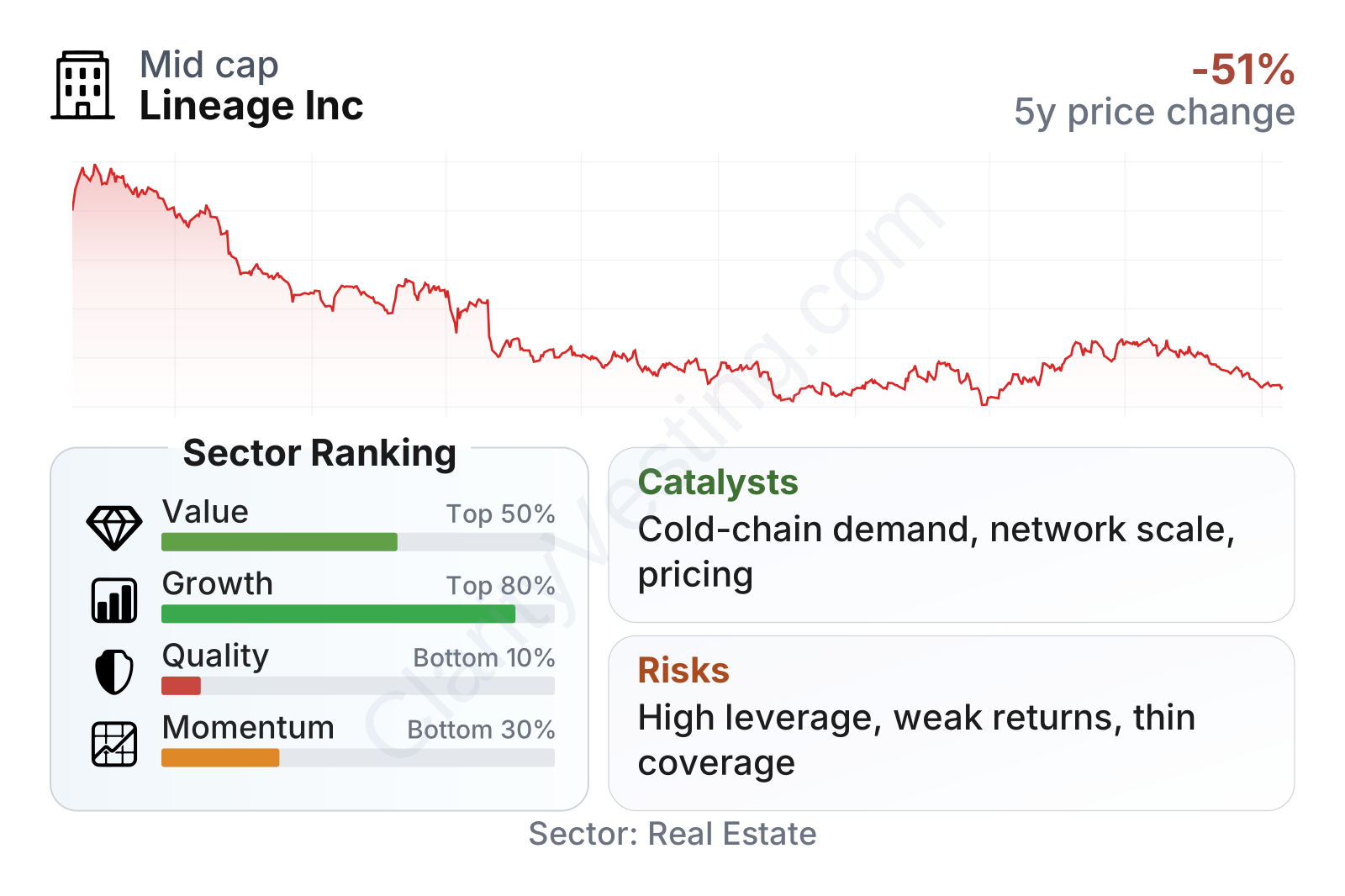
Lineage is a large industrial REIT, with a market value around $9 billion and a stock that has shown somewhat lower volatility than the broader market. The stock price fell sharply after its 2024 listing period and then recovered part of that decline in 2026, which suggests sentiment has improved but not fully normalized.
The overall metric profile is mixed. On growth, Lineage ranks in the stronger part of its sector, supported by a five-year revenue-per-share growth rate of roughly 8% and much faster growth in book value per share and dividends per share. On the other hand, quality metrics are weak versus peers: returns on assets, equity, and invested capital are below sector medians, profitability is negative on a net basis, and leverage remains elevated. In valuation terms, the shares do not screen as unusually cheap on cash-flow-based measures, even though the dividend yield stands above the sector median.
Growth
Lineage operates in a part of logistics that benefits from durable long-term demand. Population growth, higher food consumption, rising demand for frozen and prepared meals, and the need for more resilient food supply chains all support cold-storage infrastructure over time. Compared with standard warehouses, refrigerated facilities are more specialized, require higher capital investment, and face stricter operating requirements. That tends to limit new supply and can support pricing when demand is healthy.
The company’s strategy also makes sense on paper for long-range expansion. A large network matters in cold storage because customers often want a provider that can handle products across regions rather than in a single building. Scale can improve route density, customer retention, and warehouse utilization. It can also make value-added services more attractive, since food companies increasingly want integrated storage, handling, and transportation rather than stand-alone space.
Revenue per share increased steadily from 2021 through 2024 before pulling back in 2025. Even with that decline, the longer trend still points upward, which suggests Lineage has been able to expand its business faster than many peers over a multi-year period. The recent drop is a reminder that growth is not perfectly smooth and can be affected by customer volumes, acquisitions, pricing, or portfolio adjustments.
The dividend profile has changed quickly. Dividend per share moved up sharply by 2025, and the trailing dividend yield is now above the sector median. That can improve the stock’s income appeal, but because profitability remains soft, the market is likely looking for evidence that distributions are supported by sustainable cash generation rather than only by balance-sheet capacity or transitional post-IPO positioning.
A notable catalyst is the company’s position as one of the largest cold-storage platforms globally. In a fragmented and infrastructure-heavy market, scale can create opportunities to consolidate assets, deepen relationships with major food customers, and optimize operations across a broad network. Another positive driver is the strategic importance of food logistics: cold storage is linked to basic consumption needs, which can make demand more resilient than in many other real-estate categories.
Recent company communications and public filings have continued to emphasize network expansion, operational efficiency, and the benefits of a global platform. For a business like this, even moderate pricing gains or improved warehouse utilization can have an outsized effect on earnings because the asset base is already in place.
Risks
This article is for informational purposes only and does not constitute financial advice. Some content is AI-generated. See Disclaimer


