Stock Analysis · Linde plc (LIN)
Overview
Linde plc is one of the world’s largest industrial gas companies. It produces and distributes gases that are essential to many everyday industries, including manufacturing, healthcare, electronics, chemicals, refining, food processing, and clean-energy projects. Its products include oxygen, nitrogen, argon, hydrogen, helium, carbon dioxide, and specialty gases. The company also designs and builds gas-related equipment and large process plants through its engineering activities.
What makes this business easier to understand is that many customers treat these gases as mission-critical inputs rather than optional purchases. Steel mills need oxygen, hospitals need medical gases, chipmakers need ultra-high-purity gases, and refiners and chemical plants need hydrogen and related services. That tends to make demand more durable than in many other chemical businesses.
Linde’s revenue base is diversified by geography and end market. Based on the company’s recent annual reporting structure, revenue is mainly split between industrial gases sold through regional operating segments and a smaller engineering business. Approximate revenue sources are:
- Americas industrial gases: about 40% of revenue. This includes packaged gases, bulk gases, on-site supply contracts, and healthcare-related gas sales across North and South America.
- EMEA industrial gases: about 25% of revenue. This covers Europe, the Middle East, and Africa, serving manufacturing, chemicals, energy, food, and healthcare customers.
- APAC industrial gases: about 25% of revenue. This region includes strong exposure to electronics, manufacturing, and developing industrial demand in Asia-Pacific markets.
- Engineering: about 10% of revenue. This activity designs and builds air separation units, hydrogen and syngas plants, carbon capture systems, and related process infrastructure.
Linde’s business mix also matters because not all sales are equally cyclical. Long-term on-site contracts and healthcare demand are typically steadier, while project work and some merchant gas volumes can move more with industrial activity. Over the last several years, the company has also improved profitability faster than revenue, showing a business model with strong pricing power and operating discipline.
The overall earnings flow points to a business that has become more efficient over time. Revenue has grown modestly since 2021, but operating income and net income have grown much faster, which suggests margin expansion rather than growth driven only by higher volume.
Key Figures
| Metric | Value | Sector ⓘ |
|---|---|---|
| Date | Oct 24, 2026 | |
| Context | ||
| Sector | Basic Materials | |
| Industry | Specialty Chemicals | |
| Market Cap ⓘ | $231.36B | |
| Beta ⓘ | 0.71 | |
Value (Cheapness) | ||
| P/E Ratio ⓘ | 32.40 | 16.92 |
| P/B Ratio ⓘ | 6.20 | 1.66 |
| FCF Yield ⓘ | 2.15% | 5.83% |
| Dividend Yield ⓘ | 1.23% | 2.07% |
| EBIT / EV ⓘ | 4.05% | 6.38% |
| PEG ⓘ | 1.80 | |
Growth (Business expansion) | ||
| Revenue Growth ⓘ | 9.30% | 11.25% |
| RPS Growth (5Y CAGR) ⓘ | 5.29% | 4.49% |
| EPS Growth (5Y CAGR) ⓘ | -8.44% | -15.24% |
| BVPS Growth (5Y CAGR) ⓘ | -1.03% | 5.49% |
| Margin Growth (5Y Trend) ⓘ | 10.07% | -1.54% |
| FCF Growth (5Y CAGR) ⓘ | -6.43% | 0.37% |
| DPS Growth (5Y CAGR) ⓘ | 9.35% | 5.91% |
Quality (Business durability) | ||
| ROIC (Latest) ⓘ | 11.45% | 9.59% |
| ROA (Latest) ⓘ | 8.31% | 4.92% |
| ROIC (5Y Median) ⓘ | 10.77% | 7.91% |
| ROA (5Y Median) ⓘ | 7.73% | 3.92% |
| Net Debt / EBIT (Latest) ⓘ | 2.41 | 1.36 |
| Net Debt / EBIT (5Y Median) ⓘ | 2.07 | 1.69 |
| Net Debt / EBITDA (Latest) ⓘ | 1.72 | 0.93 |
| Net Debt / Assets ⓘ | 26.16% | 13.69% |
| EBITDA / Interest ⓘ | 50.12 | 12.38 |
| Operating Margin (Latest) ⓘ | 27.10% | 13.24% |
| Operating Margin (5Y Median) ⓘ | 24.67% | 11.82% |
| Debt to Equity (Latest) ⓘ | 71.68% | 40.30% |
| Profit Margin (Latest) ⓘ | 20.44% | 6.38% |
| Free Cash Flow (Latest) ⓘ | $4.97B | |
Momentum (Price trend) | ||
| 3Y Return ⓘ | +41.98% | +73.47% |
| 12M Return (excl. last month) ⓘ | -3.19% | +27.59% |
| 6M Return ⓘ | +1.81% | -4.02% |
| Price vs. 200-Day MA ⓘ | +2.56% | -0.65% |
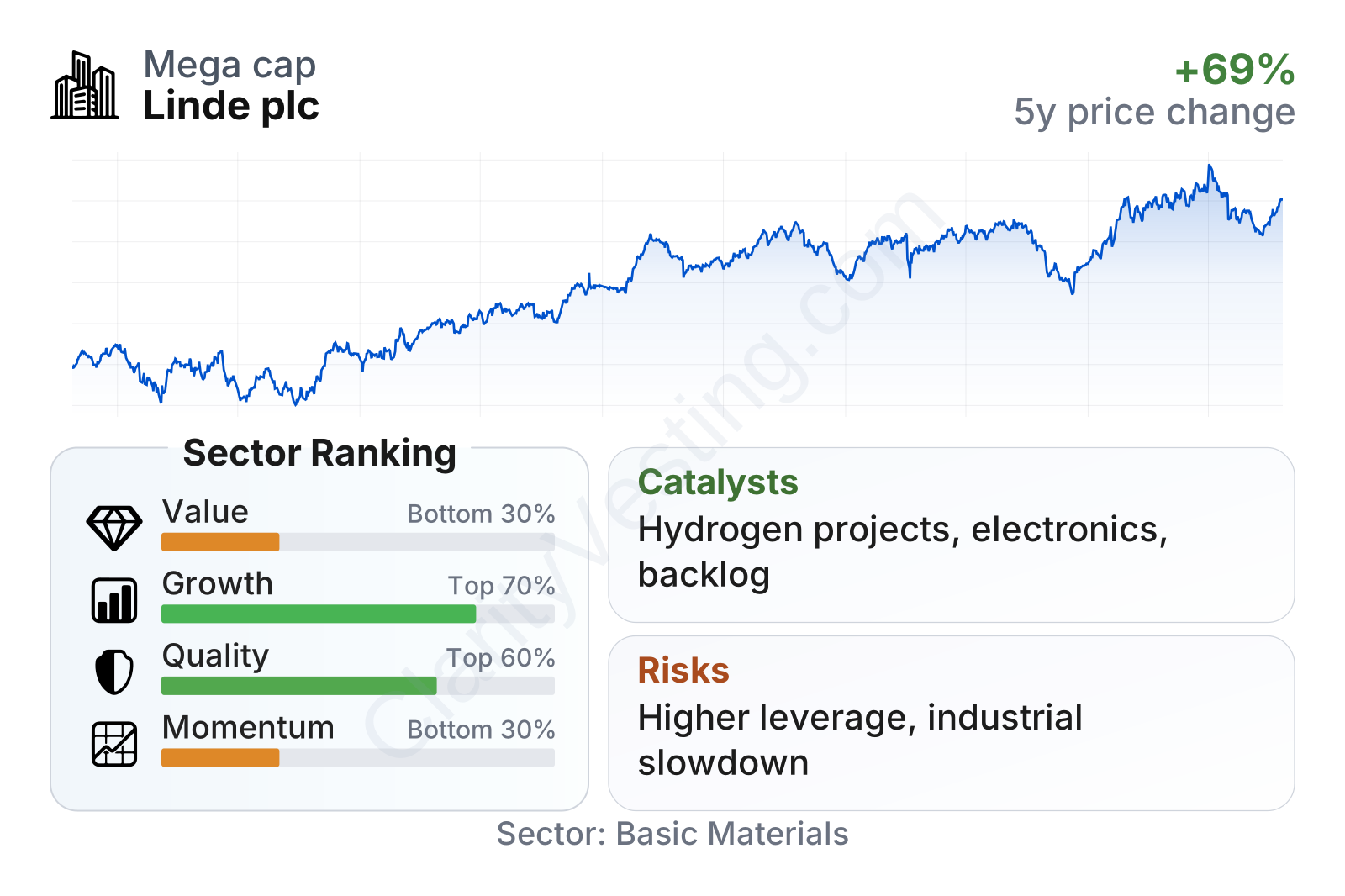
Linde is a very large company with lower share-price volatility than the broader market, as reflected by its beta below 1. On quality, it stands out: returns on capital and assets are above the sector median, while operating and profit margins are far stronger than many peers. Growth is more mixed. Long-term revenue per share and dividend growth look solid, but free cash flow has been less consistent. On valuation, the shares trade at higher multiples than the sector median, which means the market is assigning a premium to the company’s stability and profitability rather than to rapid expansion.
Growth
Linde operates in a sector with long-term structural support. Industrial gases benefit from broad manufacturing activity, but the more important growth angle is that these gases are increasingly tied to industries with rising technical requirements: semiconductors, healthcare, electronics, hydrogen, carbon capture, and high-efficiency industrial production. That gives the company exposure to both traditional industry and newer energy and technology themes.
The company’s strategy is built around assets that are difficult and expensive to replicate. Linde often signs long-term contracts to build gas supply systems directly at or near a customer site. Once installed, these systems can become deeply embedded in the customer’s operations, creating sticky relationships and recurring revenue. This is especially relevant in hydrogen, large air separation units, and electronics-grade gases, where reliability and purity matter more than price alone.
Recent top-line momentum has improved after a softer period in 2023 and parts of 2024. The latest trend shows revenue growth moving back into a high-single-digit range, which is a healthier pace for a company of this size. That rebound suggests Linde is still finding new project demand and has maintained pricing discipline.
Cash generation remains substantial, even though free cash flow has come off earlier highs and has been fairly flat to slightly lower over the last few years. For a capital-intensive company, the important point is not explosive cash growth but the ability to keep producing several billion dollars of annual free cash flow while funding new projects, dividends, and share repurchases.
Recent company updates have continued to highlight project backlogs and investments tied to clean hydrogen, carbon capture, and electronics capacity. These areas are important because they can support multi-year growth rather than one-off sales. In particular, decarbonization infrastructure and semiconductor manufacturing buildouts are promising opportunities for Linde because they typically require large-scale, technically demanding gas systems where the company already has established capabilities.
Risks
This article is for informational purposes only and does not constitute financial advice. Some content is AI-generated. See Disclaimer


