Stock Analysis · Neutron Holdings Inc (LIME)
Overview
Neutron Holdings Inc., known commercially as Lime, operates a shared micromobility platform. The company rents electric scooters and electric bikes through a mobile app, mainly in cities and university markets. Its business is built around short urban trips: users unlock a vehicle, ride it for a short distance, and pay a fee based on time and local pricing. Lime also works with cities under permits and operating agreements, which makes regulatory compliance and fleet operations as important as the consumer app itself.
The company’s revenue is primarily tied to ride activity, with a smaller contribution from other service-related items. Based on company disclosures and the structure of the business, the main sources are approximately:
- Shared vehicle rentals: about 90% to 95% — rider payments for e-scooter and e-bike trips, including unlock fees, time-based charges, passes, and subscriptions where offered.
- Partnerships and other revenue: about 5% to 10% — this can include fees tied to commercial partnerships, city-related arrangements, advertising or promotional activity, and other ancillary items.
Lime is still essentially a single-business company: urban transportation rentals. That concentration makes the model easy to understand, but it also means performance depends heavily on ridership growth, pricing discipline, city permits, and vehicle-level economics.
Financially, the recent direction shows a business that has scaled meaningfully. Revenue rose from roughly $522 million in 2023 to about $687 million in 2024 and nearly $887 million in 2025. Gross profit also expanded over that period, which suggests that a larger fleet and more rides have been supporting better unit economics even though full profitability remains uneven.
The operating picture has improved from 2023, with losses narrowing sharply in 2024 before widening again in 2025. Even so, gross profit growth has remained strong, showing that the core service is expanding faster than before, while overhead, fleet investment, and operating costs still determine whether that growth translates into durable earnings.
Key Figures
| Metric | Value | Sector ⓘ |
|---|---|---|
| Date | Oct 03, 2026 | |
| Context | ||
| Sector | Industrials | |
| Industry | Rental & Leasing Services | |
| Market Cap ⓘ | $1.82B | |
| Beta ⓘ | N/A | |
Value (Cheapness) | ||
| P/E Ratio ⓘ | 8.80 | 22.45 |
| P/B Ratio ⓘ | 2.64 | 1.98 |
| FCF Yield ⓘ | -5.70% | 6.31% |
| Dividend Yield ⓘ | N/A | 1.96% |
| EBIT / EV ⓘ | -4.19% | 4.81% |
| PEG ⓘ | N/A | |
Growth (Business expansion) | ||
| Revenue Growth ⓘ | 23.60% | 9.10% |
| RPS Growth (5Y CAGR) ⓘ | 30.31% | 7.75% |
| EPS Growth (5Y CAGR) ⓘ | N/A | -13.59% |
| BVPS Growth (5Y CAGR) ⓘ | N/A | 6.22% |
| Margin Growth (5Y Trend) ⓘ | N/A | 0.72% |
| FCF Growth (5Y CAGR) ⓘ | 882.88% | 10.98% |
| DPS Growth (5Y CAGR) ⓘ | N/A | 9.48% |
Quality (Business durability) | ||
| ROIC (Latest) ⓘ | N/A | 10.92% |
| ROA (Latest) ⓘ | N/A | 5.41% |
| ROIC (5Y Median) ⓘ | N/A | 9.21% |
| ROA (5Y Median) ⓘ | N/A | 4.94% |
| Net Debt / EBIT (Latest) ⓘ | N/A | 2.07 |
| Net Debt / EBIT (5Y Median) ⓘ | N/A | 2.28 |
| Net Debt / EBITDA (Latest) ⓘ | N/A | 1.43 |
| Net Debt / Assets ⓘ | N/A | 19.27% |
| EBITDA / Interest ⓘ | 2.29 | 9.53 |
| Operating Margin (Latest) ⓘ | -8.58% | 10.50% |
| Operating Margin (5Y Median) ⓘ | -3.23% | 10.27% |
| Debt to Equity (Latest) ⓘ | N/A | 65.48% |
| Profit Margin (Latest) ⓘ | 21.32% | 6.62% |
| Free Cash Flow (Latest) ⓘ | -$103.74M | |
Momentum (Price trend) | ||
| 3Y Return ⓘ | N/A | +58.56% |
| 12M Return (excl. last month) ⓘ | N/A | +15.63% |
| 6M Return ⓘ | N/A | +4.19% |
| Price vs. 200-Day MA ⓘ | N/A | +0.93% |
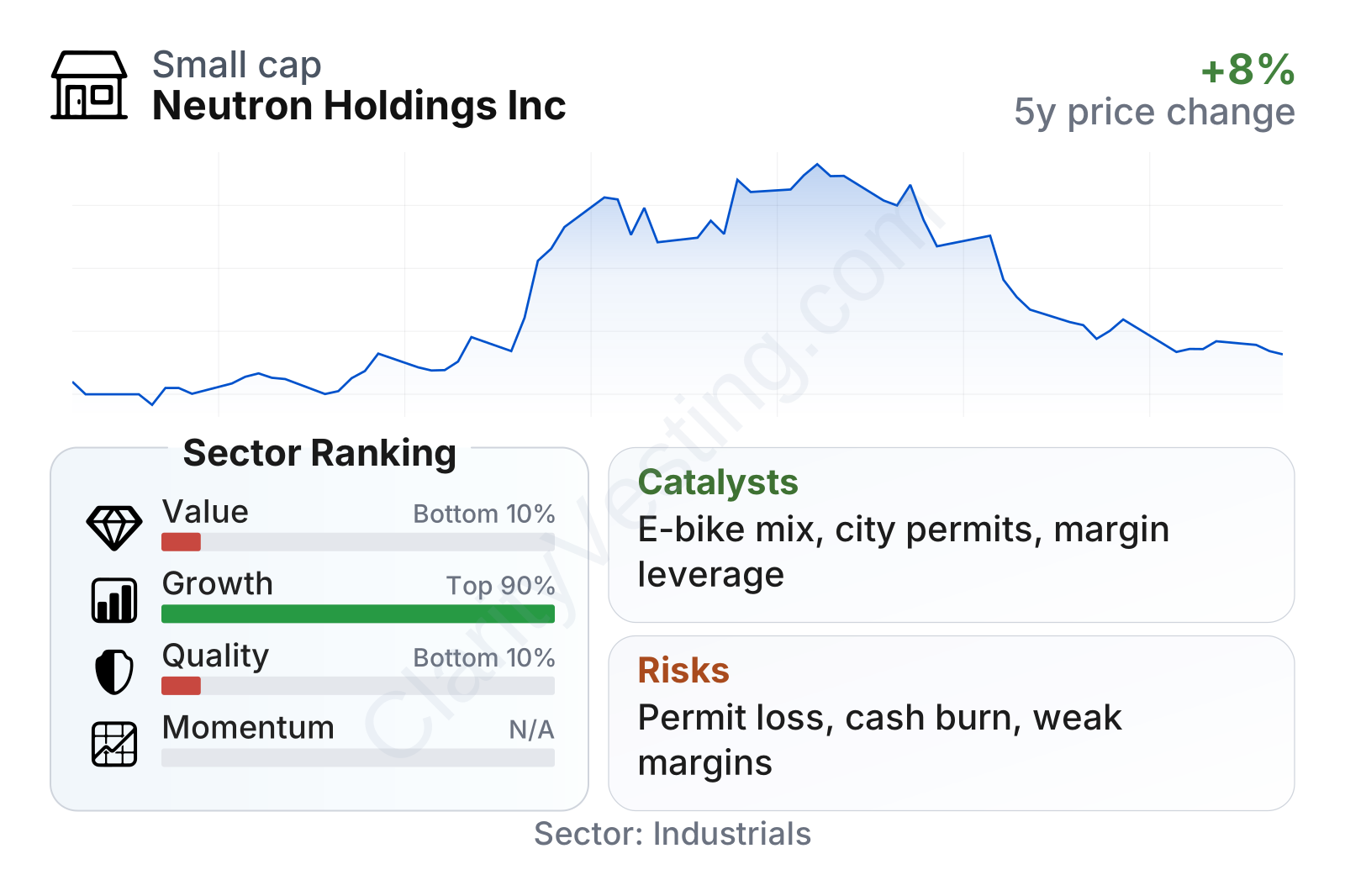
The key metrics paint a mixed but understandable picture. Growth stands out versus the broader Industrials universe: recent revenue growth is well above the sector median, and five-year revenue-per-share expansion is also strong. On the other hand, quality measures remain weak. Operating margin is still negative, free cash flow is negative, and interest coverage is thin compared with the sector, which shows that scale has not yet fully turned into resilient profitability. Value screens also look contradictory: the earnings multiple is low, but cash-flow-based measures remain unattractive because cash generation is still negative. In short, the company looks like a fast-growing operator that has not yet reached the financial consistency usually associated with stronger-quality businesses.
The stock-price history placeholder should be read in that context. This is a relatively small public company in a sector where sentiment can shift quickly as the market weighs growth against cash burn, competition, and regulation. For a business like Lime, progress in margins and free cash flow usually matters more than headline revenue alone.
Growth
Lime operates in a segment that can still grow over the long term. Cities continue to look for alternatives to private car use, especially for short-distance trips. Electric bikes and scooters fit well with broader trends such as congestion reduction, lower-emission transport, multimodal commuting, and app-based urban mobility. This does not make micromobility risk-free, but it does place Lime in a part of transportation that remains structurally relevant.
The company’s strategy appears sensible for that setting. Rather than trying to become a broad transportation conglomerate, Lime stays focused on dense urban markets where short trips, repeat usage, and city partnerships can support better vehicle utilization. The model gets stronger if more riders use higher-value products such as e-bikes, if fleet maintenance becomes more efficient, and if the company can keep expanding revenue without allowing operating expenses to rise at the same pace.
One visible catalyst is operating leverage. Revenue has grown rapidly over the last three years, and gross profit has expanded with it. If that trend continues while central costs grow more slowly, the business could move closer to stable operating profitability. Another catalyst is market structure: many weaker micromobility operators have struggled over time, so a scaled platform with established city relationships can benefit if the industry becomes more consolidated.
Recent company communications have also emphasized continued international expansion, fleet upgrades, and discipline around city selection. Those points matter because growth in this industry is not only about entering more places; it is about choosing markets where regulation, rider density, and asset utilization support acceptable returns. For Lime, growth that improves margins is more important than growth at any cost.
Risks
This article is for informational purposes only and does not constitute financial advice. Some content is AI-generated. See Disclaimer