Stock Analysis · L3Harris Technologies Inc (LHX)
Overview
L3Harris Technologies is a large American aerospace and defense company that supplies communications equipment, sensors, space payloads, mission systems, and specialized defense technologies to the U.S. government, allied nations, and commercial customers. The company was formed through the 2019 merger of L3 Technologies and Harris Corporation, and it has since focused on national security, intelligence, military modernization, space systems, and secure communications.
Its business is organized into four main segments. Based on the latest annual reporting structure, revenue is spread across these activities in roughly the following order:
- Integrated Mission Systems: about 30% of revenue. This segment includes intelligence, surveillance, reconnaissance, electro-optical and infrared systems, maritime and airborne mission equipment, and training solutions.
- Space & Airborne Systems: about 28% of revenue. This covers missile warning and tracking payloads, classified space work, avionics, electronic warfare, and airborne sensors.
- Communication Systems: about 23% of revenue. This business provides tactical radios, broadband communications, public safety systems, datalinks, and related networking products.
- Aerojet Rocketdyne: about 19% of revenue. This segment adds propulsion systems used in missiles, missile defense, space launch, and strategic programs.
The customer base is concentrated in government spending, especially the U.S. Department of Defense and other U.S. federal agencies, with additional sales to international defense customers. That makes L3Harris less dependent on everyday consumer demand and more tied to defense budgets, procurement cycles, and geopolitical priorities.
The business mix also shows a company with meaningful scale but not extreme concentration in a single product line. Over the last several years, revenue has climbed from roughly $18 billion to nearly $22 billion, while operating income and net income have also recovered after a weaker 2022 period. One positive operating change is that selling and administrative expenses fell sharply as a share of revenue after the Aerojet Rocketdyne integration period, helping profitability improve.
The overall picture is a defense contractor with diversified exposure across communications, sensors, space, and propulsion, rather than a narrow single-program business.
Key Figures
| Metric | Value | Sector ⓘ |
|---|---|---|
| Date | Oct 24, 2026 | |
| Context | ||
| Sector | Industrials | |
| Industry | Aerospace & Defense | |
| Market Cap ⓘ | $46.32B | |
| Beta ⓘ | 0.51 | |
Value (Cheapness) | ||
| P/E Ratio ⓘ | 24.58 | 22.29 |
| P/B Ratio ⓘ | 2.23 | 1.98 |
| FCF Yield ⓘ | 6.06% | 6.26% |
| Dividend Yield ⓘ | 2.01% | 1.92% |
| EBIT / EV ⓘ | 5.11% | 4.83% |
| PEG ⓘ | 1.19 | |
Growth (Business expansion) | ||
| Revenue Growth ⓘ | 8.40% | 9.30% |
| RPS Growth (5Y CAGR) ⓘ | 7.26% | 7.76% |
| EPS Growth (5Y CAGR) ⓘ | -18.29% | -13.17% |
| BVPS Growth (5Y CAGR) ⓘ | 2.46% | 6.13% |
| Margin Growth (5Y Trend) ⓘ | -2.74% | 0.74% |
| FCF Growth (5Y CAGR) ⓘ | 3.34% | 10.79% |
| DPS Growth (5Y CAGR) ⓘ | 4.49% | 9.41% |
Quality (Business durability) | ||
| ROIC (Latest) ⓘ | 7.54% | 10.75% |
| ROA (Latest) ⓘ | 4.46% | 5.41% |
| ROIC (5Y Median) ⓘ | 6.76% | 9.37% |
| ROA (5Y Median) ⓘ | 3.59% | 4.95% |
| Net Debt / EBIT (Latest) ⓘ | 3.38 | 2.04 |
| Net Debt / EBIT (5Y Median) ⓘ | 4.45 | 2.27 |
| Net Debt / EBITDA (Latest) ⓘ | 2.55 | 1.39 |
| Net Debt / Assets ⓘ | 22.07% | 19.27% |
| EBITDA / Interest ⓘ | 6.62 | 9.58 |
| Operating Margin (Latest) ⓘ | 12.24% | 10.49% |
| Operating Margin (5Y Median) ⓘ | 10.65% | 10.30% |
| Debt to Equity (Latest) ⓘ | 52.75% | 64.82% |
| Profit Margin (Latest) ⓘ | 8.17% | 6.67% |
| Free Cash Flow (Latest) ⓘ | $2.81B | |
Momentum (Price trend) | ||
| 3Y Return ⓘ | +48.91% | +67.77% |
| 12M Return (excl. last month) ⓘ | -11.59% | +12.05% |
| 6M Return ⓘ | -26.61% | 0.00% |
| Price vs. 200-Day MA ⓘ | -18.80% | +0.67% |
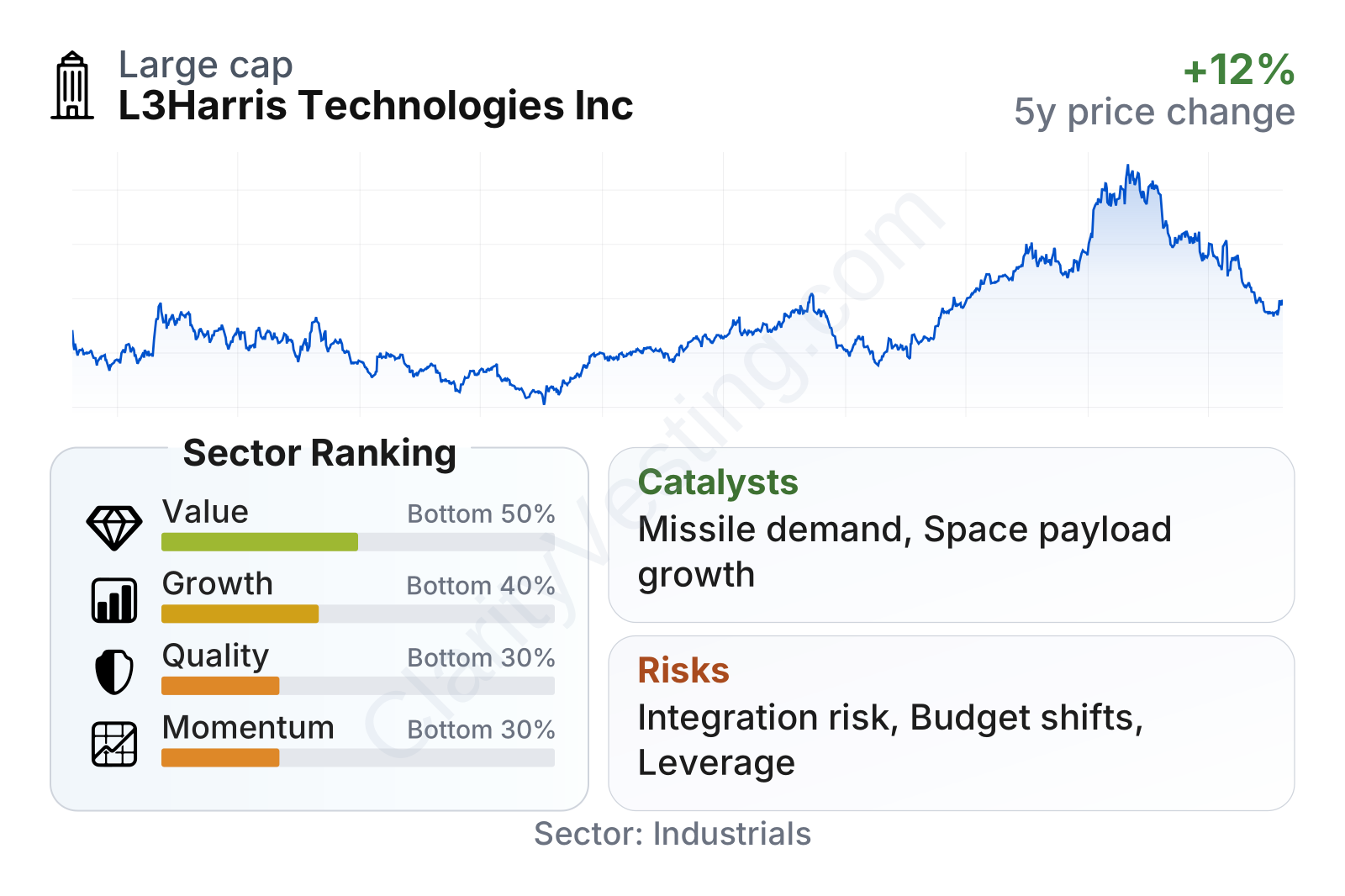
L3Harris is a large defense company with relatively low share-price volatility, as shown by a beta near 0.5. On valuation, it sits close to the sector on earnings and book value multiples rather than at a deep discount. Cash generation remains an important support: free cash flow yield is roughly in line with the sector, and the dividend yield is also near the industry median.
The weaker part of the profile is not size or cash generation, but relative ranking in growth, quality, and recent market momentum. Revenue growth has been positive, but the multi-year record has been slower than many industrial peers, and returns on capital are not standing out. The share price has also lagged much of the sector in recent periods, which suggests the market still wants clearer proof that margin recovery and integration benefits are durable.
Growth
Defense and national security remain structurally supported sectors. The backdrop includes higher military spending among NATO countries, continued demand for missile defense, secure communications, electronic warfare, resilient space assets, and munitions replenishment. These are all areas where L3Harris has active programs and established positions.
The company’s strategy also makes industrial sense. The Aerojet Rocketdyne acquisition expanded L3Harris from electronics and communications into propulsion, giving it a broader role on missile, interceptor, and space platforms. That matters because many current procurement priorities are centered on integrated systems rather than isolated components. A company that can contribute radios, sensors, payloads, propulsion, and mission integration has more ways to participate in defense modernization budgets.
Revenue growth has been uneven, but the trend improved materially after the 2022 slowdown. Growth accelerated strongly through 2023, moderated in 2024 and 2025, and remained positive again in 2026. That pattern fits a company moving past a more difficult post-merger period into steadier execution, although it still does not look like a consistently fast grower compared with the broader sector.
Cash generation is a more encouraging part of the growth profile. Free cash flow has recovered from a softer 2024 level and moved back above $2.5 billion on a trailing basis. For a defense contractor, that matters because free cash flow supports debt reduction, dividends, share repurchases, and internal investment without relying heavily on external financing.
Recent company announcements have also pointed to opportunities in missile systems, strategic deterrence, space payloads, and military communications. Aerojet Rocketdyne broadens exposure to propulsion programs tied to U.S. missile defense and space priorities, while L3Harris has also emphasized software-defined communications, autonomous systems, and multi-domain networking. Those are attractive demand areas because they align with how defense customers are trying to modernize forces for more connected and contested environments.
A significant near-term catalyst is the push for faster missile production and stronger space resilience in the United States and allied countries. L3Harris now has a more direct seat in both themes than it did before the propulsion acquisition. If execution remains solid, that combination could improve the company’s position on larger, longer-cycle programs.
Risks
This article is for informational purposes only and does not constitute financial advice. Some content is AI-generated. See Disclaimer